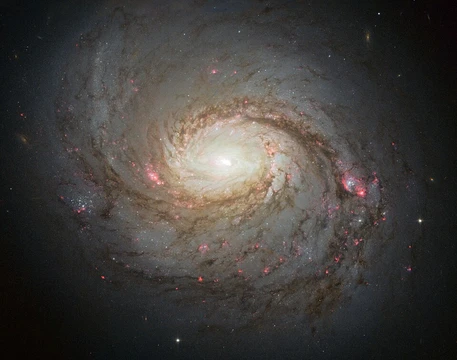
Grand design spiral galaxy
A spiral galaxy with prominent, well-defined continuous spiral arms.

A grand design spiral galaxy is defined by its clear, continuous spiral arms that stand out sharply, unlike the more irregular or patchy arms seen in flocculent or multi-arm spirals. These arms stretch prominently around much of the galaxy’s disk and are rich in star formation, which produces many bright, hot, massive stars that burn out quickly.
As of 2002, only about one in ten known spiral galaxies qualifies as a grand design type. Examples include M51 (the Whirlpool Galaxy), M74 (the Phantom Galaxy), M81 (Bode’s Galaxy), M83 (the Southern Pinwheel Galaxy), M101 (the Pinwheel Galaxy), NGC 6946 (the Fireworks Galaxy), and IC 342 (the Hidden Galaxy).
The most widely accepted explanation for their distinct structure is density wave theory, first proposed by Chia-Chiao Lin and Frank Shu in 1964. The term “grand design” itself was not used in that initial paper but appeared in a follow-up in 1966, with Lin, Yuan, and Shu generally credited for coining it. According to the theory, spiral arms form within density waves that rotate around the galaxy at a different speed than the stars in the disk. Gravity pulls stars and gas toward these dense regions, but their position in the arm is temporary. As material approaches a spiral arm, gravity draws it in; as it passes through, the same gravitational pull slows its exit. This causes gas to accumulate in the dense areas, leading to cloud collapse and subsequent star formation.
- Percentage of known spirals
- approximately 10 percent as of 2002
- Example galaxies
- M51 (Whirlpool Galaxy), M74 (Phantom Galaxy), M81 (Bode’s Galaxy), M83 (Southern pinwheel galaxy), M101 (Pinwheel Galaxy), NGC 6946 (Fireworks Galaxy), IC 342 (The Hidden Galaxy)
- Preferred explanation
- density wave theory
- Theory proposed by
- Chia-Chiao Lin and Frank Shu
- Theory proposed year
- 1964
- Term coined by
- Lin (along with Yuan and Shu)
- Term first appeared year
- 1966
Lore & Background
The term 'grand design' was not used in the initial 1964 work by Chia-Chiao Lin and Frank Shu, but appeared in the 1966 continuation paper; Lin (along with Yuan and Shu) is usually credited with coining the term. Density wave theory is the preferred explanation for the well-defined structure of grand design spirals. According to this theory, the spiral arms are created inside density waves that turn around the galaxy at different speeds from the stars in the galaxy's disk. Stars and gas are clumped in these dense regions due to gravitational attraction toward the dense material, though their location in the spiral arm may not be permanent. When they come close to the spiral arm, they are pulled toward the dense material by the force of gravity; and as they travel through the arm, they are slowed from exiting by the same gravitational pull. This causes the gas in particular to clump in the dense regions, which in turn causes gas clouds to collapse, resulting in star formation.
Reader's Guide
Grand design spiral galaxies are notable for their clear, continuous spiral arms that host abundant star formation, producing many bright, hot, and short-lived massive stars. As of 2002, approximately 10 percent of all known spiral galaxies are classified as grand design type spirals, making them a relatively rare but visually striking subclass. The density wave theory, first suggested by Chia-Chiao Lin and Frank Shu in 1964, provides the preferred explanation for their structure, describing how density waves rotating at different speeds from the stars create and maintain the spiral arms. The term 'grand design' itself was coined by Lin, Yuan, and Shu in a 1966 paper. Examples include well-known galaxies such as M51 (Whirlpool Galaxy), M74 (Phantom Galaxy), M81 (Bode’s Galaxy), M83 (Southern pinwheel galaxy), M101 (Pinwheel Galaxy), NGC 6946 (Fireworks Galaxy), and IC 342 (The Hidden Galaxy). The theory explains that the spiral arms are not permanent structures but rather regions where stars and gas are temporarily concentrated due to gravitational forces, leading to star formation.
Did You Know?
- The density wave theory, the preferred explanation for grand design spirals, was first suggested by Chia-Chiao Lin and Frank Shu in 1964.
- The term 'grand design' was coined by Lin, Yuan, and Shu in a 1966 continuation paper.
- Examples of grand design spiral galaxies include M51, M74, M81, M83, M101, NGC 6946, and IC 342.
Defining Characteristics
A grand design spiral galaxy is distinguished by its strikingly orderly architecture. Unlike the more chaotic multi-arm, patchy, or flocculent spiral types that display only subtle structural features, a grand design system presents prominent, well-defined, and continuous spiral arms. These arms trace clearly around the galactic disk, sweeping across a significant portion of the galaxy's full circumference. The visual result is a structure that reads almost like a carefully drawn pinwheel, with each arm maintaining coherence as it winds outward from the center. This clarity of form is what sets grand design spirals apart in the broader family of spiral galaxies. Rather than a mottled or fragmented appearance, the arms stand out as distinct, unbroken lanes of material, giving these objects a particularly elegant and symmetrical profile when observed. The continuity and prominence of the arms are the defining hallmarks that earn a galaxy its grand design classification.
Stellar Nurseries Within the Arms
The spiral arms of a grand design galaxy are far more than decorative features; they serve as the primary engines of stellar birth within the system. Because these arms concentrate dense material, they host a substantial amount of ongoing star formation. The result is an abundance of bright, hot, and short-lived massive stars that give the arms their luminous, vivid character. The mechanism behind this productivity ties directly to the gravitational dynamics of the arms themselves. As gas and stars pass through the dense regions of a spiral arm, gravitational attraction pulls them toward the concentrated material. The same force then slows their exit, effectively trapping them long enough for gas to accumulate and clump. These dense gas clouds eventually collapse under their own weight, igniting new stars. In this way, the very structure that defines a grand design spiral also fuels its most spectacular stellar population, ensuring that the arms remain the brightest and most active regions of the galaxy.
The Density Wave Explanation
The most widely accepted explanation for why grand design spirals possess such well-defined arms is the density wave theory. This framework was first proposed by Chia-Chiao Lin and Frank Shu in 1964, though the specific phrase grand design did not appear in that initial work. It surfaced in a 1966 continuation paper, and Lin, along with Yuan and Shu, is generally credited with coining the term. According to the theory, the spiral arms are not rigid structures but rather density waves that rotate through the galactic disk at a different speed than the individual stars. Stars and gas are drawn into these waves by gravitational attraction toward the denser material, though their residence in any given arm is not permanent. As objects approach an arm, gravity pulls them inward; as they travel through it, the same gravitational pull slows their departure. This differential motion and gravitational focusing produce the persistent, well-organized arm patterns that characterize grand design spirals.
Notable Examples and Prevalence
Grand design spirals represent a relatively small but visually remarkable subset of the spiral galaxy population. As of 2002, roughly ten percent of all spiral galaxies known at that time carried the grand design classification. Among the most celebrated members of this group are several objects that have become iconic in both professional astronomy and public imagination. M51, known as the Whirlpool Galaxy, is perhaps the most famous example. M74, the Phantom Galaxy, and M81, Bode's Galaxy, are other well-known representatives. M83, the Southern Pinwheel Galaxy, and M101, the Pinwheel Galaxy, add to the roster, as do NGC 6946, nicknamed the Fireworks Galaxy, and IC 342, called The Hidden Galaxy. Each of these systems displays the hallmark continuous, prominent arms that distinguish grand design spirals from their less structured counterparts, making them prime targets for both detailed study and public outreach in astronomy.
More in Spiral Galaxies 1-24
Spotted an error? Know more?
Reader corrections go straight into our review queue. Suggest an edit · How this site is sourced