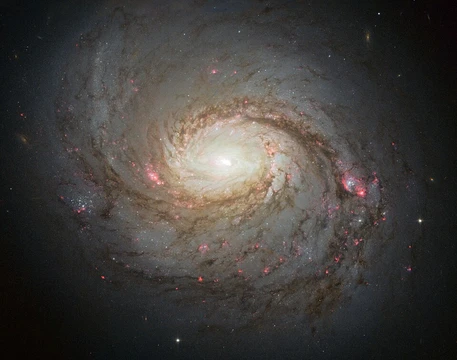
0313−192
An edge-on spiral galaxy with rare double-lobed radio jets.

0313−192, also cataloged as PGC 97372 and LO95 0313−192, is a spiral galaxy seen edge-on that also qualifies as a double-lobed radio galaxy. It lies roughly 1 billion light-years away in the constellation Eridanus and belongs to the galaxy cluster Abell 428. The galaxy hosts an active galactic nucleus. NASA first detected its radio jets in 2003, and its radio lobes span about 1.5 million light-years across.
The galaxy’s spiral structure resembles that of the Milky Way, with a prominent central bulge and arms dotted with bright gas and crisscrossed by thick dust lanes. A companion galaxy, designated [LOY2001] J031549.8−190623, appears to its right. While powerful radio jets—fast-moving outbursts of superheated gas—are typically found at the cores of giant elliptical galaxies or merging galaxies, 0313−192 is an unusual exception: its jets erupt from a supermassive black hole at the center of a spiral. The galaxy also shows two additional regions of strong radio emission, making it even rarer. Since the 2003 discovery, only three more spiral galaxies with radio-emitting jets have been identified, raising questions about how such jets form and propagate.
The galaxy’s core is notably bright. Its supermassive black hole is highly active, which accounts for the unusually luminous bulge. Around the nucleus, a disk-like structure of emission lines is tilted about 20° relative to the stellar disk but nearly perpendicular to the jets. This feature may result from a past galactic encounter, where gas is photoionized by direct exposure to the nucleus’s radiation. The black hole’s mass is roughly 8×10⁸ solar masses.
Nearly all classic double-lobed radio galaxies are centered on elliptical galaxies or mergers. 0313−192 is a striking exception: confirmed in 2003, it is a spiral galaxy flanked by large, bright radio clouds. Its dark dust lane appears twisted, possibly due to a collision or close pass with a smaller galaxy, which may have also triggered activity in its nucleus.
- Distance
- around 1 billion light-years
- Constellation
- Eridanus
- Cluster
- Abell 428
- Radio lobe diameter
- estimated 1.5 million light years
- Central black hole mass
- ~8×10^8 M☉
- Discovery year of radio jets
- 2003
- Discoverer of radio jets
- NASA
Lore & Background
0313−192 has a spiral shape similar to that of the Milky Way, with a large central bulge and arms speckled with brightly glowing gas inhabited by thick lanes of dark dust. Its companion galaxy is known as [LOY2001] J031549.8−190623. The galaxy's dark plane of dust is distinctly twisted, possibly due to a collision or near pass-by with a smaller galaxy, which may have sparked the nucleus to life. The core is rather bright, with a central supermassive black hole known to be highly active, indicating the unusually luminous bulge. A disklike emission-line structure is seen around the nucleus, inclined by ~20° to the stellar disk but nearly perpendicular to the jets, possibly representing the aftermath of a galaxy encounter in which gas is photoionized by a direct view of the nuclear continuum.
Reader's Guide
Nearly all classic double-lobed radio galaxies have either an elliptical galaxy or some galactic merger at their center. However, 0313−192 is a remarkable exception: an edge-on spiral galaxy flanked by large, bright clouds of radio emissions. Jets, outbursts of superheated gas moving at close to the speed of light, have long been associated with the cores of giant elliptical galaxies and merging galaxies, but astronomers unexpectedly found 0313−192 to have intense radio jets spewing from its central supermassive black hole. The galaxy appears to have two more regions strongly emitting in the radio spectrum, making it even rarer. The discovery of these giant jets in 2003 has been followed by the unearthing of a further three spiral galaxies containing radio-emitting jets in recent years. This growing class of unusual spirals continues to raise significant questions about how jets are produced within galaxies and how they are thrown out into the cosmos.
Did You Know?
- 0313−192 is also known as PGC 97372 and LO95 0313−192.
- Its radio lobes are an estimated 1.5 million light years in diameter.
- The central supermassive black hole has a mass of ~8×10^8 M☉.
Discovery and a Paradigm Shift
In 2003, astronomers made a finding that upended long-held assumptions about where the most violent outbursts in the universe occur. The object now catalogued as 0313−192—also referenced as PGC 97372 and LO95 0313−192—was identified as an edge-on spiral galaxy hosting powerful radio jets, a combination previously thought to be exclusive to giant elliptical galaxies or systems caught in the act of merging. Located roughly one billion light-years from Earth in the constellation Eridanus, this galaxy sits within the cluster Abell 428. Its radio lobes span an estimated 1.5 million light-years in diameter, making them a truly colossal feature. The discovery was made by NASA, and the jets themselves are not visible in optical imagery but were detected through radio observations. This single finding challenged the prevailing model of jet production and opened a new line of inquiry into the physics governing galactic cores.
Structure, Appearance, and a Twisted Dust Plane
Through Hubble composite imaging, 0313−192 reveals a morphology strikingly reminiscent of the Milky Way. It presents a prominent central bulge flanked by spiral arms threaded with brightly glowing gas and interspersed with thick, dark dust lanes. The galaxy is viewed edge-on, and its dark dust plane shows a distinct twist—a feature astronomers attribute to a past collision or close gravitational encounter with a smaller companion galaxy. That companion, catalogued under the rather unglamorous designation [LOY2001] J031549.8−190623, sits to the right in the frame. The twisted geometry of the dust disk suggests the encounter may have also played a role in igniting the galaxy's nuclear activity. Beyond the spiral structure, the galaxy is flanked by enormous, luminous clouds of radio emission that extend far beyond the visible stellar disk, giving the system a double-lobed appearance characteristic of powerful radio galaxies.
The Active Nucleus and Its Supermassive Black Hole
At the heart of 0313−192 lies a supermassive black hole with an estimated mass of roughly 8×10⁸ solar masses, and it is in a state of intense activity. The nuclear region appears unusually bright in Hubble observations, a signature of the active galactic nucleus feeding on surrounding material. Surrounding the nucleus, astronomers have identified a disklike emission-line structure that is inclined by approximately 20 degrees relative to the stellar disk yet oriented nearly perpendicular to the radio jets. This geometric arrangement is thought to represent the aftermath of a galactic encounter, in which gas was photoionized by a direct line of sight to the nuclear continuum source. The black hole drives jets of superheated gas that travel at velocities approaching the speed of light, ejecting material far into intergalactic space. Additionally, the galaxy exhibits at least two further regions of strong radio emission beyond the primary lobes, a feature that makes it even rarer among known jet-producing systems.
A Growing Class of Jet-Bearing Spirals
Before 2003, the astronomical consensus held that powerful radio jets were the province of elliptical galaxies or systems undergoing violent mergers. The confirmation that 0313−192, a spiral galaxy with a structure not unlike our own Milky Way, could launch jets of near-light-speed gas shattered that paradigm. The discovery prompted a re-examination of the mechanisms that power and collimate such outflows, and it raised fundamental questions about what conditions within a galactic core are truly necessary to produce them. In the years following the initial finding, astronomers identified at least three additional spiral galaxies harboring radio-emitting jets, establishing a small but growing class of unusual objects. This emerging population continues to challenge theoretical models of jet formation, forcing researchers to reconsider how energy is extracted from supermassive black holes and channeled into the intergalactic medium. Each new discovery in this category deepens the mystery and underscores how much remains unknown about the most energetic processes in the universe.
More in Spiral Galaxies 1-24
Spotted an error? Know more?
Reader corrections go straight into our review queue. Suggest an edit · How this site is sourced