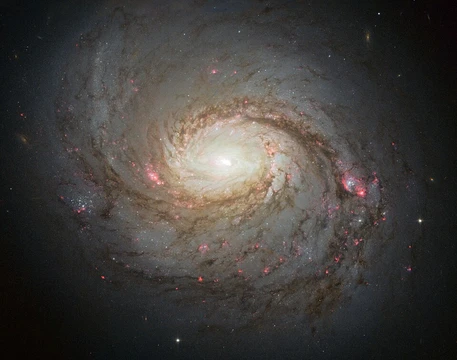
Anemic galaxy
A spiral galaxy with low arm contrast and reduced star formation.

An anemic galaxy is a spiral galaxy whose spiral arms stand out only faintly against its disk. It represents a transitional stage between gas-rich, actively star-forming spirals and gas-poor, quiescent lenticular galaxies.
These galaxies contain less neutral hydrogen—the raw material for star formation—than normal spirals, and that hydrogen is also less densely distributed. Their overall color is redder, they have fewer H II regions, and their rate of star formation is low. Early studies suggested their molecular hydrogen content matched that of normal spirals, but later research found many are also deficient in molecular gas. Anemic galaxies should not be confused with other red, low-star-formation galaxies that still have normal amounts of neutral gas, such as the Andromeda Galaxy.
Most anemic galaxies are found in dense galaxy clusters. This has led to the idea that cluster processes turn normal spirals into anemic ones. Observations of the Virgo Cluster show that its spiral galaxies often have their neutral gas and star formation cut off within their optical disks—sometimes severely—and that their star formation activity is lower than that of spirals outside clusters. Likely causes include interactions with the intracluster medium (such as ram-pressure stripping) and encounters with other galaxies. These processes strip gas from normal spirals, may temporarily boost star formation, and eventually shut it down as the gas is used up and not replaced. A spiral could also become anemic simply by exhausting its gas supply through normal star formation. The probable end state of an anemic galaxy is to lose all remaining gas and star formation, becoming similar to a lenticular galaxy. Thus, most lenticular galaxies in clusters are thought to be former spirals.
Passive spiral galaxies, also called passive spirals, are a separate type found in rich, high-redshift clusters. They have spiral structure but little or no star formation, sometimes hidden by dust and concentrated in their innermost regions. They often lack massive stars (over 20 solar masses). Computer simulations suggest they are spirals that have lost the hydrogen normally present in their halos, which would otherwise supply new gas for star formation, and are on their way to becoming lenticulars.
- Coined by
- Sidney van den Bergh
- Coined in
- 1976
- Type
- spiral galaxy
- Key feature
- low contrast between spiral arms and disk
- Examples
- NGC 4921 in the Coma Cluster, Messier 90 in the Virgo Cluster
Lore & Background
The term 'anemic galaxy' was coined in 1976 by Canadian astronomer Sidney van den Bergh to classify galaxies that are an intermediate form between gas-rich, star-forming spiral galaxies and gas-poor, inactive lenticular galaxies. Anemic galaxies show spiral arms of low contrast, a low content and density of neutral hydrogen, redder colours than normal spirals, fewer H II regions, and low star formation activity. Initially believed to have molecular hydrogen content similar to normal spirals, subsequent studies have shown that a number of them are deficient in molecular gas. They should not be confused with galaxies that have red colors due to low star formation but normal neutral gas content, such as the Andromeda Galaxy.
Most anemic galaxies are present in rich galaxy clusters, suggesting that cluster processes convert normal spirals into anemic ones. Studies of spiral galaxies in the nearby Virgo Cluster show that their neutral gas and star formation are truncated within their optical disks, often severely, and star formation activity is lower than in spirals outside clusters. Processes such as ram-pressure stripping and interactions with other galaxies are responsible, stripping gas, sometimes increasing star formation temporarily, and ultimately quenching it as gas is exhausted. An anemic galaxy's most probable fate is to lose its remaining gas and star formation, becoming similar to a lenticular galaxy; thus most lenticular galaxies in clusters are likely former spiral galaxies.
Reader's Guide
The concept of anemic galaxies is significant because it describes a transitional stage in the evolution of spiral galaxies within dense cluster environments. According to the article, anemic galaxies are an intermediate form between normal spirals and lenticular galaxies, and their study helps explain how cluster processes—such as ram-pressure stripping and galaxy interactions—can strip gas from spirals, alter their star formation, and eventually quench it. The article notes that most anemic galaxies are found in rich clusters, and observations of the Virgo Cluster show that their neutral gas and star formation are truncated within their optical disks, with lower star formation activity compared to isolated spirals. This suggests that cluster environments drive the transformation. The legacy of the anemic galaxy classification is its role in understanding galaxy evolution: it provides a plausible pathway for how spiral galaxies become lenticular galaxies, with the article stating that most lenticular galaxies in clusters are likely former spiral galaxies. The term also distinguishes these objects from other red, low-star-formation galaxies that retain normal gas content, like the Andromeda Galaxy, and from passive spiral galaxies, whose relationship to anemic galaxies remains unclear—they may be a more advanced stage or the same type at greater distances.
Did You Know?
- Most anemic galaxies are found in rich galaxy clusters, such as the Virgo Cluster.
- Examples include NGC 4921 in the Coma Cluster and Messier 90 in the Virgo Cluster.
Morphological Identity and Classification
Lenticular galaxies occupy a peculiar middle ground in the Hubble sequence, sitting between ellipticals and spirals. They possess a visible disk component alongside a prominent central bulge, yet they lack the grand spiral arms that define late-type galaxies. This dual nature makes them awkward to classify: their disks are typically featureless, ruling out the spiral classification scheme, while their bulges are spherical, making elliptical taxonomy equally unsuitable. As a result, astronomers subdivide lenticulars by dust content or bar prominence. Unbarred types are labeled S01, S02, and S03, with the subscript reflecting increasing dust absorption in the disk. Barred counterparts carry the SB0 prefix with the same numerical progression. The bulge dominance of lenticulars is quantified through their axis ratio distribution, which rises steadily between 0.25 and 0.85, unlike the flat distribution seen in spirals. This statistical signature confirms that a spheroidal component governs their inner structure, distinguishing them clearly from disk-dominated neighbors.
Surface Brightness and Internal Architecture
The internal light distribution of lenticular galaxies can be decomposed into distinct structural layers. The spheroidal bulge follows a Sérsic profile with an index typically ranging from 1 to 4, producing a steep inner brightness gradient reminiscent of elliptical galaxies. The disk, by contrast, declines exponentially with a Sérsic index near 1, echoing the disk structure of spirals. A third component is often needed to model a central bar. Notably, surface brightness profiles in lenticulars sometimes show a sharp truncation at roughly four disk scalelengths, a feature shared with spiral galaxies. This layered architecture allows astronomers to separate lenticular samples from diskless elliptical populations purely through profile analysis. The bulge's steeper profile and the disk's gentler falloff together paint a picture of a galaxy that has assembled two structurally distinct components, one inherited from an elliptical-like spheroid and the other from a disk-like reservoir of stars.
Stellar Population and Evolutionary State
Lenticular galaxies are, in stellar terms, remarkably similar to ellipticals. Their star populations are overwhelmingly old, with essentially all stars estimated to be older than roughly a billion years. This advanced age is consistent with their offset from the Tully-Fisher relation, a kinematic benchmark that younger, actively forming galaxies tend to follow. Because they have exhausted or lost most of their interstellar gas, lenticulars exhibit virtually no ongoing star formation. They show little to no molecular gas, and their spectra lack significant hydrogen alpha or 21-centimeter emission. Yet they differ from ellipticals in one important respect: they can still harbor substantial dust within their disks. Globular clusters are also more abundant in lenticulars than in spirals of comparable mass and luminosity. In the local universe, both lenticulars and ellipticals are regarded as passively evolving early-type galaxies, sharing spectral features and scaling relations despite their morphological differences. ES galaxies, with their intermediate-scale disks, serve as a visible bridge between the two populations.
Bars, Box-Shaped Bulges, and Kinematic Duality
Lenticular galaxies can host central bars much like their spiral cousins, and the degree of bar prominence defines their barred subclasses. SB01 objects display only a faint enhancement in surface brightness flanking the bulge, while SB03 galaxies boast dramatic, well-defined bars. NGC 1460 stands out as a lenticular with one of the largest bars known, extending through the transition zone between bulge and disk. A rarer morphological curiosity appears in galaxies such as NGC 1375 and NGC 1175, which exhibit box-shaped bulges when viewed edge-on, earning them the designation SB0 pec. Such boxy structures are more common in edge-on spirals but remain unusual in lenticulars. On the kinematic side, lenticulars inherit a dual character: the bulge is pressure-supported, with stellar motions dominated by random velocity dispersion analogous to gas particles in a balloon, while the disk component rotates in a more orderly fashion. This combination of pressure support and rotation makes lenticulars a natural laboratory for studying how two distinct dynamical regimes coexist within a single galaxy.
More in Spiral Galaxies 1-24
Spotted an error? Know more?
Reader corrections go straight into our review queue. Suggest an edit · How this site is sourced