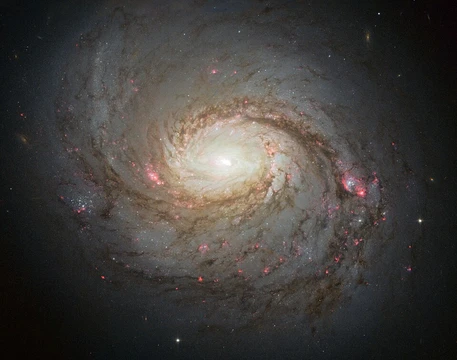
Magellanic spiral
A spiral galaxy with only one spiral arm.

A Magellanic spiral is a type of spiral galaxy that has just one spiral arm. Classified as type Sm, these galaxies come in three subtypes: SAm (unbarred), SBm (barred), and SABm (intermediate). The Large Magellanic Cloud, an SBm galaxy, serves as the prototype and namesake for this class. Typically dwarf galaxies, they fall somewhere between dwarf spirals and irregular galaxies in terms of structure. They often appear near larger spiral galaxies like the Milky Way—the Large and Small Magellanic Clouds are examples. These galaxies also show a layered stellar arrangement: main sequence stars reside in the single spiral arm, while supergiants cluster in a thick, rectangular bar that crosses the center. The classification system was developed by Gerard de Vaucouleurs, who also introduced the Magellanic irregular (Im) type as part of his revision of the Hubble sequence. Sm galaxies are often disrupted and asymmetrical, and they have sometimes been categorized as irregular galaxies with some structure (type Irr-1). The dSm designation refers to dwarf versions that may be classified as either dwarf spirals or dwarf irregulars, depending on the scheme used.
- Classification types
- Sm (with sub-categories SAm, SBm, SABm)
- Prototype galaxy
- Large Magellanic Cloud (SBm)
- Typical size
- dwarf galaxies
- Relation to other types
- intermediate between dwarf spiral galaxies and irregular galaxies
- Introduced by
- Gerard de Vaucouleurs
Lore & Background
Magellanic spiral galaxies have a stratified stellar structure; main sequence stars are found in their spiral arm, and supergiants are clustered in a thick rectangular bar across the middle. SAm galaxies are a type of unbarred spiral galaxy, while SBm are a type of barred spiral galaxy. SABm are a type of intermediate spiral galaxy. Type Sm and Im galaxies have also been categorized as irregular galaxies with some structure (type Irr-1). Sm galaxies are typically disrupted and asymmetric. dSm galaxies are dwarf spiral galaxies or dwarf irregular galaxies, depending on categorization scheme. The Magellanic spiral classification was introduced by Gerard de Vaucouleurs, along with Magellanic irregular (Im), when he revamped the Hubble classification of galaxies.
Reader's Guide
Magellanic spirals are notable as a distinct morphological class introduced by Gerard de Vaucouleurs during his revision of the Hubble classification system. They represent a bridge between dwarf spiral galaxies and irregular galaxies, often found near larger galaxies like the Milky Way. Their single-arm structure and stratified stellar content—with main sequence stars in the arm and supergiants in a thick rectangular bar—set them apart from classical spirals. The classification includes barred (SBm), unbarred (SAm), and intermediate (SABm) subtypes, with the Large Magellanic Cloud serving as the prototype. Sm galaxies are often disrupted and asymmetric, and some are categorized as irregular galaxies with structure (Irr-1). The designation dSm further blurs the line between dwarf spirals and dwarf irregulars, reflecting ongoing debate in galaxy classification. Their proximity to the Milky Way makes them valuable for studying galaxy interactions and evolution.
Did You Know?
- Magellanic spiral galaxies have only one spiral arm.
- The Large Magellanic Cloud is the prototype Magellanic spiral, classified as SBm.
- Magellanic spirals are usually dwarf galaxies, intermediate between dwarf spirals and irregulars.
- Gerard de Vaucouleurs introduced the Magellanic spiral classification when revamping the Hubble classification.
Hubble's SB Taxonomy and the Magellanic Clouds
Edwin Hubble's morphological sequence assigned the designation SB to spirals possessing a central bar, setting them apart from unbarred spirals, ellipticals, and irregulars. Within the SB family, sub-categories reflect how tightly the spiral arms are wound: SBa galaxies display tightly bound arms, SBc types show the most loosely bound arms, and SBb occupies the middle ground. A barred lenticular variant, SB0, was also recognized. Perhaps most relevant to the Magellanic Clouds, the SBm category was later introduced to capture barred spirals with somewhat irregular morphology. The Magellanic Clouds themselves had long been filed under irregular galaxies, yet observations eventually revealed that they harbor barred spiral structures, prompting their reclassification into this new SBm slot. This taxonomic refinement illustrates how our understanding of galactic architecture continues to evolve as deeper observations reveal hidden order in what once appeared chaotic. The Milky Way, home to our Solar System, sits firmly within the barred spiral class, underscoring that this is not a rare configuration but a common one among the spiral population.
Bar Formation and the Stellar Nursery
Surveys of the local universe indicate that roughly two-thirds of all spiral galaxies host a bar, making this structure a dominant feature rather than an exception. The prevailing explanation involves a density wave emanating from the galactic center that progressively reshapes the orbits of inner stars. As this effect propagates outward, stars at greater radii are drawn into the pattern, producing a self-perpetuating bar that sustains itself over time. Beyond mere structural interest, the bar functions as a powerful stellar nursery. Through orbital resonance, it channels interstellar gas inward from the spiral arms, concentrating fuel near the galactic core and igniting vigorous episodes of star formation. This inward gas flow is also believed to power active galactic nuclei, a phenomenon observed in barred spirals such as the Southern Pinwheel Galaxy. In this way, the bar is not a passive architectural element but an active engine that redistributes mass, drives star birth, and can energize the central regions of a galaxy.
Buckling, Decay, and the Two-Billion-Year Cycle
Far from being permanent fixtures, bars are now understood as transient phases in a spiral galaxy's life. Once a bar accumulates sufficient mass, its own weight undermines structural stability, and the configuration begins to decay, eventually giving way to a more conventional spiral pattern. Simulations reveal that many bars undergo a dramatic buckling event: a disturbance in the orbital resonances of stars within the bar triggers an inward collapse, leaving behind a thicker, shorter bar. The precise mechanism driving this buckling instability remains a subject of active debate among astrophysicists. Notably, the presence of a supermassive black hole at the galactic center significantly suppresses and delays buckling, though it does not prevent it entirely. Because bars appear so widely across the spiral population, researchers infer that they are recurring features in galactic development. The full oscillating cycle from spiral to barred spiral and back is estimated to average around two billion years, suggesting that a galaxy may experience multiple bar episodes over its lifetime.
Bars as Markers of Galactic Maturity
Recent observational evidence has reshaped assumptions about when bars first appear in cosmic history. Earlier theoretical models of galaxy formation had not anticipated that galaxies would become stable enough to host bars very early in the universe's history. Yet surveys of distant galaxies have uncovered numerous spiral systems in the early cosmos, challenging those expectations. A 2008 investigation provided a striking quantitative contrast: only about 20 percent of spiral galaxies in the distant past possessed bars, compared with roughly 65 percent among their local counterparts. This gradient strongly suggests that bars are a hallmark of galactic maturity, emerging only after a galaxy's turbulent formative years have subsided. In other words, the presence of a bar signals that a spiral has settled into a more stable configuration capable of sustaining the density waves and orbital resonances that build and maintain the structure. The Magellanic Clouds, now recognized as SBm barred spirals, offer a nearby reminder that even relatively small and irregular-looking systems can harbor this mature architecture, blurring the traditional boundaries between galaxy classes.
More in Spiral Galaxies 1-24
Spotted an error? Know more?
Reader corrections go straight into our review queue. Suggest an edit · How this site is sourced