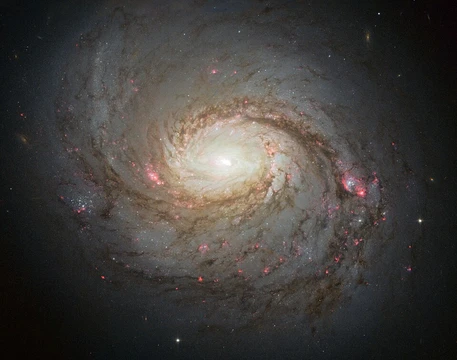
Barred spiral galaxy
A spiral galaxy with a central bar of stars.

A barred spiral galaxy is a type of spiral galaxy distinguished by a straight, bar-shaped core made of stars. In the nearby universe, roughly two out of every three spiral galaxies contain such a bar, which influences the movement of both stars and interstellar gas, and can also shape the galaxy’s spiral arms. Our own Milky Way, home to the Solar System, is itself a barred spiral galaxy.
Edwin Hubble originally classified these galaxies as “SB” (spiral, barred) in his Hubble sequence, further dividing them by how tightly or loosely their spiral arms are wound. SBa galaxies have very tightly bound arms, SBc types have loosely bound arms, and SBb galaxies fall in between. SB0 denotes a barred lenticular galaxy. Later, a new category—SBm—was added for somewhat irregular barred spirals, like the Magellanic Clouds, which were once thought to be irregular galaxies but are now known to contain barred spiral structures. Other major galaxy types in Hubble’s system include spiral, elliptical, and irregular galaxies.
Though earlier theoretical models did not predict that galaxies could become stable enough to host bars early in cosmic history, recent evidence has revealed numerous spiral galaxies with bars in the early universe.
**Bars**
Barred galaxies appear to be the norm: surveys indicate that up to two-thirds of all spiral galaxies develop a bar. The bar is generally thought to form from a density wave radiating from the galaxy’s center, which gradually reshapes the orbits of inner stars. Over time, this effect extends outward, creating a self-sustaining bar structure.
The bar is believed to act as a stellar nursery, funneling gas inward from the spiral arms via orbital resonance and fueling star formation near the center. This process may also explain why many barred spiral galaxies host active galactic nuclei, such as the one seen in the Southern Pinwheel Galaxy.
Bars are thought to be temporary features in a spiral galaxy’s life; they decay over time, turning barred spirals into more regular spiral patterns. Once a bar grows too massive, its own accumulated mass destabilizes it. Simulations suggest that many bars undergo a “buckling” event—a disturbance in stellar orbital resonances that causes the bar to collapse inward, becoming thicker and shorter. The exact mechanism behind this buckling remains debated.
- Classification type
- SB (spiral, barred)
- Subcategories
- SBa (tightly bound arms), SBb (intermediate), SBc (loosely bound arms), SBm (somewhat irregular barred spirals), SB0 (barred lenticular galaxy)
- Prevalence in local universe
- about two thirds of all spiral galaxies
- Prevalence in distant past
- 20 percent of spiral galaxies (based on a 2008 investigation)
- Prevalence in local counterparts
- about 65 percent (based on a 2008 investigation)
- Average cycle time
- about two billion years
Lore & Background
Edwin Hubble classified barred spiral galaxies as 'SB' in his Hubble sequence, arranging them into sub-categories based on how open the spiral arms are. SBa types feature tightly bound arms, while SBc types have loosely bound arms, with SBb lying in between. SB0 is a barred lenticular galaxy, and SBm was later created to describe somewhat irregular barred spirals such as the Magellanic Clouds, which were once classified as irregular galaxies but have since been found to contain barred spiral structures. The creation of the bar is generally thought to be the result of a density wave radiating from the center of the galaxy, whose effects reshape the orbits of inner stars and build over time to stars orbiting farther out, creating a self-perpetuating bar structure.
Reader's Guide
Barred spiral galaxies are apparently predominant, with surveys showing that up to two-thirds of all spiral galaxies develop a bar. The bar structure is believed to act as a type of stellar nursery, channeling gas inwards from the spiral arms through orbital resonance, fueling star birth in the vicinity of its center. This process is also thought to explain why many barred spiral galaxies have active galactic nuclei. Bars are thought to be temporary phenomena in the lives of spiral galaxies, decaying over time and transforming galaxies from barred spirals to more regular spiral patterns. Past a certain size, the accumulated mass of the bar compromises its stability, and simulations show that many bars likely experience a 'buckling' event leading to an inward collapse, though the exact mechanism remains hotly debated. Such buckling is significantly suppressed and delayed by the presence of a supermassive black hole in the galactic center but occurs nonetheless. Since so many spiral galaxies have bar structures, they are likely recurring phenomena in spiral galaxy development, with an oscillating evolutionary cycle thought to take on average about two billion years. Recent studies have confirmed that bars are a sign of galaxies reaching full maturity as their formative years end, with only 20 percent of spiral galaxies in the distant past possessing bars compared with about 65 percent of local counterparts.
Did You Know?
- The Milky Way Galaxy is classified as a barred spiral galaxy.
- Bars are found in about two thirds of all spiral galaxies in the local universe.
- A 2008 investigation found that only 20 percent of spiral galaxies in the distant past possessed bars, compared with about 65 percent of local counterparts.
- The oscillating evolutionary cycle from spiral galaxy to barred spiral galaxy is thought to take on average about two billion years.
Prevalence and the Hubble Taxonomy
Barred spiral galaxies represent one of the most common morphological types in our cosmic neighborhood, with surveys indicating that roughly two-thirds of all spiral galaxies in the local universe possess a central bar of stars. Edwin Hubble formalized this category within his broader classification sequence, designating these objects with the prefix "SB" to distinguish them from unbarred spirals, ellipticals, and irregulars. Within the SB family, Hubble carved out sub-categories according to the openness of the spiral arms: SBa galaxies display tightly wound, compact arms; SBc types sit at the opposite extreme with widely spread, loosely bound arms; and SBb occupies the middle ground between the two. A barred lenticular variant, SB0, was also recognized for galaxies with a bar but no prominent spiral structure. Later, astronomers introduced the SBm designation to accommodate somewhat irregular barred spirals—a category that notably absorbed the Magellanic Clouds, which had long been filed under irregular galaxies before their underlying barred spiral architecture was identified.
The Bar as a Stellar Engine
The bar at the heart of a barred spiral galaxy is far more than a static structural feature; it functions as a dynamic engine that reshapes the galaxy's internal dynamics. The prevailing explanation for bar formation involves a density wave emanating from the galactic center, progressively altering the orbital paths of inner stars. As this effect propagates outward to stars orbiting at greater distances, it builds a self-sustaining bar configuration that persists over time. Crucially, the bar acts as a gravitational conveyor belt, drawing interstellar gas inward from the spiral arms through orbital resonance and concentrating it near the galactic core. This inward channeling of fuel ignites vigorous episodes of star formation in the bar's vicinity, effectively turning the structure into a stellar nursery. The same gas-feeding mechanism is believed to power active galactic nuclei, as observed in systems like the Southern Pinwheel Galaxy. In this way, the bar simultaneously influences the motions of stars, the distribution of interstellar material, and even the configuration of the spiral arms themselves.
Lifespan, Buckling, and the Oscillating Cycle
Far from being permanent fixtures, bars are understood to be transient features in a spiral galaxy's life. Over time, the accumulated stellar mass within the bar eventually compromises its structural integrity, triggering a decay that transforms the galaxy back into a more conventional spiral pattern. Simulations suggest that many bars undergo a dramatic "buckling" event: a disturbance in the orbital resonances of stars within the bar causes an inward collapse, leaving behind a thicker, shorter bar. The precise physics driving this buckling instability remains a subject of active debate among astrophysicists. Galaxies that have accumulated substantial mass in their central regions tend to exhibit short, stubby bars as a result. Interestingly, the presence of a supermassive black hole at the galactic center significantly suppresses and delays buckling, though it cannot prevent it entirely. Because bars appear so frequently across the local universe, astronomers view them as recurring phenomena, with the oscillating cycle between barred and unbarred states estimated to average roughly two billion years per iteration.
Maturity Markers and the Early-Universe Surprise
Recent research has reframed the bar as a milestone of galactic maturity rather than a random structural accident. A 2008 study examining spiral galaxies in the distant past found that only about twenty percent possessed bars, in stark contrast to the roughly sixty-five percent prevalence seen among their local counterparts. This disparity strongly suggests that bars emerge only after a galaxy has completed its formative years and settled into a stable configuration capable of sustaining the density waves that generate them. The discovery of numerous barred spiral galaxies in the early universe has, however, challenged earlier theoretical models that had not anticipated galaxies becoming stable enough to host bars so soon after the Big Bang. The Milky Way itself, home to the Solar System, is classified as a barred spiral, meaning the bar that channels gas toward our galactic core and shapes the motions of billions of stars is a feature we inhabit. Together, these findings paint barred spirals as a natural, recurring chapter in the broader story of galaxy evolution.
More in Spiral Galaxies 1-24
Spotted an error? Know more?
Reader corrections go straight into our review queue. Suggest an edit · How this site is sourced