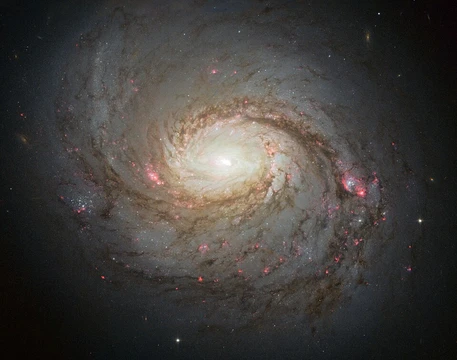
Unbarred spiral galaxy
A spiral galaxy without a central bar, designated SA.

An unbarred spiral galaxy is a type of spiral galaxy without a central bar, designated with an SA in the galaxy morphological classification scheme. A nearby example is the Triangulum Galaxy. Roughly one third of known spiral galaxies are unbarred, and they tend to have a higher redshift and are older than barred spirals, suggesting they represent an earlier stage in galactic evolution.
- Classification designation
- SA
- Proportion of known spiral galaxies
- roughly one third
- Diameter range
- 20,000 to over 100,000 light-years
- Redshift trend
- higher redshift than barred spirals
- Age trend
- older than barred spirals
- Evolutionary trend
- ratio of unbarred to barred spirals has fallen over the history of the universe
Lore & Background
In 1926, Edwin Hubble introduced the Hubble sequence for morphological classification of galaxies, dividing spiral galaxies into unbarred (SA) and barred (SB) types. Both types were further subdivided along a continuum of how tightly wound their spiral arms were, from tightly to loosely (a–c). Gérard de Vaucouleurs expanded on this system in 1959, describing an intermediate class of spiral galaxy (SAB) between barred and unbarred, and noting the continuity between loosely wound spiral galaxies and Magellanic spirals (galaxies with only one spiral arm), which he assigned the classes Sd and Sm. He also introduced classes for a galaxy's inner structure, sorted by whether the arms originated from a central ringlike structure or were purely spiral, allowing for mixed types: (r), (rs), (sr), and (s).
Reader's Guide
Unbarred spiral galaxies are one of three general types of spiral galaxies under the de Vaucouleurs classification system, the other two being intermediate spiral galaxy and barred spiral galaxy. Under the Hubble tuning fork, it is one of two general types of spiral galaxy, the other being barred spirals. Smaller spiral galaxies are less likely to have a stable bar than larger ones. The ratio of unbarred to barred spiral galaxies has fallen over the history of the universe, and unbarred spirals tend to have a higher redshift and are older than barred spirals, suggesting they represent an earlier stage in galactic evolution. An unbarred lenticular galaxy is a lenticular version of an unbarred spiral galaxy, with the Hubble type SA0; an example is AM 0644-741.
The Bar as a Stellar Engine
The defining feature of a barred spiral galaxy is the elongated, bar-shaped concentration of stars stretching across its core. This structure is far from rare; surveys indicate that roughly two-thirds of all spiral galaxies in the local universe possess one. The bar is not merely a static arrangement of stars but a dynamic engine that reshapes the galaxy's internal behavior, influencing the trajectories of both stellar populations and interstellar gas, and even modifying the shape of the spiral arms themselves. Astronomers believe the bar originates from a density wave emanating outward from the galactic center. This wave progressively distorts the orbits of inner stars, and the effect cascades to stars orbiting at greater distances, ultimately producing a self-sustaining bar configuration. Crucially, the bar functions as a powerful stellar nursery. Through orbital resonance, it funnels gas inward from the spiral arms toward the galactic core, where conditions trigger vigorous episodes of star formation. This inward gas flow is also thought to be the mechanism behind the active galactic nuclei observed in many barred spirals, a phenomenon clearly visible in the Southern Pinwheel Galaxy.
Hubble's Taxonomic Framework
Edwin Hubble introduced the designation SB — standing for spiral, barred — into his broader morphological sequence for classifying galaxies. Within this framework, barred spirals are further subdivided according to how tightly or loosely their spiral arms wind around the central bar. At one extreme, SBa galaxies display arms that are tightly coiled and closely bound to the core. At the opposite end, SBc galaxies exhibit arms that are widely spread and loosely connected. The intermediate SBb category captures galaxies whose arm geometry falls between these two poles. Two additional sub-types extend the system. SB0 designates a barred lenticular galaxy, a form that retains the bar but lacks the prominent spiral arms of its SBa through SBc relatives. SBm was introduced later to accommodate somewhat irregular barred spirals; the Magellanic Clouds serve as prime examples, having long been catalogued as irregular galaxies before observations revealed the barred spiral structure hidden within them. Hubble's full classification scheme also encompasses unbarred spiral galaxies, elliptical galaxies, and irregular galaxies, placing barred spirals as one distinct branch within a much larger family of galactic forms.
A Marker of Galactic Maturity
The presence of a bar is now understood as a signpost of a spiral galaxy reaching full maturity. A 2008 investigation compared spiral galaxies in the distant past with their local counterparts and found a striking contrast: only about 20 percent of the ancient population displayed bars, whereas roughly 65 percent of nearby spirals do. This gap suggests that bars are not present from a galaxy's earliest days but emerge later, once the system has settled into a stable configuration capable of sustaining the density waves that build them. The prevalence of barred spirals in the local universe is remarkable. Our own Milky Way, home to the Solar System, is itself classified as a barred spiral, meaning the bar structure that channels gas and fuels star formation is an integral part of our galactic neighborhood. Recent observations have also pushed the timeline of spiral galaxy formation further back, revealing numerous spiral galaxies in the early universe, a finding that challenged earlier theoretical models which had not anticipated galaxies becoming stable enough to host bars so soon after the Big Bang. Together, these findings paint a picture in which the bar is a natural, recurring milestone in a spiral galaxy's life.
The Ephemeral Bar and Its Decay
Despite their prevalence, bars are not permanent fixtures in a spiral galaxy's anatomy. They are understood to be temporary structures that gradually decay, eventually giving way to a more conventional, unbarred spiral pattern. As a bar accumulates mass over time, it can reach a critical threshold beyond which its own weight undermines structural integrity. Computer simulations reveal that many bars undergo a dramatic buckling event: a disturbance in the orbital resonances of stars within the bar triggers an inward collapse, causing the bar to become both thicker and shorter. The precise physics governing this instability remains a subject of active debate. Galaxies that have accumulated substantial mass in their central regions tend to develop short, stubby bars as a consequence. Interestingly, a supermassive black hole at the galactic center can significantly suppress and delay the onset of buckling, though it cannot prevent it entirely. Because so many spirals host bars, astronomers believe the bar is a recurring feature in spiral evolution. The oscillating cycle — from a regular spiral, through a barred phase, and back again — is estimated to take on average roughly two billion years, making the bar a transient chapter in a galaxy's long story.
More in Spiral Galaxies 1-24
Spotted an error? Know more?
Reader corrections go straight into our review queue. Suggest an edit · How this site is sourced