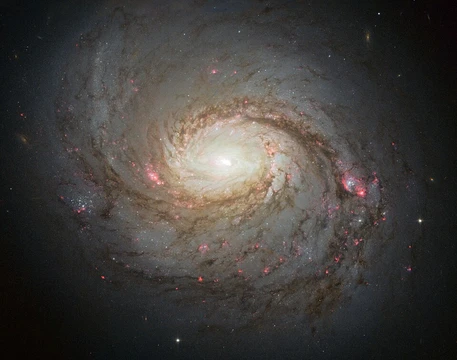
IC 438
Seyfert I spiral galaxy in Lepus with three observed supernovae.

IC 438 is a spiral galaxy in the constellation Lepus. It was discovered by American astronomer Lewis Swift on 7 January 1891. The galaxy is classified as a Seyfert I Galaxy, meaning its nucleus is quasar-like with very high surface brightness and strong, high-ionization emission lines, but unlike a quasar, the host galaxy is clearly visible.
Measurements of its velocity relative to the cosmic microwave background give a Hubble distance of about 153.9 ± 10.8 million light-years (47.18 ± 3.30 Mpc). However, 17 non-redshift measurements suggest a closer distance of roughly 136.45 ± 4.29 million light-years (41.835 ± 1.314 Mpc).
IC 438 is the namesake of the IC 438 galaxy group (also known as LGG 134), which includes four other members: IC 2143, UGCA 113, MCG-03-15-021, and ESO 555-5, according to A.M. Garcia.
Three supernovae have been observed in IC 438. SN 1997B (Type Ic, magnitude 16.5) was discovered by Alessandro Gabrijelcic on 13 January 1997. SN 2016blx (Type II, magnitude 16.5) was found by the Backyard Observatory Supernova Search (BOSS) on 9 April 2016. SN 2017gbb (Type Iax [02cx-like], magnitude 16.39) was detected by the Gaia Photometric Science Alerts programme on 9 August 2017.
- Constellation
- Lepus
- Velocity (cmb)
- 3,199±6 km/s
- Hubble distance
- 153.9 ± 10.8 Mly (47.18 ± 3.30 Mpc)
- Non-redshift distance (mean)
- 136.45 ± 4.29 Mly (41.835 ± 1.314 Mpc)
- Discovery date
- 7 January 1891
- Discoverer
- Lewis Swift
- Group membership
- IC 438 group (LGG 134), five members
Lore & Background
IC 438 was discovered by American astronomer Lewis Swift on 7 January 1891. Its velocity with respect to the cosmic microwave background is 3,199±6 km/s, which corresponds to a Hubble distance of 153.9 ± 10.8 Mly (47.18 ± 3.30 Mpc). However, 17 non-redshift measurements give a much closer distance of 136.45 ± 4.29 Mly (41.835 ± 1.314 Mpc), indicating a discrepancy between the two distance estimates.
The galaxy is classified as a Seyfert I Galaxy, characterized by a quasar-like nucleus with very high surface brightness and spectra revealing strong, high-ionisation emission lines, but unlike quasars, the host galaxy is clearly detectable. According to A.M. Garcia, IC 438 is one of five members of the IC 438 galaxy group (also known as LGG 134), which includes IC 2143, UGCA 113, MCG-03-15-021, and ESO 555-5.
Three supernovae have been observed in IC 438: SN 1997B (Type Ic, mag. 16.5) discovered by Alessandro Gabrijelcic on 13 January 1997; SN 2016blx (Type II, mag. 16.5) discovered by the Backyard Observatory Supernova Search (BOSS) on 9 April 2016; and SN 2017gbb (Type Iax[02cx-like], mag. 16.39) discovered by the Gaia Photometric Science Alerts programme on 9 August 2017.
Reader's Guide
IC 438 holds significance as a Seyfert I galaxy, offering a nearby laboratory for studying active galactic nuclei where the host galaxy remains visible, unlike more distant quasars. The article notes a notable distance discrepancy: its Hubble distance (153.9 ± 10.8 Mly) differs from the mean of 17 non-redshift measurements (136.45 ± 4.29 Mly), a tension that may inform debates on cosmic distance scales. Its membership in the IC 438 group (LGG 134) places it within a small cluster of five galaxies, providing context for studies of group dynamics and galaxy evolution. The three recorded supernovae—SN 1997B (Type Ic), SN 2016blx (Type II), and SN 2017gbb (Type Iax[02cx-like])—demonstrate ongoing stellar death events in the galaxy, with the latter discovered by the Gaia Photometric Science Alerts programme, highlighting modern survey capabilities. The galaxy's discovery by Lewis Swift in 1891 connects it to the history of visual astronomical discovery. Its legacy, as described in the article, lies in its dual role as a Seyfert galaxy and a site of multiple supernovae, offering opportunities for comparative studies of supernova types and host galaxy properties.
More in Spiral Galaxies 1-24
Spotted an error? Know more?
Reader corrections go straight into our review queue. Suggest an edit · How this site is sourced