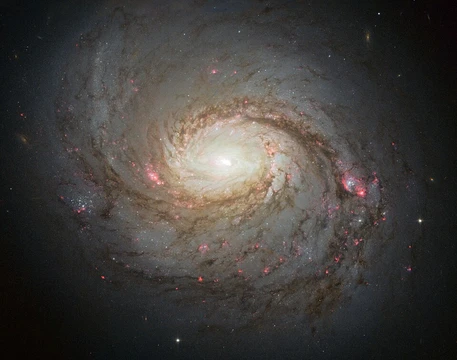
IC 184
A faint, small spiral galaxy with a water megamaser.

IC 184 is a spiral galaxy located in the constellation of Cetus. It was first discovered by the American astronomer Ormond Stone in October 1887, who described the object as both faint and small. The galaxy is notable for its classification as a Type 2 Seyfert galaxy and for hosting a water megamaser source.
- Constellation
- Cetus
- Redshift
- 0.0179
- Discoverer
- Ormond Stone
- Discovery date
- October 1887
- Type
- Type 2 Seyfert galaxy
- Morphological classification
- SB(r)a (early-type spiral)
- Megamaser luminosity
- 1.0 L☉
Lore & Background
IC 184 is classified as an early-type spiral galaxy of type SB(r)a based on Calar Alto CCD imaging. It is a member of a small galaxy group comprising three other galaxies: MCG -01-06-09, MCG -01-06-020, and MCG -01-06-022. When observed, it shows an outer bar feature that is clearly resolved into multiple spiral arms, depicted as having a bright appearance. The central region of the galaxy exhibits isophotal twisting and rotation of its position angle (PA). An inner bar is present, visible as a thick curved elongated feature that begins at the end. The northern spiral arm is much brighter than the southern spiral arm. Traces of both inner and outer shell features have been found based on imaging made with the Hubble Space Telescope (HST).
Evidence has also found IC 184 to be an isolated galaxy. Its galaxy rotation curve is orientated along the major axis position angle of 7° and 97°, with the rotation of both gas and stars described as decoupled within 4 arcseconds of its own galactic center. A further observation found a structure within the innermost region of nine arcseconds, depicted as having a wavy central shape appearance. A water megamaser source has been detected in the galaxy, with its luminosity estimated to be 1.0 L☉.
Reader's Guide
IC 184 holds significance as a Type 2 Seyfert galaxy, a class of active galactic nuclei, and as a host of a water megamaser, which provides a tool for studying the dynamics of its central region. The galaxy's morphological features—including an outer bar resolved into multiple spiral arms, an inner bar, isophotal twisting, and shell structures seen in HST imaging—offer insights into its formation and evolution. The decoupled rotation of gas and stars near its center, along with the wavy central structure, suggests complex internal dynamics. Its membership in a small galaxy group, despite evidence of isolation, adds to its contextual interest. The megamaser emission, with a luminosity of 1.0 L☉, is a key observational marker for further study.
Did You Know?
- IC 184 was discovered by American astronomer Ormond Stone in October 1887.
- It is classified as a Type 2 Seyfert galaxy.
- A water megamaser source has been detected in IC 184 with a luminosity of 1.0 L☉.
- The galaxy shows traces of both inner and outer shell features based on Hubble Space Telescope imaging.
More in Spiral Galaxies 1-24
Spotted an error? Know more?
Reader corrections go straight into our review queue. Suggest an edit · How this site is sourced