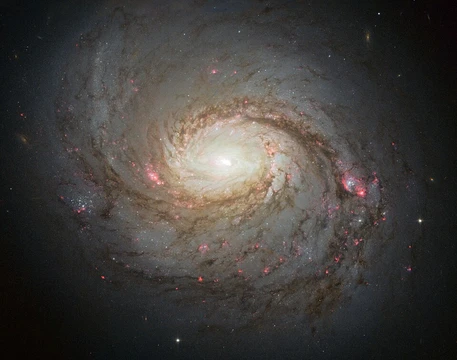
IC 1481
Spiral galaxy with a LINER nucleus and a luminous H2O megamaser disk.

IC 1481 is a spiral galaxy located in the Pisces constellation, approximately 289 million light years from Earth. It is notable for hosting an active galactic nucleus (AGN) classified as a LINER galaxy, and for containing a luminous H2O megamaser that reveals a large, edge-on molecular gas disk around its central black hole.
- Constellation
- Pisces
- Distance from earth
- 289 million light years
- Discoverer
- Rudolf Spitaler
- Discovery date
- October 6, 1891
- Diameter
- 65,000 light years
- Surface brightness
- 12.8 square arcmin
- Morphological classification
- Sb
- Supernova observed
- SN 2000ey (type Ia, mag. 16.2)
Lore & Background
IC 1481 was discovered by Austrian astronomer Rudolf Spitaler on October 6, 1891. It is classified as an Sb spiral galaxy and contains an active galactic nucleus (AGN) of the LINER type, showing an extensive narrow-line region. Optical imaging reveals bright portions forming a figure-eight pattern extending at Position Angle 50° by about 13 arcseconds on both sides of its nucleus, with emission knots toward the field edges. The stellar population exhibits a post-starburst signature, with strong absorption in the Balmer lines.
A luminous H2O maser emission is detected toward IC 1481, with a narrow, strong feature of 0.15 Jy and FWHM = 2 km/s, as well as a weak, broad component. Its isotropic luminosity of L = 320 L☉ qualifies it as a megamaser. The maser features show a velocity gradient, suggesting the AGN hosts an unstable molecular gas disk seen edge-on. The disk has a mass of (4.3 ± 0.3) × 10⁷ M☉, a thickness of 2H = 1.5–4.2 pc, and a radius of r = 2.8–14.0 pc, making it the largest among maser disks observed in other AGNs. Its rotation velocity is Vrot = 124–168 km/s, with a velocity dispersion of about 31 km/s. The disk's rotation curve is sub-Keplerian, indicating it is huge, and its mass is higher than the galaxy's black hole mass of <10⁷ M☉.
One supernova has been observed in IC 1481: SN 2000ey, a type Ia event with magnitude 16.2.
Reader's Guide
IC 1481 is significant primarily for its H2O megamaser, which provides a rare and detailed probe of the molecular gas disk orbiting its active galactic nucleus. The disk's large size—the largest among known maser disks in other AGNs—and its sub-Keplerian rotation curve offer insights into the dynamics and instability of gas near supermassive black holes. The galaxy's LINER classification and post-starburst stellar population indicate a history of star formation followed by nuclear activity. The detection of a luminous maser with a velocity gradient and a measured disk mass exceeding the black hole mass (which is less than 10⁷ M☉) suggests a complex interplay between the black hole and its surrounding environment. The presence of a single observed supernova, SN 2000ey, adds a transient event to its record. These characteristics make IC 1481 a valuable target for studying AGN feedback, maser emission mechanisms, and the structure of circumnuclear disks in spiral galaxies.
Did You Know?
- It contains a luminous H2O megamaser with an isotropic luminosity of 320 L☉.
- The molecular gas disk around its AGN is the largest among maser disks observed in other AGNs, with a radius of 2.8–14.0 pc.
- One supernova, SN 2000ey (type Ia, mag. 16.2), has been observed in IC 1481.
More in Spiral Galaxies 1-24
Spotted an error? Know more?
Reader corrections go straight into our review queue. Suggest an edit · How this site is sourced