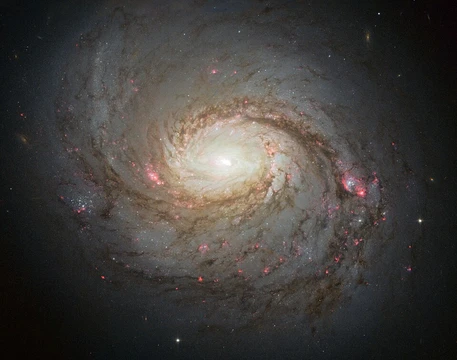
IC 1166
A pair of galaxies 977 million light-years away in Corona Borealis.

IC 1166 is a galactic pair located in the constellation Corona Borealis, consisting of two components: IC 1166 NED01 and IC 1166 NED02. The pair lies about 977 million light-years from the Solar System and was first observed on July 28, 1892, by astronomer Stephane Javelle.
The upper member, IC 1166 NED01 (also cataloged as PGC 56771), is an elliptical galaxy of type E. It spans roughly 110,000 light-years in diameter. This galaxy hosts an active nucleus and is classified as a Seyfert type 1 galaxy. Its appearance resembles a quasar, though its host galaxy is clearly visible, and it displays two sets of superimposed emission lines. Designated as a Markarian galaxy (Mrk 867), it emits an unusually high amount of ultraviolet radiation from its nucleus. Its surface brightness is 23.2 magnitude, with coordinates at right ascension 16:02:08.92 and declination +26:19:45.60.
The lower member, IC 1166 NED02 (PGC 1771884), is a spiral galaxy of type SBbc. It is slightly larger than its companion, with an approximate diameter of 160,000 light-years, and lacks an active galactic nucleus. Its surface brightness is 23.4 magnitude, located at right ascension 16:02:08.83 and declination +26:19:31.20.
- Constellation
- Corona Borealis
- Distance from solar system
- 977 million light-years
- Discovery date
- July 28, 1892
- Discoverer
- Stephane Javelle
- Number of components
- 2
- Components
- IC 1166 NED01, IC 1166 NED02
Lore & Background
IC 1166 NED01, also known as PGC 56771, is a type E elliptical galaxy located above IC 1166 NED02. It has a diameter of approximately 110,000 light-years and an active nucleus classified as a Seyfert type 1 galaxy. It has a quasar-like appearance, but its host is clearly seen and presents two sets of emission lines superimposed on each other. PGC 56771 is classified as a Markarian galaxy (designated Mrk 867) because its nucleus emits excessive amounts of ultraviolet rays compared to other galaxies. It has a surface brightness of 23.2 magnitude and is located at right ascension (16:02:08.92) and declination (26:19:45.60).
IC 1166 NED02, also known as PGC 1771884, is a type SBbc spiral galaxy located below IC 1166 NED01. It has an approximate diameter of 160,000 light-years, making it slightly larger than the other galaxy, and does not have an active galactic nucleus. PGC 1771884 has a surface brightness of 23.4 magnitude and a right ascension of (16:02:08.83) and declination (26:19:31.20).
Reader's Guide
IC 1166 is notable as a pair of galaxies discovered by Stephane Javelle in 1892, located 977 million light-years away in Corona Borealis. The pair consists of an elliptical galaxy (IC 1166 NED01) and a spiral galaxy (IC 1166 NED02), offering a contrast in morphology and activity. IC 1166 NED01 is particularly significant as a Seyfert type 1 galaxy with an active nucleus and a quasar-like appearance, and it is classified as a Markarian galaxy (Mrk 867) due to its excessive ultraviolet emission. Its two sets of superimposed emission lines add to its scientific interest. IC 1166 NED02, a larger SBbc spiral galaxy without an active nucleus, provides a comparative baseline. The pair's differing diameters (110,000 and 160,000 light-years) and surface brightness values (23.2 and 23.4 magnitude) further characterize them. Their discovery by Javelle and their distinct properties make IC 1166 a valuable subject for studying galaxy interactions and active galactic nuclei.
Did You Know?
- IC 1166 NED01 is a Seyfert type 1 galaxy with a quasar-like appearance.
- IC 1166 NED01 is classified as a Markarian galaxy (Mrk 867) due to excessive ultraviolet emission.
- IC 1166 NED02 is a type SBbc spiral galaxy and is slightly larger than IC 1166 NED01.
- The pair was discovered on July 28, 1892, by Stephane Javelle.
More in Spiral Galaxies 1-24
Spotted an error? Know more?
Reader corrections go straight into our review queue. Suggest an edit · How this site is sourced