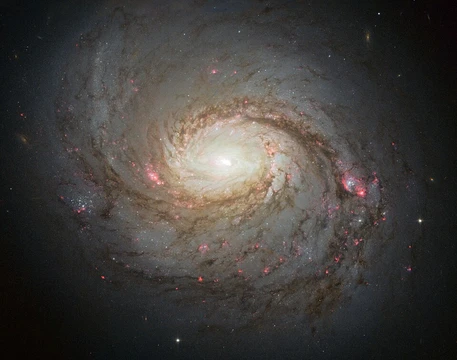
ESO 248-G10
A giant spiral galaxy with a quasar-like nucleus and enormous radio lobes.

ESO 248-G10, also cataloged as MRC B0319-454, is a spiral galaxy, radio galaxy, and Seyfert galaxy located in the constellation Eridanus. It lies at a redshift of 0.0624, roughly 893 million light-years (274 megaparsecs) away, with a visual magnitude of 15. The galaxy belongs to the Abell 3104 galaxy cluster and was first mentioned in scientific literature in 1960, in the second MSH catalog of radio sources.
This galaxy is part of a gravitationally bound pair designated [T2015] nest 201388, which includes 2MASX J03142173-4525128. ESO 248-G10 spans about 369,000 light-years (113,000 parsecs) across, roughly four times the diameter of the Milky Way, based on an angular diameter of 85.11 arcseconds and a redshift distance corrected for Virgo, GA, and Shapley flows. It is a class II Seyfert galaxy, characterized by a very bright core, narrower spectral lines, and broader absorption lines. Its active galactic nucleus has an estimated absolute magnitude of -25.9, corresponding to a luminosity of about 1.96 trillion times that of the Sun, so luminous it is suspected to be a quasar. This nucleus is powered by a supermassive black hole with a predicted mass of 10^8.6 solar masses, equivalent to roughly 398.1 million Suns.
The galaxy’s stellar mass is 2 × 10^11 solar masses, or about 200 billion Suns, roughly twice that of the Milky Way. It features a warped dust lane and large starburst bubbles of hot gas and plasma extending 25,000 light-years (8,100 parsecs) across, with high rates of star formation. In 1989, ESO 248-G10 was identified as a giant radio galaxy with a projected size of 1.27 million parsecs, making it the third largest known radio galaxy at the time. More recent studies from 2000 and 2009 suggest its radio lobes now measure 2.51 million parsecs (8.2 million light-years) across, based on an angular diameter of 26 arcminutes. This makes it the second largest spiral-hosted radio galaxy discovered, after NGC 6185. Its radio lobes exhibit a class II Fanaroff-Riley morphology, meaning they are edge-brightened and far more luminous than the opposite type.
- Constellation
- Eridanus
- Redshift
- z = 0.0624
- Distance
- approximately 893 million light years (274 megaparsecs)
- Visual magnitude
- 15
- Diameter
- 369,000 light years (113,000 parsecs)
- Stellar mass
- 200 billion M☉ (2 × 10^11 M☉)
- Active galactic nucleus absolute magnitu
- -25.9
- Supermassive black hole mass
- 398.1 million M☉ (10^8.6 M☉)
Lore & Background
ESO 248-G10 was first mentioned in literature in 1960 in the second MSH catalog of radio sources. It is a member of the galaxy cluster Abell 3104 and forms a gravitationally associated pair with 2MASX J03142173-4525128, designated [T2015] nest 201388. The galaxy is classified as a class II Seyfert galaxy, with a very bright core and narrower spectral lines, and its active galactic nucleus is so luminous (absolute magnitude -25.9, luminosity ~1.96 trillion L☉) that it is suspected to be a quasar. The nucleus is powered by a supermassive black hole with a predicted mass of 398.1 million M☉.
The galaxy exhibits a warped dust lane and large starburst bubbles of hot gas and plasma spanning 25,000 light years (8,100 parsecs), indicating high rates of star formation. In 1989, it was identified as a giant radio galaxy with a projected size of 1.27 million parsecs, then the third largest known. More recent studies from 2000 and 2009 suggest an extent of 2.51 million parsecs (8.2 million light years), making it the second largest spiral-hosted radio galaxy after NGC 6185. Its radio lobes are class II Fanaroff-Riley morphology, edge-brightened and far more luminous than their counterparts.
Reader's Guide
ESO 248-G10 is significant as one of the most extreme examples of a spiral galaxy hosting a giant radio galaxy, a phenomenon more commonly associated with elliptical galaxies. Its discovery in 1989 as the third largest radio galaxy at the time highlighted the potential for spiral galaxies to produce enormous radio structures. Later measurements in 2000 and 2009 revised its size upward to 2.51 million parsecs, cementing its status as the second largest spiral-hosted radio galaxy known, behind only NGC 6185. The galaxy's active nucleus, suspected to be a quasar, and its supermassive black hole of nearly 400 million solar masses underscore the energetic processes at work. The presence of starburst bubbles and a warped dust lane further indicate ongoing star formation and galactic dynamics. As a member of the Abell 3104 cluster, ESO 248-G10 provides a valuable case study for understanding the interplay between galaxy mergers, active nuclei, and radio jet formation in spiral galaxies. Its legacy lies in challenging assumptions about the types of galaxies that can host giant radio lobes and in offering a nearby (by cosmological standards) laboratory for studying quasar-like activity in a spiral host.
Did You Know?
- ESO 248-G10 is roughly four times the diameter of the Milky Way, spanning 369,000 light years.
- Its active galactic nucleus has an absolute magnitude of -25.9, so luminous it is suspected to be a quasar.
More in Spiral Galaxies 1-24
Spotted an error? Know more?
Reader corrections go straight into our review queue. Suggest an edit · How this site is sourced