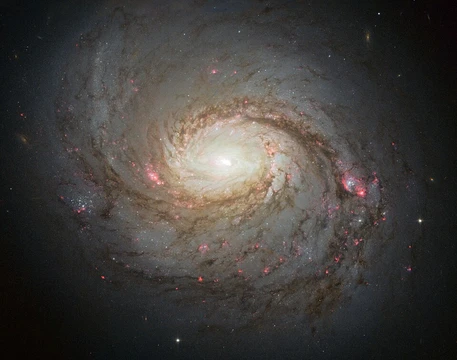
Corotation circle
Circle where stars and spiral arms move at same speed.

In a spiral galaxy, the corotation circle is the ring around the galactic center where stars and the spiral arms travel at the same speed. The distance from the center to this ring is the corotation radius. Stars inside that radius move faster than the arms, while those outside move slower. Our Sun sits close to the Milky Way’s corotation circle.
This circle can help reveal dark matter’s presence. In barred spiral galaxies like ours, the bar’s stars rotate faster than the arms because they are nearer the center. Models indicate that if a dark matter halo is massive enough, it slows rotation enough to push the corotation radius beyond 1.4 times the bar’s length. Most observations, however, show the corotation radius is smaller than that, suggesting dark matter does not strongly affect galactic rotation. But a 2017 study found that spiral arms rotate more slowly than once thought, meaning dark matter can sometimes influence a galaxy’s rotation even when the corotation radius is less than 1.4 times the bar length.
- Corotation radius threshold
- 1.4 times the bar length
- Location of sun
- near the corotation circle of the Milky Way
Lore & Background
The corotation circle is defined by the balance of orbital speeds: inside it, stars outpace the spiral arms; outside, they lag behind. In barred spiral galaxies such as the Milky Way, stars in the bar rotate faster than those in the arms because they are closer to the center. Calculations have shown that sufficiently massive dark matter haloes slow rotation, causing the corotation radius to be greater than 1.4 times the length of the bar. Most measurements have found the corotation radius to be less than 1.4 times the bar length, leading to the conclusion that dark matter does not significantly influence galactic rotation. However, a 2017 study found that the arms of galaxies rotate more slowly than previously thought, implying that dark matter does sometimes influence rotation even when the corotation radius is less than 1.4 times the bar length.
Reader's Guide
The corotation circle serves as a tool to probe dark matter in galaxies. In barred spiral galaxies, the ratio of the corotation radius to the bar length provides a test: if the radius exceeds 1.4 times the bar length, it indicates a sufficiently massive dark matter halo slowing rotation. Most measurements have found the radius below this threshold, suggesting dark matter does not significantly affect galactic rotation. However, a 2017 study introduced uncertainty by showing that spiral arms rotate more slowly than previously assumed, which implies dark matter can influence rotation even when the corotation radius is less than 1.4 times the bar length. This unresolved dispute means the corotation circle remains a key but contested diagnostic for dark matter's role in galaxy dynamics.
Did You Know?
- The Sun is located near the corotation circle of the Milky Way.
- Inside the corotation circle, stars move faster than the spiral arms; outside, they move slower.
- In barred spiral galaxies, stars in the bar rotate faster than stars in the spiral arms.
More in Spiral Galaxies 1-24
Spotted an error? Know more?
Reader corrections go straight into our review queue. Suggest an edit · How this site is sourced