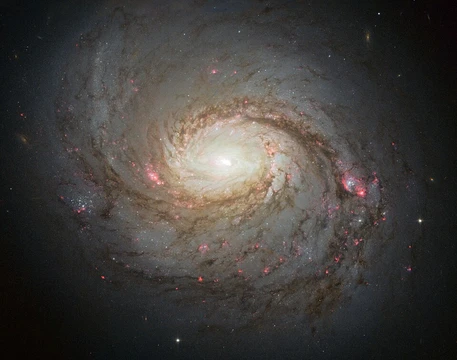
Carina–Sagittarius Arm
A minor spiral arm of the Milky Way galaxy.

The Carina–Sagittarius Arm (also called the Sagittarius Arm, Sagittarius–Carina Arm, or simply Arm -I) is considered a minor spiral arm of the Milky Way. Spiral arms are long, diffuse, curving streams of stars that extend outward from the Galactic Center, typically containing billions of stars and thousands of gas clouds. This particular arm stands out because it hosts a high concentration of HII regions, young stars, and giant molecular clouds. The Milky Way is a barred spiral galaxy, with a central bar and bulge from which two major and several minor arms radiate. The Carina–Sagittarius Arm sits between two major arms: the Scutum–Centaurus Arm (visible inward toward the Galactic Center, with parts beyond the bulge) and the Perseus Arm (similar in size, but closer when looking outward from the Milky Way’s bright band). Its name comes from the constellations Sagittarius and Carina, which lie in the direction of the Galactic Center as seen from Earth.
The arm fades near its midpoint, after reaching a maximum angle of about 80° from the Galactic Center as viewed from the Solar System. The Sagittarius Arm begins at the galaxy’s central bar, and beyond the faded region lies the Carina Arm. A study using the BeSSeL Survey and the VLBA measured parallaxes and motions of 10 massive-star-forming regions in the Sagittarius Arm, finding a spiral pitch angle of 7.3 ± 1.5 degrees and a half-width of 0.2 kpc. The portion nearest the Sun is about 1.4 ± 0.2 kpc away.
In 2008, infrared observations from the Spitzer Space Telescope revealed that the Carina–Sagittarius Arm has relatively few young stars compared to the Scutum–Centaurus and Perseus Arms. This supports the idea that it is a minor arm, like the Norma Arm (Outer Arm), consisting mostly of gas with only sparse pockets of newly formed stars.
Several Messier objects and other celestial sights visible through amateur telescopes or binoculars lie in the Sagittarius Arm, listed roughly east to west: M11 (Wild Duck Cluster) in Scutum, M26 in Scutum, M16 (Eagle Nebula) in Serpens, M17 (Omega Nebula) in Sagittarius, M18 in Sagittarius, M55 in Sagittarius, M24 (Small Sagittarius Star Cloud), M21 in Sagittarius, M8 (Lagoon Nebula) in Sagittarius, and NGC 3372 (Carina Nebula) in Carina.
- Pitch angle
- 7.3 ± 1.5 degrees
- Half width
- 0.2 kpc
- Distance to nearest part
- 1.4 ± 0.2 kpc
- Maximal angle from galactic center
- 80°
- Number of regions studied
- 10
Lore & Background
The Carina–Sagittarius Arm is a long, diffuse curving streamer of stars that radiates from the Galactic Center, composed of billions of stars and thousands of gas clouds. It is one of several spiral arms in the Milky Way, a barred spiral galaxy consisting of a central crossbar and bulge. The arm dissipates near its middle, shortly after reaching its maximal angle from the Galactic Center of about 80°, as viewed from the Solar System. Beyond the dissipated zone it is the Carina Arm. Extending from the galaxy's central bar is the Sagittarius Arm (Sagittarius bar).
In 2008, infrared observations with the Spitzer Space Telescope showed that the Carina–Sagittarius Arm has a relative paucity of young stars, in contrast with the Scutum-Centaurus Arm and Perseus Arm. This suggests it is a minor arm, along with the Norma Arm (Outer Arm), appearing mostly as concentrations of gas sparsely sprinkled with pockets of newly formed stars.
A study using measured parallaxes and motions of 10 regions in the Sagittarius arm where massive stars are formed, with data from the BeSSeL Survey using the VLBA, found the spiral pitch angle of the arms to be 7.3 ± 1.5 degrees and the half-width of the arms to be 0.2 kpc. The nearest part to the Sun is around 1.4 ± 0.2 kpc away.
Reader's Guide
The Carina–Sagittarius Arm is notable as a minor spiral arm of the Milky Way, lying between two major arms and containing many HII regions, young stars, and giant molecular clouds. Its classification as a minor arm is supported by infrared observations showing a relative lack of young stars compared to the Scutum-Centaurus and Perseus Arms, suggesting it is primarily a concentration of gas with sparse star formation. The arm's geometry has been studied through parallax and motion measurements of massive star-forming regions, yielding a pitch angle of 7.3 ± 1.5 degrees and a half-width of 0.2 kpc. It hosts several prominent Messier objects and other celestial sights visible through amateur telescopes or binoculars, including the Eagle Nebula (M16), Omega Nebula (M17), Lagoon Nebula (M8), and the Carina Nebula (NGC 3372). The arm's proximity to the Sun—about 1.4 kpc at its nearest point—and its location toward the Galactic Center make it a key region for studying spiral structure and star formation in the Milky Way.
Did You Know?
- The Carina–Sagittarius Arm is also known as the Sagittarius Arm or Sagittarius–Carina Arm, labeled -I.
- It lies between the Scutum–Centaurus Arm and the Perseus Arm.
- The arm dissipates near its middle after reaching a maximal angle of about 80° from the Galactic Center.
- Infrared observations with the Spitzer Space Telescope showed it has a relative paucity of young stars.
More in Spiral Galaxies 1-24
Spotted an error? Know more?
Reader corrections go straight into our review queue. Suggest an edit · How this site is sourced