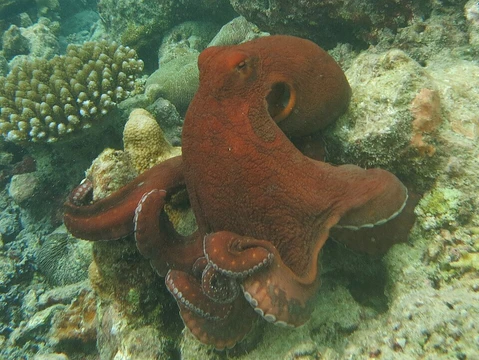
Big blue octopus (Octopus cyanea)
Source-cited species reference: taxonomy from WoRMS, biology from SeaLifeBase, occurrence map from GBIF, conservation from IUCN Red List, description from Wikipedia.

Octopus cyanea, also known as the big blue octopus or day octopus, is an octopus in the family Octopodidae. It occurs in both the Pacific and Indian Oceans, from Hawaii to the eastern coast of Africa. O. cyanea grows to 16 cm in mantle length with arms to at least 80 cm. This octopus was described initially by the British zoologist John Edward Gray in 1849; the type specimen was collected off Australia and is at the Natural History Museum in London.
- Scientific name
- Octopus cyanea
- Authority
- J. E. Gray, 1849
- Family
- Octopodidae
- Order
- Octopoda
- Maximum length
- 22 cm
- Depth range
- 0–150 m
- Habitat zone
- reef-associated
- Iucn red list
- Least Concern
- Gbif occurrence records
- 4,354
Anatomy and Physical Mastery
The Big Blue Octopus belongs to an order of roughly three hundred soft-bodied, eight-limbed molluscs that share a remarkable body plan. Its form is bilaterally symmetrical, with two eyes and a sharp chitinous beak positioned at the centre where all eight arms converge. Unlike creatures built around a rigid skeleton, this animal is composed almost entirely of soft tissue, a trait that lets it contort its entire body to thread through gaps barely wider than a thumb. The arms themselves function as muscular hydrostats, packed with longitudinal, transverse, and circular muscle fibres wrapped around a central axial nerve, allowing them to coil, stiffen, stretch, or squash in virtually any direction. The inner surfaces of each arm are lined with circular, bowl-shaped suckers built from two thick muscular structures—an outer infundibulum and an inner acetabulum—that seal against a surface to grip or release with precision. Propulsion comes from a muscular siphon that expels water in a jet, and when the animal swims it trails its appendages behind in a backwards glide.
A Brief, Fierce Life
The reproductive drama of octopuses is among the most stark in the invertebrate world. Most species in the order to which the Big Blue Octopus belongs grow rapidly, reach maturity early, and live only a short span. When the time comes to mate, the male employs a specially adapted arm to transfer sperm directly into the female's mantle cavity. The act is essentially terminal: once fertilisation is complete, the male enters senescence and dies. The female, by contrast, takes on a prolonged vigil. She deposits her fertilised eggs inside a den and guards them tirelessly until they hatch. The moment the young emerge, her own life ends. Despite this brevity, the species is a formidable hunter, preying on crustaceans, bivalves, gastropods, and small fish across habitats that range from coral reefs and intertidal zones to the crushing pressures of abyssal depths. The entire cycle—explosive growth, a single reproductive event, and a swift death—compresses a full evolutionary strategy into a window measured in months rather than years.
Defense, Deception, and Venom
When threatened, the Big Blue Octopus and its close relatives deploy a layered arsenal that blends physical speed with psychological misdirection. A sudden burst of jet propulsion from the siphon can hurl the animal clear of danger in an instant, while its soft, boneless body allows it to vanish into crevices that would trap any rigid creature. Ink clouds, rapid colour shifts mediated by specialised skin cells, and deliberate threat displays form a second line of defence, and outright deceit—mimicking or feigning—rounds out the toolkit. Beneath these behavioural strategies lies a biochemical one: every octopus carries venom, a trait shared across all species in the order. In the vast majority of cases this venom poses no serious risk to humans, though the blue-ringed octopuses stand as a notable exception, being the only ones documented as lethal to people. Underpinning all of these capabilities is a complex nervous system paired with excellent vision, placing octopuses among the most intelligent and behaviourally diverse invertebrates on Earth.
From Myth to Menu
Long before taxonomists pinned a specimen to a board, octopuses haunted the human imagination as monstrous presences in the deep. Norse sailors spoke of the kraken, the Ainu of Japan knew the Akkorokamui, and some scholars have even linked the many-headed Gorgons of Greek myth to the creature's eight radiating arms. Victor Hugo gave a dramatic one-on-one battle with an octopus a place in his novel Toilers of the Sea, and in Japan the animal found an unexpected niche in shunga erotic art. In the kitchen, octopus is treated as a prized delicacy across the Mediterranean and much of Asia, where its tender flesh is prepared in countless regional styles. The very name carries a linguistic history: the scientific term derives from the Ancient Greek oktōpous, literally 'eight-foot,' and the debate over whether to pluralise it as octopuses, octopodes, or the widely considered incorrect octopi has occupied English dictionaries and style guides for well over a century.
More in Taxonomy & Classification
Related in Big blue octopus
Links follow this subject's own source article.
Elsewhere in Big blue octopus
Spotted an error? Know more?
Reader corrections go straight into our review queue. Suggest an edit · How this site is sourced