Pelvic fin
The ventral twin pair that steadies, brakes, and steers the bony fish.

The pelvic fin (also called the ventral fin) is one of the two paired fins found on the body of most bony fish (Osteichthyes), the other being the pectoral fin. Positioned on the ventral (underside) surface of the trunk, typically posterior to or just below the pectoral fins, the pelvic fin is supported by the pelvic girdle and composed of fin rays (lepidotrichia) radiating from a series of fin bones (pterygiophores). Unlike the unpaired dorsal, anal, and caudal fins, pelvic fins occur in a left–right mirror pair and are homologous with the pectoral pair in evolutionary origin.
Functionally, the pelvic fin serves as a stabilizer, brake, and fine-maneuvering organ. In many reef and benthic species it provides lateral thrust for slow, precise positioning near substrate or within coral structures, while in open-water swimmers it contributes to pitch and roll control. Its morphology varies enormously across taxa: from the broad, fan-shaped fins of damselfish to the vestigial flaps of seahorses, to its complete absence in most eels.
- Type
- Paired fin (one of two pairs in most Osteichthyes)
- Position
- Ventral surface, typically posterior to pectoral fins
- Supporting girdle
- Pelvic girdle (scapulocoracoid complex)
- Fin ray type
- Lepidotrichia (bony fin rays) in teleosts
- Present in
- Most bony fish (Teleostei, Actinistia, Chondrostei)
- Absent or reduced in
- Most Anguilliformes (eels), Syngnathidae (seahorses, pipefish)
Lore & Background
In the standard teleost body plan, the pelvic fins sit in the 'thoracic' or 'abdominal' position depending on the lineage. In primitive actinopterygians the pelvic girdle is a well-developed bony ring (the scapulocoracoid), bearing a series of pterygiophore bones from which the lepidotrichial rays fan out. The anterior rays are often thicker and more heavily ossified, while posterior rays are thinner and more flexible, allowing the fin to act as both a rigid strut and a compliant surface.
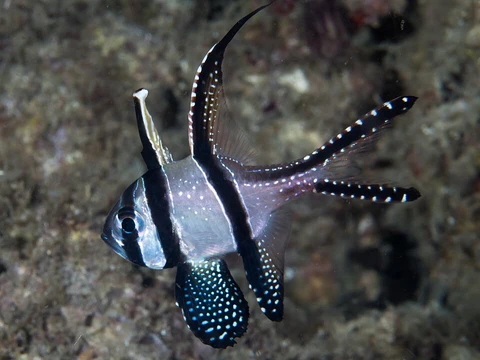
Comparative anatomy reveals dramatic modifications. In the Banggai cardinalfish (Pterapogon kauderni), the pelvic fins are relatively small, fan-shaped, and held close to the body during the species' characteristic hovering posture, contributing to fine lateral stability rather than primary propulsion. In contrast, the seahorse (Hippocampus) retains only a tiny, membrane-bound pelvic flap, while the moray eel (Muraenidae) has lost the structure entirely, relying on undulatory body motion for all steering. In some benthic scorpaenids, the pelvic fins are enlarged and splayed, functioning almost as a support platform on the substrate.
Developmentally, the pelvic fin bud appears after the pectoral bud in most teleost embryos, and its morphogenesis is governed by a largely conserved set of Hox and FGF signaling genes. Loss of the pelvic fin in eels and syngnathids is attributed to regulatory changes in these pathways rather than to the loss of the underlying genetic toolkit, making the pelvic fin a classic model in evolutionary developmental biology (evo-devo) of paired appendages.
Reader's Guide
The eye catches first the position: two small, paired fins on the ventral midline, just behind and slightly below the pectoral fins. In Pterapogon kauderni they are modest in span—roughly one-third the length of the pectoral fin—and held in a relaxed, slightly forward-tilted posture rather than the fully splayed fan seen in many damselfish.
Coloration is subtle. The pelvic fin membrane is a pale, almost translucent pinkish-amber, with no bold bars or spots. Unlike the vivid orange-and-white banding of the body, the ventral fins carry only a faint dusky smudge near the base of the anterior rays, giving a ghostly shadow against the bright flank. The lepidotrichial rays themselves are barely visible through the membrane, appearing as fine, parallel striations when the fin is fully extended.
Ray count in the Banggai cardinalfish is low by cardinalfish standards—typically six or seven soft rays supported by a small series of pterygiophores. This is fewer than the eight to nine rays common in larger Pterapogon relatives, and the anterior rays are noticeably thicker, almost spine-like, while the posterior rays taper to near-translucency.
Scale texture immediately anterior to the pelvic-fin base is smooth and cycloid, lacking the rough, ctenoid texture found on the dorsal surface. The fin-fold (membrane) is thin and slightly opalescent, catching light differently from the thicker pectoral-fin membrane. In a stressed or agitated specimen the pelvic fins are drawn tight against the body, nearly invisible; in a calm, hovering individual they relax outward, revealing their full, delicate architecture.
Did You Know?
- The pelvic fin is one of only two paired fins in most bony fish; the other is the pectoral fin. All other fins (dorsal, anal, caudal) are unpaired and midline.
- In seahorses (Hippocampus) and pipefish (Syngnathidae), the pelvic fin is reduced to a tiny, non-functional flap, yet the underlying pelvic girdle bones are still present in the skeleton.
- In some bottom-dwelling scorpionfishes (Scorpaenidae), the pelvic fins are enlarged and splayed laterally, effectively serving as a three-legged support on the substrate in addition to their role in maneuvering.
More in Description
Elsewhere in Banggai cardinalfish
Spotted an error? Know more?
Reader corrections go straight into our review queue. Suggest an edit · How this site is sourced