Description and natural history
A vivid portrait of the Banggai cardinalfish: its look, life, and fragile world.

The Banggai cardinalfish (Pterapogon kauderni) is a small tropical cardinalfish in the family Apogonidae, and the sole member of its genus. This striking fish, with its tasseled fins and bold black-and-silver pattern, is a favorite in the aquarium trade. It is among the few marine fish regularly bred in captivity, yet wild populations still suffer from overcollection and habitat loss, earning it an endangered status. Human impacts and fatal iridovirus outbreaks are major threats to its survival.
Quick Facts
- Genus
- Pterapogon
- Species
- kauderni
Facts from the source article.
Lore & Background
== Distribution ==
This species is restricted to the Banggai Islands of Indonesia. This species has an extremely limited geographic range (5,500 km2) and small total population size (estimated at 2.4 million). The Banggai cardinalfish is composed of isolated populations concentrated around the shallows of 17 large and 10 small islands within the Banggai Archipelago. A small population also occurs off Central Sulawesi, within Luwuk harbor. One additional population has become established in the Lembeh Strait (North Sulawesi), 400 km north of the natural area of the species distribution, following introduction by aquarium fish traders in 2000. Small populations seen (May 2014) in Secret Bay, northwest Bali (Banggai cardinal fish, Secret Bay, Bali).
== Description ==
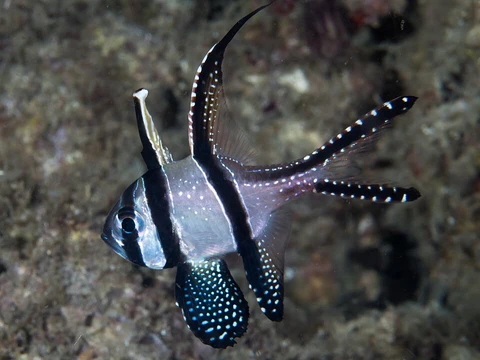
This species grows up to 8 centimetres (3 in) total length. It is easily differentiated from all other cardinalfishes by its tasseled first dorsal fin, elongated anal and second dorsal fin rays, deeply forked caudal fin, and color pattern consisting of three black bars across the head and body and prominent black anterior edges on the anal and second dorsal fin. The male can be differentiated from the female by a conspicuous, enlarged oral cavity, which is apparent only when they are brooding.
== Ecology ==
The Banggai cardinalfish is the only member of its family that is diurnal. It is a demersal tropical marine fish that forms stable groups of about 9 individuals in shallow water, being most common at 1.5 to 2.5 m in depth. It inhabits a variety of shallow habitats, including coral reefs, seagrass beds, and open areas of sand and rubble. It is most common in calm habitats on the protected side of larger islands.
=== Symbiosis and mutualism ===
It is often found associated with the seagrass Enhalus acoroides and the long spined sea urchin Diadema setosum. It occurs among various living benthic substrates such as sea urchins, sea anemones, and branching corals; young fish are most commonly associated with sea anemones, while juveniles and adults occur most frequently among long-spined sea urchins and branching corals, as well as sea stars, hydrozoans, and mangrove prop roots. Individuals of 2 to 60 hover above the urchins, with the younger ones about 2 to 3 centimeters SL staying closest to them. The fish retreat among the spines when threatened. Individual fish exhibit well-defined homing behaviour and return to the original location of their group when disturbed. The Banggai cardinalfish often coexists with various anemonefish and anemone shrimp when sheltering in anemones and corals; when found among sea urchin spines, it associates with several other genera of cardinalfish. Following removal of the fish by aquarium collectors, the abundance of associated invertebrates has been shown to decline.
Banggai cardinalfish live in shallow lagoons in groups that include up to 500 individuals. They are often found near sea urchins, where the fish hide when threatened. They are capable of hiding among the spines of sea urchins without being stung. In addition to sea urchins, other living benthic substrates such as soft corals, anemones, hydrozoans, and mangrove roots also serve as microhabitats around which the cardinalfish group. These groups of fish are rather sedentary, and movements between groups are observed to be very limited, especially because they feed on plankton that pass through water currents. Such limited dispersal of Banggai cardinalfish prevents them from spreading over large geographic ranges, thus serving as a major risk of extinction along with heavy exploitation by aquarium fish collectors, as well as low fecundity.
== Diet ==
This fish is an opportunistic feeder. Its diet includes planktonic, demersal, and benthic organisms. Copepods constitute the bulk of its diet. It serves as an important food source for several species of lionfish (Pterois spp.), the honeycomb grouper (Epinephelus merra), the crocodilefish (Cymbacephalus beauforti), the snowflake moray (Echidna nebulosa), the estuarine stonefish (Synanceia horrida), and the yellow-lipped sea krait (Laticauda colubrina).
Reader's Guide
This account is drawn from the species' own Wikipedia article and is reproduced under CC BY-SA 4.0. Follow the source link for the article's own citations and revision history.
Sources Wikipedia: Banggai cardinalfish — https://en.wikipedia.org/wiki/Banggai_cardinalfish — Licence: CC BY-SA 4.0 — Accessed 2026-09-19
Did You Know?
- The Banggai cardinalfish is one of the few marine fish where the male broods eggs in his mouth—up to 80 at a time—and continues to shelter the fry for weeks after hatching.
- This species has a natural range smaller than the state of Delaware, restricted to just 27 islands in the Banggai Archipelago of Indonesia.
- A single introduced population in the Lembeh Strait, 400 km from its native home, was established by aquarium traders in 2000 and still persists today.
- Young Banggai cardinalfish often hover just centimeters above long-spined sea urchins, darting among the spines for protection when danger approaches.
Taxonomic Singularity and Striking Morphology
The Banggai cardinalfish holds a taxonomic position unlike any other in its family. As the sole representative of the genus Pterapogon, it stands alone among the Apogonidae, a distinction that highlights how isolated its lineage has become. A former relative, the sailfin cardinalfish, was once included within Pterapogon but has since been elevated to its own genus, further narrowing the Banggai species' taxonomic neighbourhood. Physically, the fish is unmistakable. Reaching a maximum of eight centimetres in total length, it is set apart from every other cardinalfish by a combination of features: a tasseled first dorsal fin, elongated rays on both the anal fin and the second dorsal fin, and a deeply forked tail. Its colouration is equally distinctive, marked by three bold black bars running across the head and body, together with prominent black leading edges on the anal and second dorsal fins. Beyond these shared traits, the sexes are essentially monomorphic, except that a brooding male reveals a conspicuously enlarged oral cavity. Despite its small size and striking appearance, the species has become a staple of the marine aquarium trade, ranking among the relatively few saltwater fish that can be bred on a regular basis in captivity.
A Narrow World: Range, Populations, and Conservation Status
The entire natural range of the Banggai cardinalfish is confined to the Banggai Islands of Indonesia, spanning roughly 5,500 square kilometres. Within that modest area, the species exists as a collection of isolated populations clustered around the shallow waters of seventeen large and ten small islands in the Banggai Archipelago. A smaller group has been recorded in Luwuk harbour off Central Sulawesi. Beyond its native range, a population became established in the Lembeh Strait of North Sulawesi, approximately 400 kilometres to the north, after aquarium fish traders introduced the species there in 2000. By May 2014, small numbers had also been sighted in Secret Bay on the northwest coast of Bali. The total wild population is estimated at around 2.4 million individuals, a figure that sounds substantial but is precarious given the species' restricted distribution. The Banggai cardinalfish is now classified as endangered. Human-driven degradation of its shallow-water habitats and the ongoing capture of wild fish for the aquarium trade place severe pressure on its numbers. In addition, iridovirus infections are recognised as a significant cause of mortality, compounding the threats posed by habitat loss and overharvesting.
Symbiotic Life in Shallow Waters
Among all cardinalfishes, the Banggai species is unique in being strictly diurnal. It is a demersal, tropical marine fish that typically assembles into stable groups of about nine individuals in shallow water, most commonly at depths of 1.5 to 2.5 metres, though larger aggregations of up to 500 individuals have been observed in shallow lagoons. Its preferred habitats include coral reefs, seagrass beds, and open stretches of sand and rubble, with a particular preference for the calm, sheltered sides of larger islands. The fish maintains close associations with a range of benthic organisms. It is frequently found near the seagrass Enhalus acoroides and the long-spined sea urchin Diadema setosum. Young fish gravitate toward sea anemones, while juveniles and adults shelter among urchin spines, branching corals, sea stars, hydrozoans, and mangrove prop roots. When threatened, individuals retreat into the spines of sea urchins, a feat they accomplish without being stung. The fish display well-defined homing behaviour, returning to their group's original location after disturbance. They often coexist with anemonefish, anemone shrimp, and other cardinalfish genera. Notably, when Banggai cardinalfish are removed by collectors, the abundance of associated invertebrates has been shown to decline, suggesting a meaningful ecological interdependence.
Courtship, Mouthbrooding, and a Brief Life
Reproduction in the Banggai cardinalfish follows a pattern unusual among marine fish. The species is a paternal mouthbrooder: the male carries the eggs and young in his enlarged oral cavity. Courtship is initiated by the female, who selects a mate and isolates him from the rest of the colony by creating a roughly spherical spawning site about 50 to 60 centimetres in diameter. A characteristic movement called side-by-side trembling accompanies pair formation, in which the female approaches the male from behind with a vigorous trembling motion while he remains still. Mating pairs establish spawning territories several metres away from the main group and defend them vigorously. The eggs measure about 2.5 millimetres in diameter, and the young remain in the male's mouth for an undetermined period after hatching. Unlike many marine fish, the Banggai cardinalfish has no planktonic larval stage. Female size governs fecundity and egg size, while male size determines the total number of eggs a pair can produce, which is why pairing tends to occur between similarly sized individuals. The species has a short lifespan, reaching roughly four years under optimal captive conditions and perhaps only one to two years in the wild.
Gallery






More in Description
Elsewhere in Banggai cardinalfish
Spotted an error? Know more?
Reader corrections go straight into our review queue. Suggest an edit · How this site is sourced