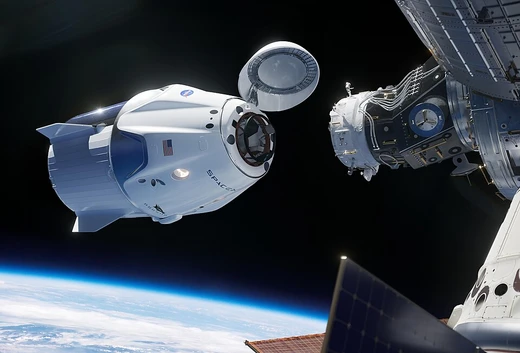
SpaceX Crew-6
Sixth operational NASA Commercial Crew flight to the ISS.

SpaceX Crew-6 marked the sixth time NASA used a Crew Dragon for a crewed operational mission under the Commercial Crew Program, and it was the ninth crewed orbital flight overall for the spacecraft. Liftoff occurred on 2 March 2023 at 05:34:14 UTC, with docking at the International Space Station (ISS) following the next day at 06:40 UTC. The crew consisted of four people: NASA astronauts Stephen Bowen and Warren Hoburg, United Arab Emirates astronaut Sultan Al Neyadi, and Russian cosmonaut Andrey Fedyaev. Fedyaev was reassigned to Crew-6 as part of a Soyuz-Dragon crew swap agreement (the Soyuz MS-23 spacecraft itself launched uncrewed as a replacement for the damaged MS-22), while Al Neyadi served as commander of the UAE’s portion of the flight.
The crew lineup took shape over several months. In March 2022, the European Space Agency named Danish astronaut Andreas Mogensen as backup pilot. The following month, the Mohammed bin Rashid Space Centre (MBRSC) and Axiom Space announced that an Emirati astronaut would join the mission. This participation stemmed from a 2021 agreement between NASA and Axiom: in exchange for NASA astronaut Mark T. Vande Hei flying on Soyuz MS-18 and MS-19 to maintain an American presence on the ISS, Axiom received a NASA-owned seat on Crew-6. Axiom then provided that seat to MBRSC through a deal with the UAE Space Agency, and Sultan Al Neyadi was later confirmed as the occupant. Andrey Fedyaev was assigned to the mission in July 2022 as part of the Soyuz-Dragon crew swap system, which ensures at least one NASA astronaut and one Roscosmos cosmonaut are on each crew rotation flight, preserving both countries’ ability to operate their own systems if either Soyuz or commercial crew vehicles face extended groundings.
The mission, the sixth in the Commercial Crew Program, launched on 2 March 2023 and lasted about six months. It was originally scheduled for 27 February 2023, but that attempt was scrubbed. The second try, at 5:34 am UTC on 2 March, succeeded. Like its predecessor Crew-5, the Dragon capsule was designed to serve as an emergency evacuation vehicle for the Soyuz MS-22 crew if needed. Roscosmos, however, chose to launch the uncrewed Soyuz MS-23 to bring that crew home instead.
The first launch attempt was called off at T−2 minutes and 12 seconds because of a problem with the TEA-TEB spontaneous ignition fluid.
Quick Facts
- Names List
- USCV-6
- Mission Type
- ISS crew transport
- Operator
- SpaceX
- Spacecraft Type
- SpaceX Crew Dragon
- Launch Mass
- 12519 kg
- Landing Mass
- 9616 kg
- Crew Size
- 4
- Crew Members
- Stephen Bowen · Warren Hoburg · Sultan Al Neyadi · Andrey Fedyaev
- Crew Expedition
- Expedition 68/69
- Launch Rocket
- Falcon 9 Block 5 (B10781), Flight 207
- Launch Site
- Kennedy, LC39A
Facts from the source article.
Lore & Background
The Crew-6 mission launched on 2 March 2023 at 05:34:14 UTC, successfully docking to the ISS on 3 March 2023 at 06:40 UTC. The crew consisted of NASA astronauts Stephen Bowen and Warren Hoburg, United Arab Emirates astronaut Sultan Al Neyadi, and Russian cosmonaut Andrey Fedyaev. Fedyaev was reassigned to Crew-6 as part of a Soyuz-Dragon crew swap agreement (the Soyuz MS-23 spacecraft itself launched uncrewed as a replacement for the damaged MS-22), ensuring both NASA and Roscosmos maintain a presence on the station.
Sultan Al Neyadi served as commander of the United Arab Emirates' mission on the flight. The inclusion of an Emirati astronaut resulted from a 2021 agreement between NASA and Axiom Space, which provided the flight opportunity to the Mohammed bin Rashid Space Centre (MBRSC) through an agreement with the United Arab Emirates Space Agency. The mission was originally scheduled for 27 February 2023 but was scrubbed due to an issue with the TEA-TEB spontaneous ignition fluid, then rescheduled and successfully launched on 2 March.
Reader's Guide
SpaceX Crew-6 represents a key milestone in international cooperation aboard the ISS, demonstrating the continued integration of commercial crew vehicles with traditional partner space agencies. The mission's crew composition—including a Russian cosmonaut flying on a U.S. commercial spacecraft and an Emirati astronaut—highlights the cross-agency agreements that maintain continuous human presence in orbit. The Soyuz-Dragon crew swap system, which placed Andrey Fedyaev on Crew-6, ensures that both the United States and Russia can operate their respective segments even if one crew vehicle is grounded. Additionally, the Dragon capsule was designed to serve as an emergency evacuation vehicle for the Soyuz MS-22 crew if needed, though Roscosmos ultimately launched the uncrewed Soyuz MS-23 for that purpose. The mission's launch delay due to a technical issue with ignition fluid underscores the rigorous safety checks inherent in crewed spaceflight.
Did You Know?
- The first launch attempt on 27 February 2023 was scrubbed at T−02:12 minutes due to an issue with the TEA-TEB spontaneous ignition fluid.
- Andrey Fedyaev was reassigned from Soyuz MS-23 to Crew-6 as part of a Soyuz-Dragon crew swap system.
- The Dragon capsule was designed to bring back the Soyuz MS-22 crew if necessary, serving as an emergency evacuation.
More in SpaceX human spaceflights 1-24
Spotted an error? Know more?
Reader corrections go straight into our review queue. Suggest an edit · How this site is sourced