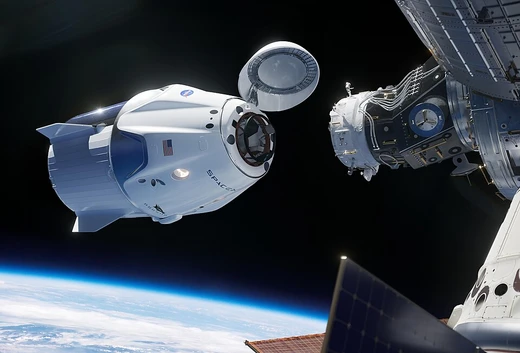
SpaceX Crew-9
First crewed launch from SLC-40; last Dragon splashdown in Gulf of Mexico.

SpaceX Crew-9 was the ninth operational NASA Commercial Crew Program flight and the 15th crewed orbital flight of a Crew Dragon spacecraft. Originally scheduled to carry four crew members to the International Space Station (ISS) in mid-August 2024, the mission was delayed by more than a month due to problems with the Boeing Starliner Calypso spacecraft docked at the ISS for the Boeing Crew Flight Test. NASA decided to return the Starliner uncrewed and launch Crew-9 with two crew members, Nick Hague and Aleksandr Gorbunov, who later returned with two additional astronauts from the Boeing Crew Flight Test.
Quick Facts
- Names List
- USCV-9
- Mission Type
- ISS crew transport
- Operator
- SpaceX
- Spacecraft Type
- SpaceX Crew Dragon
- Crew Size
- 2 up, 4 down
- Crew Members
- Nick Hague · Aleksandr Gorbunov
- Crew Landing
- Barry E. Wilmore · Sunita Williams
- Crew Expedition
- Expedition 72
- Launch Date
- September 28, 2024, 17:17:21UTC / (1:17:21pmEDT)
- Launch Rocket
- Falcon 9 Block 5 (B10852), Flight378
- Launch Site
- Cape Canaveral, SLC40
- Recovery By
- Megan
Facts from the source article.
Lore & Background
SpaceX Crew-9 launched on September 28, 2024, at 17:17:21 UTC from Cape Canaveral Space Launch Complex 40, marking the first crewed mission from that pad. The crew consisted of NASA astronaut Nick Hague and Roscosmos cosmonaut Aleksandr Gorbunov. Hague, a U.S. Space Force colonel, became the first active Space Force Guardian to launch to space. Gorbunov was the first Russian cosmonaut to fly on a Crew Dragon, though Russian cosmonauts had previously operated American spacecraft (e.g., Space Shuttle missions).
The mission was originally to carry four astronauts, but after NASA decided to return the Boeing Starliner uncrewed, two seats were left open for the Boeing Crew Flight Test astronauts. Hague, who survived a launch abort on Soyuz MS-10, served as commander.
Crew Dragon Freedom was relocated from the forward port of the Harmony module to the zenith port to free up the forward port for CRS-31. The mission concluded with a splashdown in the Gulf of Mexico on March 18, 2025, the last Dragon capsule to do so in the eastern United States.
Reader's Guide
SpaceX Crew-9 holds significance as a mission that adapted to unforeseen technical challenges with the Boeing Starliner, demonstrating NASA's flexibility in crew transportation. The decision to launch with two crew members and return with four highlighted the interdependence of commercial crew programs. The mission marked several firsts: the first crewed launch from Cape Canaveral Space Launch Complex 40, the first active U.S. Space Force Guardian in space, and the last Dragon splashdown in the Gulf of Mexico. The shift to Pacific Ocean splashdowns for future missions was driven by debris concerns from trunk modules surviving reentry. The shortened handover with Crew-10, due to supply constraints and weather, underscored the logistical pressures of ISS operations. The mission also showcased the integration of Russian cosmonauts into American spacecraft operations, with Gorbunov taking limited control of the Dragon. Overall, Crew-9 exemplified the evolving nature of human spaceflight, balancing technical risk, international cooperation, and operational efficiency.
Did You Know?
- Crew-9 was the first crewed mission to launch from Cape Canaveral Space Launch Complex 40.
- The mission was the last Dragon capsule to splash down in the Gulf of Mexico.
Design & Engineering
Starfall takes the form of a flat, circular disk roughly three and a half feet tall and just over ten feet across, giving it a compact, saucer-like silhouette. At its core sits a top plate studded with maneuvering thrusters, while the underside carries a heat shield that separates from the body before the final parachute-assisted splashdown. In its empty configuration the vehicle weighs about 2,100 kilograms, and when loaded to its 1,000-kilogram payload ceiling inside a cargo bay measuring roughly 2.5 by 1.5 by 0.5 meters, total mass climbs to approximately 3,100 kilograms. SpaceX designed the capsule to inherit lessons from both the Dragon line of crew and cargo vehicles and the reentry techniques being refined on Starship. It is not tied to a single launch vehicle: either a Falcon 9 or a Starship can deliver Starfall to orbit, giving operators flexibility in how the capsule reaches its destination.
Operational Profile
Once deployed into orbit, a Starfall capsule is not bound by a strict timeline; it can loiter in space for as long as mission planners require. When the return window opens, the vehicle follows a pre-planned reentry trajectory rather than executing an ad-hoc descent. During the initial demonstration phase, splashdowns are expected to occur roughly 1,300 kilometers west of the United States or Mexico, placing recovery operations in the Pacific. Ground and maritime teams then retrieve three separate items: the capsule itself, the jettisoned heat shield, and the parachute hardware. A key operational advantage is that Starship can carry several Starfall units on a single launch, seeding multiple capsules into orbit at once. Looking ahead, SpaceX envisions expanding the concept beyond simple orbital return to support rapid, point-to-point delivery of Earth-produced goods between distant locations, effectively turning the capsule into a high-speed cargo shuttle.
Applications & Strategic Value
SpaceX has identified two primary missions for Starfall. The first is the urgent, point-to-point transport of critical cargo on compressed timelines—a capability that could serve both commercial and military customers needing fast global resupply. The second, and perhaps more transformative, application is the return of goods manufactured in microgravity. Certain materials simply cannot be produced under Earth's gravity, and the company points to pharmaceuticals, single-crystal optical fiber, and even bio-printed human organs as examples where the absence of gravity is a prerequisite. Starfall's payload capacity is modest compared with Starship's cargo variants, but it trades raw volume for simplicity: no landing pad or runway infrastructure is needed, only a splashdown and recovery team. For larger-scale point-to-point logistics, SpaceX's Rocket Cargo contracts with the U.S. Air Force target payloads up to 100 tons, positioning Starfall as the nimble complement to those heavier missions.
Development Path & Starship Synergy
Starfall's existence first became public through filings submitted to the Federal Aviation Administration in 2026. On 15 May 2026 the FAA issued its final environmental approval for two test missions, each designed to validate reentry dynamics, splashdown procedures, and recovery operations in the Pacific. These demonstrations were intended to generate the safety data needed for full licensing reviews. SpaceX executed the first Starfall demonstration on 23 June 2026, riding a Falcon 9 into orbit. The capsule's role is deliberately complementary to Starship: where Starship provides heavy-lift access to orbit with a payload capacity that may exceed 100 metric tons in reusable configuration, and features a large bay for deploying satellites and cargo, Starfall handles the precise, smaller-scale return of those assets back to Earth. Together the two vehicles form a paired architecture for both sending and retrieving payloads.
Frequently Asked Questions
What is SpaceX Crew-9?
Crew-9 is the ninth operational flight under NASA's Commercial Crew Program and the fifteenth crewed orbital mission flown in a Crew Dragon capsule. It was initially planned as a four-person ISS rotation in mid-August 2024 but was restructured after the Boeing Starliner incident.
Who flew on Crew-9?
The capsule launched with NASA astronaut Nick Hague and Roscosmos cosmonaut Aleksandr Gorbunov. At splashdown, they were joined by Boeing's Sunita Williams and Barry E. Wilmore, bringing the returning crew to four.
Why was Crew-9 delayed by more than a month?
Problems with the Boeing Starliner Calypso, which was docked at the ISS for its crewed test, forced NASA to abort a crewed Starliner return. The agency chose to fly Starliner home empty and reconfigured Crew-9 as a two-person mission, pushing the launch past its original mid-August window.
Why did four people come home on Crew-9 instead of two?
After the Starliner was returned uncrewed, NASA assigned Sunita Williams and Barry E. Wilmore to ride back with Hague and Gorbunov on the Crew Dragon. This made the mission the final Dragon splashdown in the Gulf of Mexico.
What made Crew-9's launch site historically significant?
It marked the first time a crewed SpaceX mission lifted off from Space Launch Complex 40 at Cape Canaveral. The mission also closed a chapter as the last Crew Dragon to splash down in Gulf of Mexico waters.
More in SpaceX human spaceflights 1-24
Spotted an error? Know more?
Reader corrections go straight into our review queue. Suggest an edit · How this site is sourced