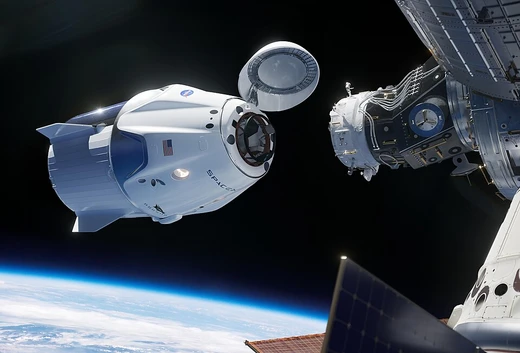
Crew Dragon Demo-2
First crewed orbital spaceflight from US since 2011.

Crew Dragon Demo-2, also known as Crew Demo-2, SpaceX Demo-2, or Demonstration Mission-2, marked the first time the Crew Dragon spacecraft carried people. The capsule, named Endeavour, lifted off on a Falcon 9 rocket on May 30, 2020, with NASA astronauts Doug Hurley and Bob Behnken aboard. Their destination was the International Space Station. This mission was the first crewed orbital launch from U.S. soil since the Space Shuttle’s final flight in 2011, and the first ever run by a private company. It was also the first two-person orbital launch from the United States since the Apollo-Soyuz Test Project in 1975. Demo-2 proved that SpaceX’s hardware could handle crewed spaceflight, earning human-rating certification after the astronauts tested the spacecraft’s capabilities in orbit.
The Crew Dragon handled docking autonomously, though the crew kept watch in case manual control was needed. The spacecraft made a soft dock with the station on May 31, 2020, about nineteen hours after launch. Once soft capture was achieved, twelve hooks closed to complete a hard capture eleven minutes later. Hurley and Behnken spent 62 days working alongside the Expedition 63 crew. During that time, Behnken joined fellow American astronaut Chris Cassidy for four spacewalks to swap out batteries delivered by a Japanese cargo ship. Endeavour undocked on its own on August 1, 2020, and thirteen hours later the astronauts splashed down in the ocean—the first water landing for a crew since 1975.
**Background** After the Space Shuttle program ended in 2011, NASA had no way to send its own astronauts to space. The agency had to buy seats on Russia’s Soyuz spacecraft, costing up to $80 million per astronaut. To find a cheaper alternative, NASA turned to private companies through the Commercial Crew Program, which is expected to cut costs by 50% once regular flights begin. By launch, NASA had given SpaceX a total of $3.14 billion to develop the Dragon 2. Demo-2 was the final big test before NASA certified the system for routine crewed missions. Before this, SpaceX had flown twenty cargo missions to the station, but never with people. Boeing was also working on crewed orbital flights under the same NASA effort.
**Crew** Doug Hurley and Bob Behnken were named the primary crew on August 3, 2018. Both had flown on the Space Shuttle before, and Demo-2 was the third spaceflight for each.
Quick Facts
- Names List
- Crew Demo-2 · SpaceX Demo-2 · Demonstration Mission-2
- Mission Type
- Flight test
- Operator
- SpaceX
- Spacecraft Type
- SpaceX Crew Dragon
- Launch Mass
- 12519 kg
- Landing Mass
- 9616 kg
- Crew Members
- Doug Hurley · Bob Behnken
- Crew Expedition
- Expedition 63
- Launch Rocket
- Falcon 9 Block 5 B1058-1
- Launch Site
- Kennedy, LC-39A
- Recovery By
- GO Navigator
Facts from the source article.
Lore & Background
After the Space Shuttle program ended in 2011, NASA relied on Russian Soyuz spacecraft to transport astronauts to the International Space Station, at a cost of up to US$80 million per astronaut. NASA contracted with private companies such as SpaceX for the Commercial Crew Program, which was expected to cost 50% less than Soyuz once in regular operation. Up to the launch, NASA had awarded a total of US$3.14 billion for the development of the Dragon 2. Demo-2 was SpaceX's last major test before NASA certified it for regular crewed spaceflights. Prior to that, SpaceX had sent twenty cargo missions to the ISS, but never a crewed one.
Reader's Guide
Crew Dragon Demo-2 completed the validation of crewed spaceflight operations using SpaceX hardware and received human-rating certification for the spacecraft, including astronaut testing of Crew Dragon capabilities on orbit. Docking was autonomously controlled by the Crew Dragon, but monitored by the flight crew. The spacecraft soft docked with the International Space Station on May 31, 2020, nineteen hours after launch. Hurley and Behnken worked alongside the crew of Expedition 63 for 62 days, including four spacewalks by Behnken to replace batteries. Endeavour autonomously undocked from the station on August 1, 2020, and thirteen hours later returned the astronauts to Earth in the first water landing by astronauts since 1975. The mission marked a pivotal shift from government-operated to commercial crewed spaceflight, reducing NASA's dependence on Russian Soyuz and validating the Commercial Crew Program's approach.
Did You Know?
- The spacecraft was named Endeavour.
- The launch was originally scheduled for May 27, 2020, but was scrubbed due to weather.
- The mission insignia was designed by Andrew Nyberg, a nephew of astronaut Bob Behnken.
A Historic Reclaiming of American Crewed Spaceflight
Demo-2 stands as a watershed moment in American spaceflight history. When Endeavour lifted off atop a Falcon 9 on May 30, 2020, it marked the first time a crewed orbital mission had been launched from U.S. soil since the Space Shuttle fleet retired in 2011. It was also the inaugural crewed orbital flight ever conducted by a commercial provider, a distinction that underscored how the landscape of human space access had fundamentally shifted. The mission carried two astronauts, making it the first two-person orbital launch from the United States since STS-4 in 1982. Perhaps most poignantly, when Endeavour splashed down in the Atlantic thirteen hours after undocking on August 1, it represented the first water landing by astronauts since 1975. Together, these milestones closed nearly a decade of dependence on foreign launch vehicles and signaled that the American crewed spaceflight program had not merely resumed but had been reinvented under a new commercial paradigm.
Sixty-Two Days Aboard the Station
From liftoff to splashdown, Demo-2 unfolded as a tightly choreographed sequence of autonomous and crew-monitored operations. Nineteen hours after the Falcon 9 carried Endeavour into orbit, the spacecraft soft-docked with the International Space Station on May 31, 2020. The docking maneuver was executed autonomously by the Crew Dragon's systems, though Hurley and Behnken remained ready to intervene manually if needed. Eleven minutes after soft capture, twelve hooks were closed to lock the capsule into a hard capture with the station. Over the following 62 days, the two astronauts integrated with the Expedition 63 crew, conducting experiments and performing duties alongside their colleagues. Behnken participated in four spacewalks with fellow American Chris Cassidy, during which they replaced batteries that had been delivered by a Japanese cargo vehicle. On August 1, Endeavour undocked autonomously, and thirteen hours later the capsule touched down in the Atlantic Ocean east of Cape Canaveral, completing the full demonstration of crewed operations.
The Road to Commercial Crew
The necessity of Demo-2 became starkly clear when the Space Shuttle program concluded in 2011, leaving NASA without any domestic capability to send humans into orbit. For nearly a decade, American astronauts were forced to travel to the International Space Station aboard Russia's Soyuz vehicle, at a staggering cost of up to eighty million dollars per seat. To break this dependency, NASA established the Commercial Crew Program, contracting with private firms to develop new crewed spacecraft. SpaceX emerged as a key partner, having already completed twenty uncrewed cargo resupply missions to the station. NASA ultimately awarded approximately three billion dollars toward the development of the Dragon 2 system, with the expectation that operational costs would run roughly half that of the Soyuz arrangement. Boeing pursued a parallel crewed vehicle under the same program. Demo-2 served as SpaceX's final major validation test before the agency could certify the spacecraft for routine crewed flights, making it the linchpin of the entire commercial crew effort.
Obstacles, Anomalies, and the Road to May 2020
The path to a May 2020 launch was far from smooth. Originally slated for July 2019, the mission was derailed when the Demo-1 capsule was destroyed during a SuperDraco thruster static fire test on April 20, 2019. Engineers traced the failure to a component that allowed oxidizer to leak into high-pressure helium lines, where it solidified and damaged a valve; the design was subsequently modified to use burst discs instead. A successful in-flight abort test finally cleared a critical milestone on January 19, 2020. The ongoing COVID-19 pandemic then complicated training schedules and final testing, though NASA administrator Jim Bridenstine expressed confidence by April that a late-May launch remained feasible. NASA calculated the loss-of-crew probability at 1 in 276, meeting the program's threshold of 1 in 270, while the loss-of-mission probability stood at 1 in 60. The launch date was officially set for May 27, 2020, before the actual liftoff on May 30.
Frequently Asked Questions
What is Crew Dragon Demo-2?
Crew Dragon Demo-2 is the first crewed flight of SpaceX's Crew Dragon spacecraft, conducted in partnership with NASA. The capsule, nicknamed Endeavour, launched on a Falcon 9 rocket on May 30, 2020, to demonstrate that the vehicle could safely take astronauts to the International Space Station and bring them back.
Who flew on Crew Dragon Demo-2?
NASA astronauts Doug Hurley and Bob Behnken made up the two-person crew. They spent 62 days in orbit, docking with the ISS and completing the first crewed orbital launch from U.S. soil since the Space Shuttle program ended in 2011.
What was the purpose of Crew Dragon Demo-2?
The mission was a crewed test flight meant to validate the full Crew Dragon and Falcon 9 stack—launch, orbital insertion, docking, and reentry—under real human conditions. It served as the final proof-of-concept NASA required before certifying the system for routine commercial crew rotations.
How did the Crew Dragon Demo-2 mission end?
After 62 days in space, the Endeavour capsule undocked from the ISS and splashed down in the Gulf of Mexico, returning Hurley and Behnken safely to Earth. The successful reentry and recovery completed the demonstration loop and cleared the way for operational crewed flights.
Why is Crew Dragon Demo-2 considered a landmark moment?
It was the first time a private company carried humans into orbit and the first crewed orbital launch from American soil in nearly a decade. The mission ended the United States' sole reliance on Russian Soyuz capsules for ISS access and kicked off a new era of commercial human spaceflight.
More in SpaceX human spaceflights 1-24
Spotted an error? Know more?
Reader corrections go straight into our review queue. Suggest an edit · How this site is sourced