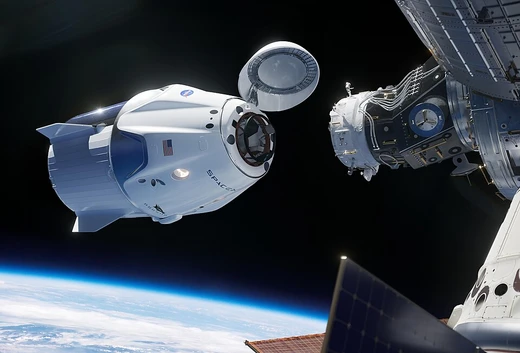
Polaris Dawn
First commercial spacewalk and farthest crewed non-lunar flight.

Polaris Dawn was a private crewed spaceflight operated by SpaceX on behalf of Shift4 CEO Jared Isaacman, the first of three planned missions in the Polaris program. Launched September 10, 2024, the mission carried Isaacman and a crew of three — Scott Poteet, Sarah Gillis, and Anna Menon — into an elliptic orbit that reached 1,400 kilometers from Earth, the farthest crewed non-lunar mission and the farthest any human had traveled since the Apollo 17 lunar landing in 1972. The crew performed the first commercial spacewalk and passed through parts of the Van Allen radiation belt to study the health effects of space radiation.
Quick Facts
- Mission Type
- Private spaceflight
- Operator
- SpaceX
- Orbits Completed
- 75
- Spacecraft Type
- Crew Dragon
- Crew Size
- 4
- Crew Members
- Jared Isaacman · Scott Poteet · Sarah Gillis · Anna Menon
- Crew Evas
- 1
- Crew Eva Duration
- 26 minutes
- Launch Rocket
- Falcon 9 Block 5 (B10834), Flight 372
- Launch Site
- Kennedy, LC39A
- Recovery By
- Shannon
Facts from the source article.
Lore & Background
The Polaris program was announced by Jared Isaacman in February 2022, five months after the first all-private astronaut mission, Inspiration4, which raised more than $250 million for St. Jude Children's Research Hospital. The program is partnered with St. Jude for the three planned missions. Development of technologies necessary for the mission included extravehicular activity (EVA) spacesuits, intersatellite laser communication links between the Dragon spacecraft and the Starlink constellation, and accommodation for the lack of an airlock in the Dragon capsule. Originally slated to fly in late 2022, the program suffered delays over the design of the EVA spacesuits and technical problems with SpaceX testing inter-satellite laser communication links, eventually launching on September 10, 2024.
Reader's Guide
Polaris Dawn marked a significant milestone in commercial spaceflight by achieving the first commercial spacewalk and setting a record for the farthest crewed non-lunar mission, reaching 1,400 kilometers from Earth. The crew included the first women to fly that far from Earth, and Sarah Gillis, at 30, became the youngest person to participate in a spacewalk. During the spacewalk, a new record was set for the number of people (four) simultaneously exposed to the vacuum of space. The mission also contributed to breaking the record for the most people (19) simultaneously in orbit. The crew conducted research on decompression sickness and spaceflight associated neuro-ocular syndrome (SANS), and tested Dragon laser interlink communication via Starlink. After a mission lasting nearly five days, the crew safely splashed down in the Gulf of Mexico on September 15, 2024.
Did You Know?
- Polaris Dawn reached 1,400 kilometers from Earth, the farthest crewed non-lunar mission and the farthest humans traveled between Apollo 17 in 1972 and the upcoming Artemis II mission.
- The crew performed the first commercial spacewalk, during which two crew members exited the spacecraft while the other two remained inside.
- Sarah Gillis, at 30 years old, became the youngest person to date to participate in a spacewalk.
- Anna Menon and Sarah Gillis flew further from Earth than any women before them.
Record-Breaking Altitude and Historic Firsts
Polaris Dawn pushed crewed spaceflight to a distance no human mission had reached since the Apollo era. In an elliptic orbit, the four-person crew traveled 1,400 kilometers from Earth, making it the farthest any person has ventured without leaving low Earth orbit and the most distant non-lunar crewed flight in history. That mark represented the farthest humans traveled between Apollo 17's 1972 lunar landing and the planned 2026 Artemis II flyby. The spacecraft also threaded through portions of the Van Allen radiation belt, offering researchers a chance to study how space radiation and the physiological demands of flight affect the human body. The mission's most celebrated moment arrived when commander Jared Isaacman and mission specialist Sarah Gillis exited the capsule for the first commercial spacewalk ever performed. During that excursion, four individuals were simultaneously exposed to the vacuum of space, surpassing a record originally set during Apollo 9. Gillis, at thirty, became the youngest person ever to perform a spacewalk, while she and Anna Menon set the record for the greatest distance flown by women. Together with the Soyuz MS-26 crew, the nine International Space Station occupants, and the three aboard China's Tiangong station, the Polaris Dawn team helped break the record for the most people in orbit at once, reaching nineteen.
The Crew Behind the Mission
Jared Isaacman, the forty-one-year-old CEO of Shift4, commanded the mission and handled primary spacecraft operations. At his side was Scott Poteet, a fifty-year-old retired Air Force fighter pilot who served as spacecraft pilot and assisted with vehicle handling. Rounding out the team were two SpaceX employees: Sarah Gillis, thirty, the company's senior space operations engineer who leads crew training for private spaceflight missions, and Anna Menon, thirty-eight, a lead space operations engineer and mission director. Menon served as the onboard medical officer, drawing on six years of experience as a biomedical flight controller at NASA, where she had overseen International Space Station operations including multiple spacewalks. Gillis joined Isaacman for the historic commercial EVA, while Menon remained inside to manage medical monitoring and mission coordination. The blend of a business leader, a military aviator, and two deep-spaceflight engineers reflected the program's ambition to push private spaceflight beyond simple orbital tourism into genuinely new operational territory.
Engineering a Spacewalk Without an Airlock
Because the Crew Dragon capsule lacks a traditional airlock, SpaceX had to devise a novel approach to extravehicular activity. The team designed EVA suits based on the intravehicular activity garments normally worn during launch and landing, so the same suit could protect astronauts in the vacuum while remaining comfortable and flexible enough for reentry. Flame-resistant, stretchable fabric and soft joints provided mobility, while the boots incorporated the same thermal material used on the Falcon 9 interstage and Dragon trunk. Thermal management was improved over the IVA baseline, and the helmet gained insulation, anti-fog treatment, and a heads-up display showing real-time suit metrics. Rather than carrying self-contained life support like the bulky EMUs on the International Space Station, the suits drew oxygen and power through an umbilical tether, echoing the approach used on early Gemini missions. The capsule itself received several modifications: extra nitrogen and oxygen tanks, a motorized forward hatch, and a mechanically supported hatch nicknamed the 'skywalker' that replaced the standard docking port. Intersatellite laser communication links to the Starlink constellation were also developed as part of the program.
A Long and Bumpy Road to the Pad
The Polaris program was announced in February 2022, just five months after the all-private Inspiration4 flight that raised over $250 million for St. Jude Children's Research Hospital — a cause Isaacman had also backed. St. Jude became the charity beneficiary for all three planned Polaris missions. What was originally targeted for late 2022 slid repeatedly: first to March 2023, then to mid-2023, then to 2024, as the team wrestled with EVA suit design and inter-satellite laser communication testing. By December 2023, Isaacman confirmed an April 2024 window; by June, the target had moved to July 12. That date was lost when a Falcon 9 upper stage failed during a test, and subsequent scheduling around NASA's Crew-9 mission pushed the launch into late summer. Weather at the recovery zone added further slippage, and after the capsule was integrated with booster B1083 at Launch Complex 39A, completed a dry dress rehearsal, and passed static fire tests on August 25, the crew finally lifted off on September 10, 2024.
Frequently Asked Questions
Who is Polaris Dawn?
Polaris Dawn is a privately funded crewed spaceflight that SpaceX flew in September 2024 on behalf of Shift4 CEO Jared Isaacman, serving as the opening chapter of his three-mission Polaris program. It is most widely recognized for carrying its four-person team to the farthest point any human had reached in non-lunar orbit since Apollo 17 in 1972.
Who flew on the Polaris Dawn crew?
The team consisted of mission commander Jared Isaacman, pilot Scott Poteet, and two specialists, Sarah Gillis and Anna Menon. All four are American citizens who were personally selected by Isaacman for this private venture.
What records did Polaris Dawn set?
The mission produced the first-ever commercial spacewalk and carried its crew to an apogee of roughly 1,400 kilometers, the highest Earth orbit reached by a crewed spacecraft at that time. It also stands as the farthest any humans had traveled from Earth's surface without going to the Moon since 1972.
What did the crew actually do during the flight?
In addition to the landmark spacewalk, the crew deliberately passed through portions of the Van Allen radiation belt to gather data on how energetic particles affect human tissue. They also ran a suite of medical and scientific experiments over the course of the roughly five-day mission.
Why does Polaris Dawn matter for the future of spaceflight?
It demonstrated that a privately funded crew can reach orbits once reserved for government programs and complete a spacewalk entirely outside a NASA framework. As the first of Isaacman's three planned Polaris flights, it established a template for increasingly ambitious commercial human spaceflight.
More in SpaceX human spaceflights 1-24
Spotted an error? Know more?
Reader corrections go straight into our review queue. Suggest an edit · How this site is sourced