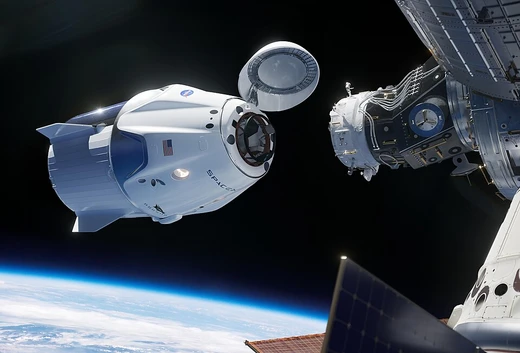
SpaceX Crew-3
Third NASA Commercial Crew operational flight, maiden voyage of Endurance.

SpaceX Crew-3 was the third NASA Commercial Crew operational flight of the Crew Dragon spacecraft and its fifth overall crewed orbital flight. The mission launched on November 10, 2021, at 02:03:31 UTC (November 9 local time) to the International Space Station, carrying NASA astronauts Raja Chari, Thomas Marshburn, Kayla Barron, and German ESA astronaut Matthias Maurer. It was the maiden flight of the Crew Dragon capsule Endurance, named to honor the endurance of the SpaceX and NASA teams during the pandemic and the ship used by Shackleton's Imperial Trans-Antarctic Expedition.
Quick Facts
- Names List
- USCV-3
- Mission Type
- ISS crew transport
- Operator
- SpaceX
- Spacecraft Type
- SpaceX Crew Dragon
- Launch Mass
- 12055 kg
- Crew Size
- 4
- Crew Members
- Raja Chari · Thomas Marshburn · Kayla Barron · Matthias Maurer
- Crew Expedition
- Expedition 66/67
- Launch Rocket
- Falcon 9 Block 5 B1067-2
- Launch Site
- Kennedy, LC39A
- Recovery By
- Shannon
Facts from the source article.
Lore & Background
The crew of SpaceX Crew-3 included Raja Chari, who became the first rookie astronaut to command a NASA space mission since the Skylab 4 crew in 1973. Kayla Barron and Matthias Maurer also made their first spaceflights. The fourth seat was initially assigned to NASA astronaut Jeanette Epps, then opened for a Russian cosmonaut under a potential barter agreement, and finally assigned to Kayla Barron in May 2021 after the agreement was unlikely to start before launch.
The capsule Endurance was named on October 7, 2021, honoring the perseverance of the SpaceX and NASA teams during the pandemic and the ship of Shackleton's Imperial Trans-Antarctic Expedition. The crew brought a stuffed turtle as a zero-g indicator, named "Pfau" (German for "peacock"), to honor Maurer's German heritage and the crew's membership in NASA Astronaut Group 22 (The Turtles).
Reader's Guide
SpaceX Crew-3 marked several milestones in commercial spaceflight. It was the first Crew Dragon indirect handover of space station crews, as NASA decided to return Crew-2 before Crew-3 launched due to delays. The mission launched after multiple postponements—from October 31 to November 3, then to November 7, then to November 9, and finally to November 11, 2021—caused by weather and a minor medical issue. The European segment of the mission was called "Cosmic Kiss." The launch brought the total number of humans who have been to space to more than 600, with Maurer being the 600th and Barron the 601st. The mission's return was also delayed multiple times, from April 2022 to early May, with splashdown occurring after 176 days in space. Crew-3 demonstrated the increasing reliability and flexibility of the Commercial Crew Program, as well as international cooperation through ESA astronaut participation.
The Artemyev Scandal and Roster Overhaul
In late November 2025, Russian cosmonaut Oleg Artemyev was aboard SpaceX's Hawthorne, California facility when he allegedly used his phone to photograph engines, technical documents, and other proprietary technologies. The act was later characterized as a violation of International Traffic in Arms Regulations, effectively "exporting" controlled information. An inter-agency investigation followed, and by December 2025—roughly two and a half months before the planned launch—Roscosmos officially announced Artemyev's removal, citing a vague "transition to other work." Investigative outlet The Insider, however, reported that he had been expelled from the United States entirely. His seat was filled by fellow cosmonaut Andrey Fedyaev, a pragmatic choice that also made history: Fedyaev became the first Russian to fly twice aboard a Crew Dragon capsule, and his prior experience on the vehicle significantly cut the training timeline his replacement would otherwise have required. The episode cast a long shadow over an otherwise routine crew rotation and raised fresh questions about the intersection of national security, international partnership, and commercial spaceflight.
A Bumpy Road to Liftoff
The Crew-12 launch window was originally set for no earlier than 11 February 2026, but a cascade of disruptions reshaped the timeline. On 15 January, the preceding Crew-11 mission returned to Earth ahead of schedule after a medical issue struck one of its members, leaving the station short-staffed. NASA and SpaceX quickly weighed pulling the Crew-12 date forward to close that gap. Yet weather intervened: on 9 February, unfavorable conditions along the ascent corridor forced a one-day slip to the 12th, and on the 10th another delay pushed the target to 13 February. At 10:15 UTC on that day, the Falcon 9 finally rose, marking a program first—the booster was recovered at Landing Zone 40, a brand-new site for Falcon 9 landings. The following evening, at 20:15 UTC on 14 February, the capsule docked with the station, and by 22:14 UTC the hatch was open and all four crew members had stepped through. The handover was notably indirect, a direct consequence of Crew-11's premature departure, and it restored the ISS to its standard complement of seven.
Epsilon: Sophie Adenot's Debut
On 20 June 2025, ESA director Josef Aschbacher revealed that the agency's share of the Crew-12 flight—astronaut Sophie Adenot's assignment—would carry the name Epsilon. The choice was deliberate: the mission patch swaps the letter "E" for a stylized lowercase epsilon (ε), framing Adenot as a "small, yet impactful" variable in the broader equation of international space exploration. A hummingbird adorns the patch as well, reinforcing the theme that even the tiniest participants shape the ecosystem. For Adenot, selected in the 2022 ESA Astronaut Group, this was her maiden voyage and a first for her class: she became the first career astronaut from that cohort to reach orbit. Aboard the station she was slated for nearly 200 experiments, many of them French innovations in crew health monitoring—autonomous ultrasound imaging, synchronized physiological sensors, bone-density and blood-flow measurements, and protocols to detect biological contamination on surfaces. She also served as the test pilot for a development version of the EuroSuit, a new European intra-vehicular activity suit built by Spartan Space, Decathlon, and MEDES for CNES. Across three sessions in May, June, and July 2026, she evaluated its ergonomics, donning and doffing speed, and freedom of movement.
Four Nations, One Crew
Crew-12 carried a deliberately international quartet: NASA astronauts Jessica Meir and Jack Hathaway, ESA astronaut Sophie Adenot, and Roscosmos cosmonaut Andrey Fedyaev. Together they represented the four major spacefaring partners in the station's ongoing operations. The mission also carried symbolic weight as the twelfth operational flight under NASA's Commercial Crew Program and the twentieth crewed orbital mission flown by a Crew Dragon capsule, underscoring how deeply the commercial architecture had become embedded in routine access to low Earth orbit. The early return of Crew-11 in mid-January 2026 had left the station operating below its normal crew level, and Crew-12's arrival on 14 February 2026 restored the standard seven-person complement. Because the two crews never overlapped aboard the station—a rare "indirect handover" in the program's history—the transition relied on careful scheduling rather than the usual face-to-face transfer of duties. Fedyaev's presence added another milestone: he became the first Russian cosmonaut to complete two Crew Dragon flights, a testament to the growing familiarity Russian crews have developed with SpaceX's hardware.
Frequently Asked Questions
Who flew on SpaceX Crew-3?
The four-person crew consisted of NASA astronauts Raja Chari, Thomas Marshburn, and Kayla Barron, joined by German ESA astronaut Matthias Maurer.
When did SpaceX Crew-3 launch to the ISS?
The mission lifted off on November 10, 2021, at 02:03:31 UTC (November 9 in local time) bound for the International Space Station.
What spacecraft carried the Crew-3 astronauts?
They rode a Crew Dragon capsule named Endurance, which made its very first crewed orbital flight on this mission.
Why is the Crew Dragon capsule called Endurance?
The name honors both the perseverance of the SpaceX and NASA teams through the pandemic and the historic vessel used by Ernest Shackleton's Imperial Trans-Antarctic Expedition.
What made SpaceX Crew-3 a milestone in Commercial Crew history?
It was the third operational NASA Commercial Crew flight and the first to carry a European Space Agency astronaut on a Commercial Crew mission to the station.
More in SpaceX human spaceflights 1-24
Spotted an error? Know more?
Reader corrections go straight into our review queue. Suggest an edit · How this site is sourced