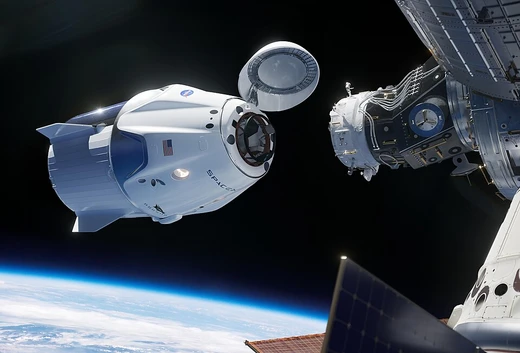
Axiom Mission 3
Private crewed mission to the ISS with first Turkish astronaut.

Axiom Mission 3 (Ax-3) was a private spaceflight to the International Space Station, operated by Axiom Space using a SpaceX Crew Dragon spacecraft. Launched on January 18, 2024, the mission lasted 22 days and ended with a splashdown in the Atlantic Ocean on February 9, 2024. It carried a multinational crew of four, all with backgrounds as military pilots, and included the first astronaut from Turkey and the first European Space Agency astronaut launched by a private provider.
Quick Facts
- Names List
- Ax-3
- Mission Type
- Private spaceflight to the ISS
- Operator
- Axiom Space · SpaceX
- Spacecraft Type
- SpaceX Crew Dragon
- Manufacturer
- SpaceX
- Launch Mass
- 12,519 kg
- Landing Mass
- 9,616 kg
- Crew Size
- 4
- Crew Members
- Michael López-Alegría · Walter Villadei · Alper Gezeravcı · Marcus Wandt
- Launch Rocket
- Falcon 9 Block 5 (B10805), Flight 291
- Launch Site
- Kennedy, LC39A
Facts from the source article.
Lore & Background
The Swedish component of Ax-3 was designated the Muninn mission, named after one of Odin's two ravens. Marcus Wandt, a Swedish project astronaut, became the first European Space Agency astronaut launched by a private space provider and the first member of the 2022 ESA Astronaut Group to receive a spaceflight mission. The mission's patch depicts Muninn gliding around Earth, with a dark blue circle representing Earth and lighter lines depicting Sweden. Wandt conducted 20 experiments and participated in five educational programs, studying topics from space habitat design effects on astronaut stress to cellular structure changes and gene expression in microgravity.
Reader's Guide
Axiom Mission 3 marked a significant step in private spaceflight, demonstrating the continued expansion of commercial access to the International Space Station. It was notable for carrying the first astronaut from Turkey, Alper Gezeravcı, and for being the first time two Scandinavians were in space simultaneously: Marcus Wandt on Ax-3 and Andreas Mogensen on SpaceX Crew-7 (the Huginn mission). The mission also highlighted the growing role of European Space Agency astronauts in private missions, with Wandt being the first ESA astronaut launched by a private provider. The use of a previously flown Falcon 9 booster (B1080) underscored SpaceX's reusable launch capabilities. The mission's 21-day duration, longer than the intended two weeks, and its splashdown in the Atlantic Ocean concluded a successful private venture.
Did You Know?
- Alper Gezeravcı was the first astronaut from Turkey.
- The mission's booster, B1080, had previously flown Axiom-2.
Crew Composition & Historic Firsts
The four individuals who flew aboard Ax-3 shared a common thread: all had served as military pilots before reaching orbit. Michael López-Alegría, an Axiom Space employee, took the helm as commander, while Walter Villadei, a veteran of the Italian Air Force, served as mission pilot. The two mission specialists brought geographic firsts to the station. Alper Gezeravcı made history as the first astronaut ever to represent Turkey in space. Marcus Wandt, a Swedish project astronaut, achieved a dual milestone: he became the first ESA astronaut to be launched by a private space provider, and the first member of the European Space Agency's 2022 astronaut cohort to receive an actual spaceflight assignment. This blend of military aviation experience and pioneering national representation gave the crew a distinctive character, uniting seasoned flight discipline with the weight of being the first from their respective countries or agencies to reach the International Space Station through a commercial provider.
The Muninn Legacy & Scandinavian Spaceflight
The Swedish element of Ax-3 carried a name steeped in Norse mythology: Muninn, one of the two ravens that perched on the shoulder of the god Odin. In that myth, the pair—Muninn and Huginn—together represent the fullness of the human mind. The naming took on a remarkable real-world resonance when Danish astronaut Andreas Mogensen flew aboard SpaceX Crew-7 under the Huginn designation, meaning that for the first time in history two Scandinavians were simultaneously orbiting Earth. The mission patch captures this narrative, depicting Muninn in flight around a dark blue circle representing our planet, with lighter lines tracing the outline of Sweden. The imagery conveys the idea of Wandt gathering knowledge in orbit and carrying it back home. This mythological framing transformed a commercial spaceflight into something that felt like a continuation of an ancient storytelling tradition, linking the Vikings' spirit of exploration to the twenty-first-century reality of private access to low Earth orbit.
Mission Operations & Technical Profile
Axiom Mission 3 was a privately operated flight to the International Space Station, launched on January 18, 2024, from Launch Complex 39A at Kennedy Space Center in Florida. The vehicle was a SpaceX Falcon 9 rocket carrying a Crew Dragon capsule, with the reusable booster B1080—a workhorse that had already supported Axiom-2 and other high-profile missions—providing the initial thrust. The crew docked with the station for what was originally planned as roughly a two-week stay, though the final duration stretched to 21 days. The mission concluded on February 9, 2024, with a splashdown in the Atlantic Ocean. Axiom Space served as the operator, making this another entry in the growing catalog of commercial crewed flights to the ISS. The reuse of a proven booster and the familiar Falcon 9 and Crew Dragon architecture underscored how private spaceflight had matured into a reliable pathway for accessing the station, even as the mission itself carried the novelty of new national firsts aboard.
Scientific & Educational Contributions
Beyond the historic firsts attached to the crew, Ax-3 delivered a substantial research and outreach payload. Marcus Wandt personally conducted twenty separate experiments during the 21-day stay and took part in five educational programs coordinated from the station. The scientific scope ranged from examining how the physical design of space habitats influences astronaut stress levels to investigating how microgravity alters cellular structure and gene expression. These topics sit at the intersection of human-factors engineering and fundamental biology, questions that grow increasingly critical as commercial and governmental agencies plan for longer-duration missions beyond low Earth orbit. The educational programs amplified the mission's reach, connecting the work being done in orbit to audiences on the ground. In the mission's visual language, the patch's depiction of Muninn gliding around Earth to share the knowledge collected by Wandt encapsulated this dual purpose: rigorous science paired with a commitment to public engagement and inspiration.
Frequently Asked Questions
What is Axiom Mission 3?
Axiom Mission 3 (Ax-3) is a privately funded crewed flight to the International Space Station, organized by Axiom Space and flown aboard a SpaceX Crew Dragon capsule. It launched in January 2024 and returned to Earth in early February of the same year.
Who flew on Axiom Mission 3?
The four-person crew was made up entirely of former military pilots from different nations. It featured Turkey's first-ever astronaut in space and the first ESA astronaut to be launched by a private provider rather than a national agency.
When did Axiom Mission 3 launch and splash down?
The Crew Dragon lifted off on January 18, 2024, and the crew touched down in the Atlantic Ocean on February 9, 2024. The full mission, from liftoff to recovery, stretched across 22 days.
What made Axiom Mission 3 historically significant?
It was the first flight to carry a Turkish citizen to orbit and the first time a European Space Agency astronaut boarded a privately operated launch vehicle. The all-pilot crew composition also distinguished it from most standard ISS rotations.
How long was the Axiom Mission 3 stay in space?
The crew spent 22 days in orbit, conducting research and outreach tasks aboard the ISS before undocking and splashing down in the Atlantic. The entire window from launch to recovery fit within that single 22-day span.
More in SpaceX human spaceflights 1-24
Spotted an error? Know more?
Reader corrections go straight into our review queue. Suggest an edit · How this site is sourced