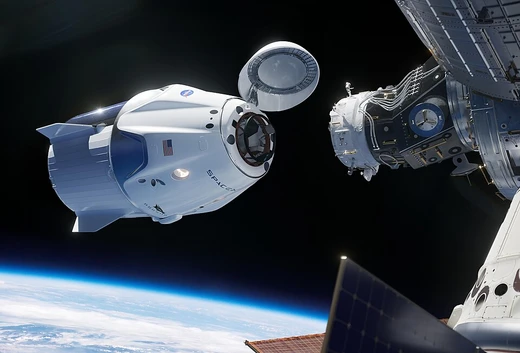
SpaceX Crew-2
Second operational Crew Dragon flight, set U.S. duration record.

SpaceX Crew-2 was the second operational flight of a Crew Dragon spacecraft and the third overall crewed orbital flight of the Commercial Crew Program. Launched on April 23, 2021, the mission carried four veteran astronauts to the International Space Station and set a record for the longest spaceflight by a U.S. crewed spacecraft at the time of its return.
Quick Facts
- Names List
- USCV-2 (2012–2019) · Crew-2
- Mission Type
- ISS crew transport
- Operator
- SpaceX
- Spacecraft Type
- SpaceX Crew Dragon
- Launch Mass
- 12055 kg
- Landing Mass
- 9616 kg
- Crew Size
- 4
- Crew Members
- Shane Kimbrough · K. Megan McArthur · Akihiko Hoshide · Thomas Pesquet
- Crew Expedition
- Expedition 65/66
- Launch Rocket
- Falcon 9 Block 5 B1061-2
- Launch Site
- Kennedy, LC39A
Facts from the source article.
Lore & Background
SpaceX Crew-2 launched on April 23, 2021, at 09:49:02 UTC and docked to the International Space Station on April 24 at 09:08 UTC. The mission used the same capsule as Crew Dragon Demo-2 (Endeavour) and the same Falcon 9 booster core as SpaceX Crew-1 (B1061), but on its second flight. All crew members were veteran astronauts; Megan McArthur made her first visit to the ISS, having previously flown on STS-125 to the Hubble Space Telescope. McArthur used the same seat on Endeavour that her husband Bob Behnken used on Demo-2. Akihiko Hoshide served as the second Japanese ISS commander during the stay, and Thomas Pesquet named his mission Alpha as a symbol of a new era.
Reader's Guide
SpaceX Crew-2 marked several milestones in commercial spaceflight. It was the first crewed mission to launch on a previously flown booster, demonstrating reusability in human spaceflight. The mission set a record for the longest spaceflight by a U.S. crewed spacecraft with a duration of 199 days, a record later surpassed by SpaceX Crew-8 at 235 days. During the mission, the Crew Dragon Endeavour was relocated from the Harmony forward port to the Harmony zenith port on July 21, 2021, to prepare for a Starliner arrival. For three days in September 2021, three Dragon spacecraft were in space simultaneously: Crew-2, CRS-23, and Inspiration4. The return was delayed by weather and a minor health issue with a Crew-3 astronaut, leading to the first indirect handover of station crews. Splashdown occurred off the coast of Florida on November 9, 2021, with one of four parachutes deploying slower than the others.
Disk-Shape, Thrusters, and a Jettisonable Shield
The Starfall capsule takes the form of a flat circular disk, standing just 3.1 meters across and a mere 0.75 meters tall — a profile that echoes the blunt-body reentry geometry SpaceX first proved with the Dragon family. Its dry mass sits at roughly 2,100 kilograms, and once loaded the vehicle tips the scales at approximately 3,100 kilograms. Inside that compact envelope, Starfall can stow up to 1,000 kilograms of cargo within a payload bay measuring 2.5 by 1.5 by 0.5 meters. The upper surface carries a plate fitted with maneuvering thrusters, giving the capsule the ability to adjust its attitude during descent. The lower face is dominated by a heat shield that is deliberately designed to separate from the airframe before the final parachute-assisted splashdown, simplifying recovery logistics. SpaceX has stated that Starfall draws on lessons learned from both Dragon capsule reentries and the Starship program's own thermal-protection work. The vehicle is agnostic about its ride to orbit: it can be lofted by either a Falcon 9 or a Starship booster, making it a flexible return vehicle across the company's launch fleet.
Loiter, Reentry, and Pacific Recovery
Once deployed into orbit, Starfall is not bound by a tight clock. The capsule can loiter in space for an indefinite period, waiting for the right operational window before committing to a descent. When the return is initiated, the vehicle follows a pre-planned reentry corridor rather than a free-fall trajectory, giving operators a predictable and repeatable flight path. During the early demonstration phase, splashdowns are expected to occur roughly 1,300 kilometers west of the United States or Mexico, placing the recovery zone in the open Pacific. Dedicated recovery teams are tasked with retrieving three separate items from the water: the capsule itself, the jettisoned heat shield, and the deployed parachutes. This multi-element retrieval adds a logistical layer that SpaceX must validate during its initial test campaigns. Looking ahead, the operational concept could stretch well beyond simple orbital return. SpaceX has outlined a vision in which Starfall supports point-to-point delivery of Earth-produced goods, effectively turning the capsule into a rapid cargo shuttle between any two points on the globe. In a single Starship launch, multiple Starfall units can be carried to orbit simultaneously, multiplying the number of return vehicles available for a given mission.
Microgravity Manufacturing and Military Resupply
SpaceX has identified two headline use cases for Starfall that go well beyond routine cargo transport. The first is rapid point-to-point delivery of critical supplies on compressed timelines, a capability that overlaps with the company's broader Rocket Cargo contracts with the U.S. Air Force, which target much larger deliveries of up to 100 tons. Starfall, by contrast, occupies a smaller-capacity niche but carries the advantage of requiring no landing infrastructure at its destination. The second application is arguably more transformative: returning products manufactured in microgravity. Certain materials simply cannot be produced under Earth's gravity, and SpaceX points to single-crystal optical fiber, advanced pharmaceutical compounds, and even bio-printed human organs as examples where the absence of gravitational forces yields superior results. By pairing Starship's heavy-lift insertion capability with Starfall's precise, small-payload return, the company envisions a closed loop in which raw materials go up, are processed in orbit, and finished goods come back down. For military planners, the same architecture enables fast global resupply without the need for a runway or port at the receiving end, a flexibility that could reshape logistics for forward-deployed forces.
From FAA Filings to First Flight
Starfall entered the public record in 2026 when SpaceX's plans surfaced through filings with the Federal Aviation Administration. The agency completed its final environmental assessment on 15 May 2026, granting approval for two dedicated test missions over the Pacific. Those demonstrations were specifically scoped to validate three critical operational elements: the reentry flight profile, the parachute-assisted splashdown, and the post-splashdown recovery of the capsule, heat shield, and parachutes. Clearing these safety gates was a prerequisite for the broader licensing reviews that would eventually permit operational use. Just over a month later, on 23 June 2026, SpaceX launched the first Starfall demonstration mission aboard a Falcon 9 rocket, marking the capsule's maiden flight. The choice of Falcon 9 for the initial test is consistent with the vehicle's design flexibility, since Starfall can also be delivered to orbit by Starship. In the broader program architecture, Starship is positioned as the heavy-lift workhorse, capable of sending more than 100 metric tons to low Earth orbit in reusable configuration, while Starfall fills the complementary role of bringing smaller, high-value payloads back to Earth with precision.
Frequently Asked Questions
Who flew on SpaceX Crew-2?
The four-person crew consisted of NASA astronauts Shane Kimbrough and Megan McArthur, along with JAXA's Akihiko Hoshide and ESA's Thomas Pesquet. All four were experienced veterans of prior orbital missions.
When did SpaceX Crew-2 launch and return to Earth?
The mission lifted off on April 23, 2021, and the crew splashed down in the Gulf of Mexico in September 2021 after roughly five months aboard the International Space Station.
What record did SpaceX Crew-2 set?
At the time of its splashdown, Crew-2 held the record for the longest duration of any U.S. crewed spacecraft in orbit. That milestone highlighted how far domestic human spaceflight had come since the Space Shuttle era ended.
Which Falcon 9 booster flew SpaceX Crew-2?
The vehicle was launched atop Falcon 9 booster B1061, on its second flight (designation B1061.2). The same reusable first stage had previously carried a Crew Dragon cargo mission in 2020.
Where does Crew-2 sit in the Commercial Crew Program timeline?
It was the second operational (crewed) Crew Dragon mission and the third crewed orbital flight overall under NASA's Commercial Crew Program. That placed it just after Crew-1 and ahead of the subsequent Crew-3 and Crew-4 rotations.
More in SpaceX human spaceflights 1-24
Spotted an error? Know more?
Reader corrections go straight into our review queue. Suggest an edit · How this site is sourced