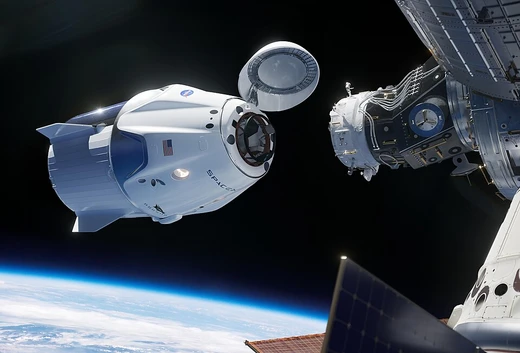
Inspiration4
First all-civilian orbital spaceflight, raising funds for St. Jude.

Inspiration4 (stylized as Inspirati④n) was a private spaceflight that took place in 2021, operated by SpaceX and funded by Shift4 Payments CEO Jared Isaacman. The mission launched on September 16, 2021, at 00:02:56 UTC from Kennedy Space Center's Launch Complex 39A, using a Falcon 9 rocket to carry the Crew Dragon capsule Resilience into low Earth orbit. The flight concluded on September 18, 2021, at 23:06:49 UTC with a splashdown in the Atlantic Ocean. It marked the first orbital mission crewed entirely by private individuals and supported St. Jude Children's Research Hospital in Memphis, Tennessee.
Isaacman served as mission commander. St. Jude selected two commercial astronauts: cancer survivor Hayley Arceneaux and military veteran Christopher Sembroski. Shift4 Payments chose entrepreneur Sian Proctor, who acted as pilot. The mission coincided with the 55th anniversary of Gemini 11, which in 1966 reached an apogee of about 1,368 kilometers (850 miles)—the highest crewed Earth orbit until Polaris Dawn in 2024, another SpaceX mission for Isaacman. Inspiration4 reached an altitude of roughly 585 kilometers (364 miles), making it one of the higher crewed Earth orbits in recent decades, though not the highest since STS-103 in 1999, as several other missions have exceeded that altitude. For comparison, the International Space Station orbits at 408 kilometers (254 miles). The mission also featured the first crewed Atlantic Ocean splashdown since Apollo-Soyuz in 1975.
The crew, nicknamed amateur astronauts, aimed to raise over US$100 million for St. Jude's childhood cancer research. Isaacman and his wife Monica personally donated US$125 million, and contributions from SpaceX founder Elon Musk (US$55 million) and others brought the total to more than US$243 million. Isaacman, an experienced pilot qualified in military jets, procured the flight and its four seats from SpaceX, donating two to St. Jude. Hayley Arceneaux, a physician assistant at the hospital and bone cancer survivor, was chosen by St. Jude. The second seat was raffled as part of the St. Jude Mission: Inspired campaign, which sought US$200 million. Entrants had to be U.S. citizens and donate between US$10 and US$10,000. Kyle Hippchen, from Embry–Riddle Aeronautical University, donated US$600 and won the raffle but gave the seat to his friend Christopher Sembroski, a U.S.
Quick Facts
- Mission Type
- Private spaceflight
- Operator
- SpaceX
- Spacecraft Type
- SpaceX Crew Dragon
- Launch Mass
- 12519 kg
- Landing Mass
- 9616 kg
- Crew Members
- Jared Isaacman · Sian Proctor · Hayley Arceneaux · Christopher Sembroski
- Launch Date
- September16, 2021, 00:02:56UTC (September15, 10:02:56pmEDT)
- Launch Rocket
- Falcon 9 Block 5 B1062-3
- Launch Site
- Kennedy, LC39A
- Recovery By
- GO Searcher
- Landing Date
- September18, 2021, 23:06:49UTC (07:06:49pmEDT)
- Landing Site
- Atlantic Ocean, near Cape Canaveral, Florida (28.8 · N · 80.3 · W)
Facts from the source article.
Lore & Background
Inspiration4 was led by Shift4 Payments CEO Jared Isaacman, who procured the flight and its four seats from SpaceX and donated two seats to St. Jude Children's Research Hospital. The hospital selected cancer survivor Hayley Arceneaux and military veteran Christopher Sembroski as commercial astronauts. Shift4 selected entrepreneur Sian Proctor through a competition modeled after Shark Tank. The crew included Isaacman as mission commander and Proctor as pilot. All four received commercial astronaut training by SpaceX, including lessons in orbital mechanics, microgravity operations, stress testing, emergency-preparedness, and mission simulations. The mission overlapped with the 55th anniversary of Gemini 11 and reached an orbital altitude of approximately 585 km, a notable altitude for a private mission, though not the highest since STS-103 in 1999.
Reader's Guide
Inspiration4 marked a significant milestone as the first orbital spaceflight crewed entirely by private citizens, demonstrating the growing role of commercial spaceflight in human space exploration. The mission's charitable component, raising over US$243 million for St. Jude Children's Research Hospital, highlighted the potential for space missions to drive philanthropic efforts. The flight also achieved a notable orbital altitude of 585 km, exposing the crew to different radiation levels than those on the International Space Station and contributing to research on the effects of spaceflight on human health. The mission's use of a modified Crew Dragon with a domed cupola window and its all-rookie crew—the first since Shenzhou 7 in 2008—underscored the shift toward broader access to space. Inspiration4's success paved the way for subsequent private missions, including Polaris Dawn, also operated by SpaceX on behalf of Isaacman.
Did You Know?
- Inspiration4 was the first orbital spaceflight with only private citizens aboard.
- The spacecraft's docking adapter was replaced by a domed plexiglass window inspired by the Cupola module.
- The crew splashed down in the Atlantic Ocean, the first crewed splashdown there since Apollo 9 in 1969.
The Four Who Reached Orbit
Unlike any crew before them in the commercial era, the four people aboard Resilience had never flown in space. Jared Isaacman, a military jet-qualified pilot and the chief executive of Shift4 Payments, took the commander's seat and the call sign 'Rook.' Beside him sat Sian Proctor, an entrepreneur who earned her pilot's seat by pitching a business idea to a panel that included Salesforce CEO Marc Benioff, Fast Company editor Stephanie Mehta, former NASA engineer Mark Rober, and Bar Rescue host Jon Taffer. Her call sign was 'Leo.' Hayley Arceneaux, a physician assistant at St. Jude and a bone-cancer survivor, was hand-picked by the hospital and flew as 'Nova.' The fourth seat belonged to Christopher Sembroski, a U.S. Air Force veteran who received the spot from raffle winner Kyle Hippchen of Embry–Riddle Aeronautical University, who was over the weight limit and chose to pass it along. Sembroski's call sign was 'Hanks.' All four completed SpaceX's commercial astronaut curriculum covering orbital mechanics, microgravity operations, stress testing, emergency procedures, and full mission simulations. It marked the first all-rookie orbital crew since China's Shenzhou 7 in 2008, and the first since NASA's STS-2 in 1981.
A Charity That Rewrote the Fundraising Record
The stated goal was ambitious: raise one hundred million dollars to expand St. Jude Children's Research Hospital's childhood cancer work in Memphis, Tennessee. What actually materialized was more than double that figure. Isaacman and his wife Monica opened the campaign with a personal gift of one hundred twenty-five million dollars. SpaceX founder Elon Musk added fifty-five million. When the dust settled, the total delivered to St. Jude surpassed two hundred forty-three million dollars. The hospital itself wove the mission into its own fundraising strategy, launching a campaign called St. Jude Mission: Inspired aimed at two hundred million dollars. As part of that effort, St. Jude raffled one of the four seats. Entrants needed U.S. citizenship and a donation anywhere from ten to ten thousand dollars. Kyle Hippchen, a student at Embry–Riddle Aeronautical University, won with a six-hundred-dollar entry but, finding he exceeded the spacecraft's weight allowance, handed the seat to fellow entrant Christopher Sembroski, who had chipped in fifty dollars. The raffle turned a spaceflight into a community act of generosity, and the final tally proved that the orbit was only the most visible part of the mission's purpose.
Resilience Redefined: A Cupola Where a Docking Port Used to Be
Resilience had already flown once, carrying the Crew-1 team to the International Space Station. For Inspiration4, SpaceX swapped out the docking adapter and installed a single, monolithic, multi-layer domed plexiglass window modeled on the station's Cupola module. The result gave the crew uninterrupted three-hundred-sixty-degree views through the nose of the capsule. During launch and re-entry the dome was shielded by the spacecraft's retractable nosecone, which also carried a custom camera for filming both the interior and exterior of the vehicle. Because four Draco thrusters sit on the nose, engineers bolted four heat-shield tiles to the outside of the plexiglass to keep engine exhaust from scorching it during propulsive maneuvers. The cupola is designed to be removed, so Resilience can be reconfigured for future docking missions. Orbitally, the flight reached roughly five hundred eighty-five kilometers, the highest crewed altitude since STS-103 in 1999 and the fifth-highest ever, well above the station's four-hundred-eight-kilometer home. It was also the first crewed orbital flight since STS-125 in 2009 that never visited a space station, and the first crewed splashdown in the Atlantic since Apollo 9 in 1969.
Two Days in Orbit: A Flight Written for Ordinary Bodies
Resilience lifted off from Kennedy Space Center's Launch Complex 39A at 00:02:56 UTC on September 16, 2021, riding Falcon 9 Block 5 booster B1062 on its third flight. The capsule entered a fifty-one-point-six-degree inclination, coincidentally the same orbital plane as the International Space Station. At that moment three Dragon spacecraft were circling Earth simultaneously: Endeavour with Crew-2, C208 with CRS-23, and Resilience with its four civilians. The mission was scheduled to run until September 18, when Resilience splashed down in the Atlantic at 23:06:49 UTC. Aboard, the crew carried individual call signs—Rook, Leo, Nova, and Hanks—and a science plan designed around the fact that none of them were professional astronauts. Planned experiments included ultrasounds, microbe sampling, fluid-shift tracking, ECG recordings, blood-oxygen monitoring, and heart-rate logging on bodies that had not undergone the exhaustive medical screening typical of government crews. The most poetic moment came at engine cutoff: Arceneaux pulled a small plush therapy-dog toy from a pouch on her leg, and as it drifted free above her head on its tether, it served as the mission's zero-gravity indicator, confirming to all four that they were truly in space.
Frequently Asked Questions
What is Inspiration4?
Inspiration4 was a privately funded orbital spaceflight carried out by SpaceX in September 2021. It sent four non-astronaut civilians on a roughly two-day journey to low Earth orbit and back.
Who paid for and led the Inspiration4 mission?
Jared Isaacman, the chief executive of Shift4 Payments, bankrolled the entire flight and also served as its commander. He was the driving force behind assembling the crew and securing the mission.
Why is Inspiration4 considered a milestone in spaceflight history?
It was the first time a group of purely private citizens reached orbit without any professional astronauts among them. No government agency mission or commercial astronaut program had done that before.
What rocket and capsule carried the Inspiration4 crew?
A Falcon 9 rocket launched the Crew Dragon capsule named Resilience from Launch Complex 39A at Kennedy Space Center. The vehicle reached an orbital altitude of about 585 kilometers before returning to Earth.
What charitable cause did Inspiration4 support?
The mission was tied to a fundraising effort for St. Jude Children's Research Hospital in Memphis, Tennessee. The flight helped raise awareness and donations for pediatric cancer research and treatment.
More in SpaceX human spaceflights 1-24
Spotted an error? Know more?
Reader corrections go straight into our review queue. Suggest an edit · How this site is sourced