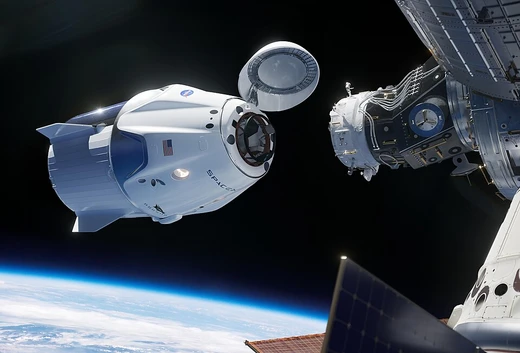
SpaceX Crew-1
First operational Crew Dragon flight to the International Space Station.

SpaceX Crew-1 (also known as USCV-1 or simply Crew-1) was the first operational crewed flight of a Crew Dragon spacecraft and the maiden flight of the Crew Dragon Resilience spacecraft. It was the second overall crewed orbital flight of the Crew Dragon and the second crewed orbital flight launch by the United States since STS-135 in July 2011. The mission launched on November 16, 2020, carrying NASA astronauts Mike Hopkins, Victor Glover, and Shannon Walker, along with JAXA astronaut Soichi Noguchi, all members of the Expedition 64 crew.
Quick Facts
- Names List
- USCV-1 (2012–2019) · Crew-1
- Mission Type
- ISS crew transport
- Operator
- SpaceX
- Spacecraft Type
- SpaceX Crew Dragon
- Launch Mass
- 12519 kg
- Landing Mass
- 9616 kg
- Crew Size
- 4
- Crew Members
- Mike Hopkins · Victor Glover · Soichi Noguchi · Shannon Walker
- Crew Expedition
- Expedition 64/65
- Launch Rocket
- Falcon 9 Block 5 B1061-1
- Launch Site
- Kennedy, LC39A
Facts from the source article.
Lore & Background
On launch day, November 15, 2020, the hatch was closed at 22:32 UTC but briefly reopened due to a pressure drop caused by foreign object debris in the seal; after troubleshooting, the hatch was closed again and the countdown proceeded. Resilience lifted off at 00:27:17 UTC on November 16, 2020. The Falcon 9 first-stage booster landed on the drone ship Just Read the Instructions. The crew used a plush toy of 'The Child' (Baby Yoda) as a Zero-G indicator and were awakened on the second day with Phil Collins's 'In the Air Tonight'. Resilience docked to the International Docking Adapter on the Harmony module on November 17, 2020, at 04:01 UTC. The astronauts lived and worked with the Soyuz MS-17 crew as part of ISS Expedition 64. On April 5, 2021, they relocated their spacecraft to make way for Crew-2. The mission departed the ISS on April 28, 2021, but due to weather returned on May 2, 2021, splashing down at 06:56:33 UTC—the first nighttime splashdown for NASA astronauts since Apollo 12 in 1969. The capsule was later reused on Crew-2. On February 8, 2021, Crew-1 broke the record for longest U.S. crewed vehicle spaceflight, surpassing the 84-day mark set by Skylab-4 on February 8, 1974. In July 2022, debris from the Crew-1 trunk was reported to have crashed into a farm in Australia.
Reader's Guide
SpaceX Crew-1 marked a pivotal transition in U.S. human spaceflight, becoming the first operational mission under NASA's Commercial Crew Program after years of development and testing. By launching the first operational Crew Dragon flight, it restored the United States' capability to send astronauts to the International Space Station on American-built spacecraft, ending a near-decade-long reliance on Russian Soyuz vehicles following the Space Shuttle's retirement. The mission demonstrated the maturity of SpaceX's crew transportation system, including the Falcon 9 rocket and Crew Dragon Resilience, and set a new endurance record for a U.S. crewed vehicle at over 84 days. Its success paved the way for regular crew rotation flights, as signaled by NASA's approval on November 10, 2020. The mission also highlighted international collaboration, carrying a JAXA astronaut as part of the Expedition 64 crew. The nighttime splashdown, the first for NASA astronauts since Apollo 8, and the subsequent reuse of the capsule on Inspiration4 underscored the program's operational and cost-saving goals. Crew-1's legacy lies in establishing a sustainable, commercial model for human spaceflight to low Earth orbit.
Engineering a Compact Reentry Vehicle
Starfall takes the form of a flat, circular disk roughly three and a half feet tall and ten feet across, giving it a deliberately low and wide profile for stable atmospheric descent. At just over two metric tons empty, the capsule is compact enough to be stowed aboard either a Falcon 9 or a Starship payload bay, yet its internal cargo compartment—measuring about eight feet by five feet by eighteen inches—can accommodate up to a thousand kilograms of goods. The total fully loaded mass hovers near 3,100 kilograms. Structurally, the vehicle is split into two principal elements: a top plate housing maneuvering thrusters for attitude control, and a detachable heat shield that is jettisoned just before the parachute-assisted splashdown phase. SpaceX drew on lessons learned from both the Dragon capsule program and the thermal-protection work done for Starship, blending the heritage of crewed reentry with the high-speed reentry challenges of a much larger vehicle. The result is a purpose-built, uncrewed return vehicle optimized for one job: bringing smaller, high-value cargo back through the atmosphere and onto the ocean surface.
Mission Profile and Recovery Operations
Once in orbit, Starfall is not bound by a strict clock. The capsule can loiter in space for an indefinite period, waiting for the optimal window to begin its descent. When reentry is initiated, the vehicle follows a pre-planned trajectory through the atmosphere rather than executing a free-fall or ballistic arc. For the initial demonstration flights, the splashdown point is set roughly 1,300 kilometers west of the United States or Mexican coastline, placing the recovery zone in the open Pacific. After the heat shield separates and the parachutes deploy, recovery teams head out to retrieve three separate items from the water: the capsule itself, the discarded heat shield, and the parachute assemblies. This multi-item retrieval is a deliberate part of the test plan, ensuring every component can be accounted for and inspected. Looking ahead, SpaceX envisions a single Starship launch placing multiple Starfall units into orbit simultaneously, each on its own independent return schedule. The operational model also leaves room for expansion into true point-to-point cargo delivery, where goods manufactured on Earth could be shipped to another location via a brief orbital detour rather than a conventional ground or sea route.
Applications: From Pharma to Fast Resupply
Starfall is aimed at two broad categories of cargo that existing systems do not address efficiently. The first is rapid point-to-point delivery of critical goods on compressed timelines. Because the capsule needs no landing pad or runway—only open water for splashdown—it can serve destinations that lack aerospace infrastructure. The second application is the return of products manufactured in microgravity. Certain materials, including single-crystal optical fiber and potentially bio-printed human organs, simply cannot be produced under Earth's gravity, making orbital fabrication a necessity rather than a luxury. Pharmaceutical manufacturing is another area where the absence of gravity changes what is chemically and structurally possible. On the defense side, the U.S. Air Force has shown interest in fast global resupply, and SpaceX's broader Rocket Cargo contracts target deliveries up to 100 tons, though Starfall itself occupies the smaller-capacity end of that spectrum. The vehicle thus fills a niche: too small for Starship's heavy-lift cargo bays, yet too specialized for conventional logistics, and uniquely suited to the final leg of orbital commerce.
Development Path and the Starship Partnership
The existence of Starfall first became public through filings submitted to the Federal Aviation Administration in 2026. On May 15 of that year, the FAA granted final environmental approval for two test missions, specifically designed to validate reentry dynamics, splashdown procedures, and recovery operations. These flights are a prerequisite step before SpaceX can pursue full safety licensing for routine Starfall operations. The first demonstration mission lifted off atop a Falcon 9 rocket on June 23, 2026, marking the capsule's maiden flight. Strategically, Starfall was conceived as the complementary half of a two-part system. Starship handles the heavy-lift leg, ferrying up to 100 metric tons or more to low Earth orbit in reusable configuration, with its own heat shield built for rapid turnaround and even mechanical catch by launch-tower arms. Starfall, by contrast, is the precision return vehicle for smaller, higher-value payloads that must come back intact. Together they form a closed loop: Starship puts cargo and manufacturing assets into orbit, and Starfall brings the finished products home.
Frequently Asked Questions
What was SpaceX Crew-1?
Crew-1 (also called USCV-1) was the first fully operational crewed mission flown on a Crew Dragon capsule, delivering four astronauts to the International Space Station. It marked the maiden voyage of the specific vehicle named Resilience (C207) and served as the second crewed orbital launch from the United States since the Space Shuttle era ended with STS-135.
Who were the astronauts on SpaceX Crew-1?
The four-person crew consisted of NASA's Mike Hopkins, Victor Glover, and Shannon Walker, joined by JAXA's Soichi Noguchi. All four were assigned to Expedition 64 aboard the ISS.
When did SpaceX Crew-1 launch and splash down?
The mission lifted off from Kennedy Space Center's LC-39A pad at 00:27 UTC on November 16, 2020. The crew returned to Earth and splashed down in the Gulf of Mexico on May 2, 2021, after roughly five and a half months in orbit.
Why do fans consider SpaceX Crew-1 a milestone?
It proved that Crew Dragon could handle a full operational crewed rotation to and from the ISS without any test-flight constraints, effectively handing SpaceX a seat at the table for routine human spaceflight. For many fans it also symbolized the return of American crewed orbital launches after a nearly nine-year gap following the Shuttle's final mission.
How is SpaceX Crew-1 different from the earlier Demo-2 mission?
Demo-2 in 2019 was a technology-demonstration flight designed to validate the system, whereas Crew-1 was the first mission treated as a standard operational rotation with a full ISS stay and a planned return. In practice the two flew very similar profiles, but Crew-1 carried the weight of being the program's first 'real' job.
More in SpaceX human spaceflights 1-24
Spotted an error? Know more?
Reader corrections go straight into our review queue. Suggest an edit · How this site is sourced