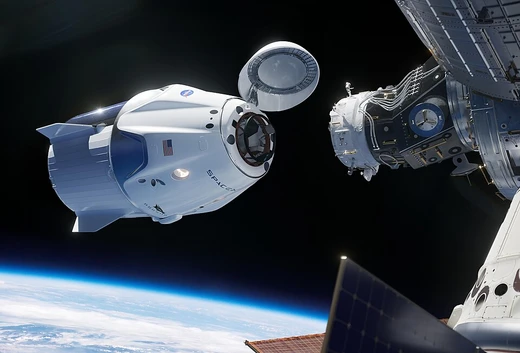
Axiom Mission 5
Upcoming private Axiom Space mission to the ISS.

Axiom Mission 5 (Ax-5) is a forthcoming private crewed flight to the International Space Station, operated by Axiom Space aboard a SpaceX Crew Dragon. The mission is expected to launch no earlier than January 2027 and will last roughly two weeks.
Like earlier Axiom flights, Ax-5 will help develop procedures for Axiom’s private astronauts to dock with the company’s own planned space station, Axiom Station. Revenue from the contract, along with a restructuring of Axiom’s debt, will support the company’s development of an Extravehicular Mobility Unit for NASA, intended for use on the Moon during the Artemis IV landing.
The crew will consist of one professionally trained commander and three private astronauts. When the mission was announced, Axiom stated it would submit four crew proposals to NASA, which would make the final selection.
Quick Facts
- Names List
- Ax-5
- Mission Type
- Private spaceflight to the ISS
- Operator
- Axiom Space · SpaceX
- Mission Duration
- 14–21 days (planned)
- Spacecraft Type
- SpaceX Crew Dragon
- Manufacturer
- SpaceX
- Crew Size
- 4
- Crew Members
- TBA · TBA · TBA · TBA
- Launch Date
- NET · no earlier than January 2027
- Launch Rocket
- Falcon 9 Block 5
- Launch Site
- Cape Canaveral, SLC40
- Recovery By
- Shannon (planned)
Facts from the source article.
Lore & Background
Axiom Mission 5 is a planned private crewed flight to the International Space Station, operated by Axiom Space. The mission is targeted to launch no earlier than January 2027 and will spend 14 days at the ISS.
The mission will carry a professionally trained commander and three private astronauts. When the mission was announced, Axiom Space said it would submit four different crew proposals to NASA, which would make the final crew selection. Ax-5, as with prior missions, will develop techniques required for Axiom-employed private astronauts to dock with their own private space station, the in-development Axiom Station.
Reader's Guide
Axiom Mission 5 represents a continuation of NASA's strategy to open the International Space Station to private commercial missions, with Axiom Space as the primary operator. The mission's significance lies in its role as a stepping stone toward Axiom's long-term goal of operating its own private space station, Axiom Station. By developing docking techniques and operational procedures for private astronauts, Ax-5 helps lay the groundwork for a future commercial low-Earth orbit economy. Additionally, funds from the awarded contract, alongside a restructuring of Axiom's debt, will help finance Axiom's development of an Extravehicular Mobility Unit for NASA, intended for use on the Moon during the Artemis IV lunar landing. The mission also highlights the growing involvement of national governments—such as the Czech Republic, Portugal, the United Kingdom, and Argentina—in securing crewed flight opportunities through private providers. Ax-5's crew selection process, with NASA making the final choice from four proposals submitted by Axiom, underscores the collaborative and competitive nature of the emerging private spaceflight sector.
A Crew of Firsts and Flight Testers
All four members of the Ax-3 crew shared one unifying trait: each had served as a military pilot before turning their skills toward orbital flight. At the helm, Michael López-Alegría commanded the mission in his capacity as an Axiom Space employee, while Walter Villadei, a veteran of the Italian Air Force, handled the mission pilot role. The two mission specialist seats brought national firsts to the station. Alper Gezeravcı made history as the first astronaut ever to represent Turkey in space, a milestone for a nation that had long aspired to send its own citizens to orbit. Marcus Wandt, a Swedish project astronaut, became the first ESA astronaut to be launched by a private space provider and the first member of the 2022 European Space Agency astronaut cohort to receive an actual flight assignment. Together, the quartet represented four nations and a blend of institutional and private-sector pathways into orbit, all bound by the common thread of disciplined flight-test experience.
Ravens of the North: The Muninn Story
The Swedish element of Ax-3 carried a name drawn from Norse mythology: Muninn, one of the two ravens that perched on the shoulder of the god Odin. In the old sagas, Muninn and its companion Huginn together embodied the human mind—memory and thought as a pair. The naming was no mere decoration. When Wandt lifted off, Danish astronaut Andreas Mogensen was already aboard the station, having flown as part of the Huginn mission on SpaceX Crew-7. For the first time in history, two Scandinavian astronauts were simultaneously in orbit, their missions linked by the mythological pair of ravens. The mission patch captures this narrative: Muninn is depicted gliding around a dark blue circle representing Earth, its lighter internal lines tracing the outline of Sweden. The image conveys the raven's purpose—carrying knowledge gathered in the void back to the ground, just as the mythological bird returned to Odin with the news of the world.
Laboratory Above the Clouds
Wandt's time aboard the station was densely packed with research and outreach. Over the course of the 21-day flight, he carried out twenty distinct experiments and took part in five educational programs, giving the mission a strong science-and-education dual focus. Among the investigations was a study into how the physical design of a space habitat influences astronaut stress levels, a question with direct implications for how future crewed environments are shaped. Other experiments probed the biological side of microgravity, examining how cellular structures shift and how gene expression changes when the body is no longer subject to Earth's pull. The breadth of the work, spanning psychological, architectural, and molecular biology questions, underscored the value of short-duration private crew rotations as a platform for rapid, focused research. The educational programs further extended the mission's reach, connecting the experiments to classrooms and the public in ways that kept the science visible and accessible throughout the flight.
From Pad to Ocean: The Flight Envelope
The operational arc of Ax-3 ran from a January 18, 2024, liftoff at Launch Complex 39A in Florida to a February 9 splashdown in the Atlantic Ocean, a total of 21 days in orbit. The vehicle was a SpaceX Crew Dragon, launched atop a Falcon 9 rocket. The first stage, booster B1080, was a veteran airframe that had previously carried Axiom-2 and other high-profile missions, making this flight another chapter in the booster's reuse record. Axiom Space operated the mission as a private spaceflight to the International Space Station, with the crew docking to the station after ascent. The original plan called for roughly two weeks aboard, but the final duration stretched to three weeks, giving the crew additional time for their experimental and educational work. The return leg ended with the Crew Dragon ocean recovery, bringing the four military-pilot crew members safely back to Earth and closing out a tightly scheduled, multi-nation, science-heavy private rotation.
Frequently Asked Questions
What is Axiom Mission 5 (Ax-5)?
Ax-5 is a privately funded crewed flight to the International Space Station, organized by Axiom Space and flown on a SpaceX Crew Dragon capsule. It is slated to last roughly two weeks while docked at the station.
When is Axiom Mission 5 expected to launch?
The earliest launch window is set at January 2027, though a firm date has not yet been confirmed. Fans should expect the schedule to shift as Axiom locks in its crew and operational timeline.
Who flies on Axiom Mission 5?
The crew consists of one professionally trained commander plus three private astronauts, mirroring the composition of earlier Axiom ISS visits. Individual names have not been publicly detailed in the available mission documentation yet.
Why does Axiom Mission 5 matter beyond just another ISS trip?
It acts as a practical rehearsal for Axiom's private astronauts to master docking and station-keeping procedures ahead of flying to the company's own Axiom Station. The contract revenue also helps Axiom restructure its debt and fund development of a lunar EVA suit for NASA.
Is Axiom Mission 5 a SpaceX mission or an Axiom mission?
It is an Axiom Space mission that uses SpaceX hardware—the Crew Dragon capsule and Falcon 9 rocket—to reach orbit and dock with the ISS. SpaceX provides the launch and spacecraft, while Axiom handles mission planning, crew selection, and the on-orbit program.
More in SpaceX human spaceflights 1-24
Spotted an error? Know more?
Reader corrections go straight into our review queue. Suggest an edit · How this site is sourced