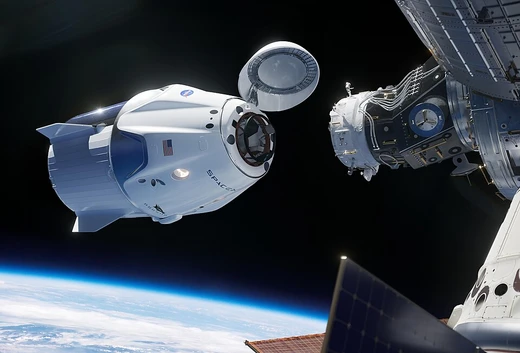
Axiom Mission 1
First wholly commercial crewed mission to the ISS.

Axiom Mission 1 (Ax-1) was a privately funded and operated crewed mission to the International Space Station (ISS), operated by Axiom Space from its Mission Control Center in Houston, Texas. Launched on April 8, 2022, from Kennedy Space Center in Florida aboard a SpaceX Crew Dragon, it was the first wholly commercially operated crewed mission to the ISS and one of the first dedicated orbital private crew missions.
Quick Facts
- Names List
- Ax-1
- Mission Type
- Private spaceflight to the ISS
- Operator
- Axiom Space · SpaceX
- Spacecraft Type
- SpaceX Crew Dragon
- Manufacturer
- SpaceX
- Launch Mass
- 12519 kg
- Landing Mass
- 9616 kg
- Crew Size
- 4
- Crew Members
- Michael López-Alegría · Larry Connor · Eytan Stibbe · Mark Pathy
- Launch Rocket
- Falcon 9 Block 5 B1062-5
Facts from the source article.
Lore & Background
Axiom Space was founded in 2016 with the goal of creating the world's first commercial space station. In early 2020, NASA granted Axiom access to the forward port of the ISS's Harmony module, where Axiom plans to berth the first node of the Axiom Orbital Segment. Prior to the first module's launch as early as 2024, Axiom organized crewed missions to the ISS consisting of paying private astronauts or astronauts from public agencies or private organizations. In March 2020, Axiom announced they would charter a flight with SpaceX's Crew Dragon spacecraft as early as late 2021.
The crew consisted of Michael López-Alegría, a Spaniard-American professionally trained astronaut hired by Axiom, and three space tourists: Eytan Stibbe from Israel, Larry Connor from the United States, and Mark Pathy from Canada. The mission launched atop a Falcon 9 Block 5 from Launch Complex 39A, a NASA-owned pad leased to SpaceX. The spacecraft spent less than a day in transit to the ISS and docked with Harmony, where the crew spent 16 days docked (total 17 days in orbit) due to bad weather delaying return. The zero-g indicator was a toy dog called Caramel, mascot for the Montreal Children's Hospital Foundation.
Reader's Guide
Axiom Mission 1 marked a significant milestone in commercial spaceflight as the first wholly privately operated crewed mission to the International Space Station. It demonstrated the viability of private companies managing end-to-end crewed missions, including mission control, crew selection, and spacecraft operations. The mission carried over 25 research experiments, including the Israeli Rakia Mission segment, which conducted scientific and artistic projects. The Rakia Mission included experiments such as the Fluidic Telescope (FLUTE) for manufacturing lenses in microgravity, the ILAN-ES atmospheric research project observing transient luminous events, brain.space EEG studies, CRISPR diagnostics, the AstroRad radiation vest test, and a flexible antenna demonstration. After the mission, Rakia transitioned into a Public Benefit Company focused on developing the Israeli space ecosystem, establishing the Israel Space Forum, Space Campus IL, cultural initiatives, and educational leadership. The mission also carried items for the Armstrong Air & Space Museum, including a John Glenn campaign button and a piece of Kapton foil from Apollo 11.
Did You Know?
- The zero-g indicator aboard Ax-1 was a toy dog named Caramel, the mascot for the Montreal Children's Hospital Foundation.
- Larry Connor carried a piece of Kapton foil removed from the Apollo 11 Command Module after splashdown.
- The Rakia Mission carried an art piece by Udi Edelman and Hadas Gur-Arie, plus 15 works by Israeli artists.
- Bad weather delayed the return, causing the crew to spend 16 days docked to the ISS instead of the planned 10.
Pioneering the Commercial Station Era
Axiom Mission 1 marked a watershed in human spaceflight history as the first crewed journey to the International Space Station entirely funded and directed by a private entity. The mission grew from Axiom Space's 2016 founding vision to build the world's first commercial space station. In early 2020, NASA granted the company access to the forward port of the Harmony module, a berth reserved for the first node of the Axiom Orbital Segment—a structure that could grow to five pressurized modules after 2024, featuring a large observation window similar to the existing Cupola on Tranquility's nadir side. Until that hardware reached orbit, Axiom planned a series of crewed flights to the station, chartering SpaceX's Crew Dragon as early as late 2021. Ax-1 thus served as both proof of concept and stepping stone, with the company intending to fly to the station as often as twice per year, aligned with NASA's availability. Alongside Roscosmos' Soyuz MS-20 in December 2021, it stood among the earliest dedicated private-crew orbital missions, signaling an era in which the station was no longer the exclusive domain of government space agencies.
A Crew Forged from Diverse Worlds
The Ax-1 crew of four reflected a deliberate blend of professional expertise and private ambition. Michael López-Alegría, a Spaniard-American and former NASA astronaut who also served as Axiom's vice president, was selected as the mission's professional commander. The remaining three seats were reserved for space tourists, each reportedly costing fifty-five million dollars: Eytan Stibbe of Israel, Larry Connor of the United States, and Mark Pathy of Canada. The backup roster was equally notable—Peggy Whitson, a former NASA astronaut and Axiom consultant, stood ready as backup commander, while John Shoffner, an airshow pilot and entrepreneur with no government astronaut training, was named backup pilot. Stibbe's backup was his own daughter, Dr. Shir Stibbe. The crew was publicly revealed on January 26, 2021, after a period of anticipation that followed the successful Crew Dragon Demo-2 test flight in May 2020. Rumors had also swirled around actor Tom Cruise and filmmaker Doug Liman as potential passengers for a movie project, though they ultimately deferred to a later Axiom flight. The international makeup of the crew—spanning Spanish-American, Israeli, American, and Canadian heritage—underscored the mission's global character.
From Pad to Splashdown
The mission lifted off at 11:17 a.m. Eastern Daylight Time on April 8, 2022, riding a Falcon 9 Block 5 rocket from Launch Complex 39A at Kennedy Space Center in Florida—a NASA-owned pad leased to SpaceX. The spacecraft was Crew Dragon Endeavour, a capsule with prior service on both the Demo-2 test flight and the Crew-2 mission. After less than a day of transit, the vehicle docked with the Harmony module, where the crew had planned to spend ten days. In orbit, they conducted more than twenty-five distinct research experiments. A charming detail emerged: the zero-gravity indicator for the first private crew visiting the station was a small toy dog named Caramel, the mascot of the Montreal Children's Hospital Foundation. Connor also carried three mementos for the Armstrong Air & Space Museum, including a John Glenn senatorial campaign button, a museum patch, and a fragment of Kapton foil salvaged from the Apollo 11 command module after its splashdown. The return was not without complication; bad weather in the Atlantic landing zone delayed undocking, stretching the docked stay to sixteen days and the total orbital duration to seventeen before splashdown.
Rakia: Science, Art, and Memory
The Israeli contribution to Ax-1 carried the name Rakia, meaning "sky" in Hebrew and echoing a book compiled from diary fragments of Ilan Ramon, who died in the 2003 Columbia disaster. A science committee led by Inbal Kreiss selected projects spanning medicine, astrophysics, and agriculture. Among the most ambitious was FLUTE, a Technion and NASA Ames collaboration to shape liquid polymers into optical lenses in microgravity, demonstrating the feasibility of manufacturing large telescopes in space. The ILAN-ES experiment, honoring Ramon, observed Transient Luminous Events—brief, high-altitude electrical discharges above thunderstorm clouds—building on the MEIDEX project he had flown aboard STS-107. After Ax-1, ILAN-ES became a recurring payload on Ax-2 and Ax-3, eventually evolving into the UHU experiment with the Hungarian Space Program. Brain.space monitored EEG signals to study neural adaptation to microgravity, while a CRISPR diagnosis study offered a proof-of-concept for gene-editing in orbit. Beyond hard science, fifteen works by Israeli artists, including Udi Edelman and Hadas Gur-Arie, were designed to function in or react to the weightless environment, exploring where human creativity meets the space setting.
Frequently Asked Questions
What is Axiom Mission 1?
Axiom Mission 1 (Ax-1) is a privately funded crewed flight to the International Space Station that lifted off on April 8, 2022. Four astronauts traveled to orbit and were managed by Axiom Space, a commercial operator based in Houston, Texas.
Which spacecraft launched Axiom Mission 1?
The crew rode a SpaceX Crew Dragon capsule called Endeavour, which launched from Kennedy Space Center in Florida.
Who was the mission operator for Ax-1?
Axiom Space handled all operations from its own Mission Control Center in Houston, making this a fully private endeavor rather than a NASA-led flight.
How long was Axiom Mission 1 in space?
The crew spent 17 days orbiting Earth before splashing down.
Why is Axiom Mission 1 a big deal in SpaceX history?
It was the first crewed ISS mission to be entirely privately funded, crewed, and operated, proving that a commercial entity could run a dedicated orbital flight without government mission control.
More in SpaceX human spaceflights 1-24
Spotted an error? Know more?
Reader corrections go straight into our review queue. Suggest an edit · How this site is sourced