STS-9
First Spacelab mission; first non-U.S. citizen on Shuttle.

NASA · Public domain
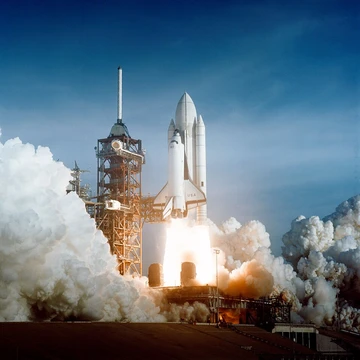
STS-9, known as Spacelab 1, was the ninth Space Shuttle mission overall and the sixth for the orbiter Columbia. It lifted off on November 28, 1983, and spent ten days in orbit with the first Spacelab laboratory module on board. This flight also saw the first non-U.S. citizen ride the Shuttle: Ulf Merbold of West Germany, who became the first European Space Agency astronaut and the first West German in space.
This mission was the last to use the original STS numbering system until STS-26, which was assigned after the Challenger disaster of STS-51-L. Note that STS-9 is not the same as STS-41-A, which was a separate mission launched in 1984. The flight originally planned to follow it, STS-10, was canceled due to payload problems; instead, STS-41-B came next. After STS-9, Columbia was pulled from service for upgrades and did not fly again until STS-61-C in early January 1986.
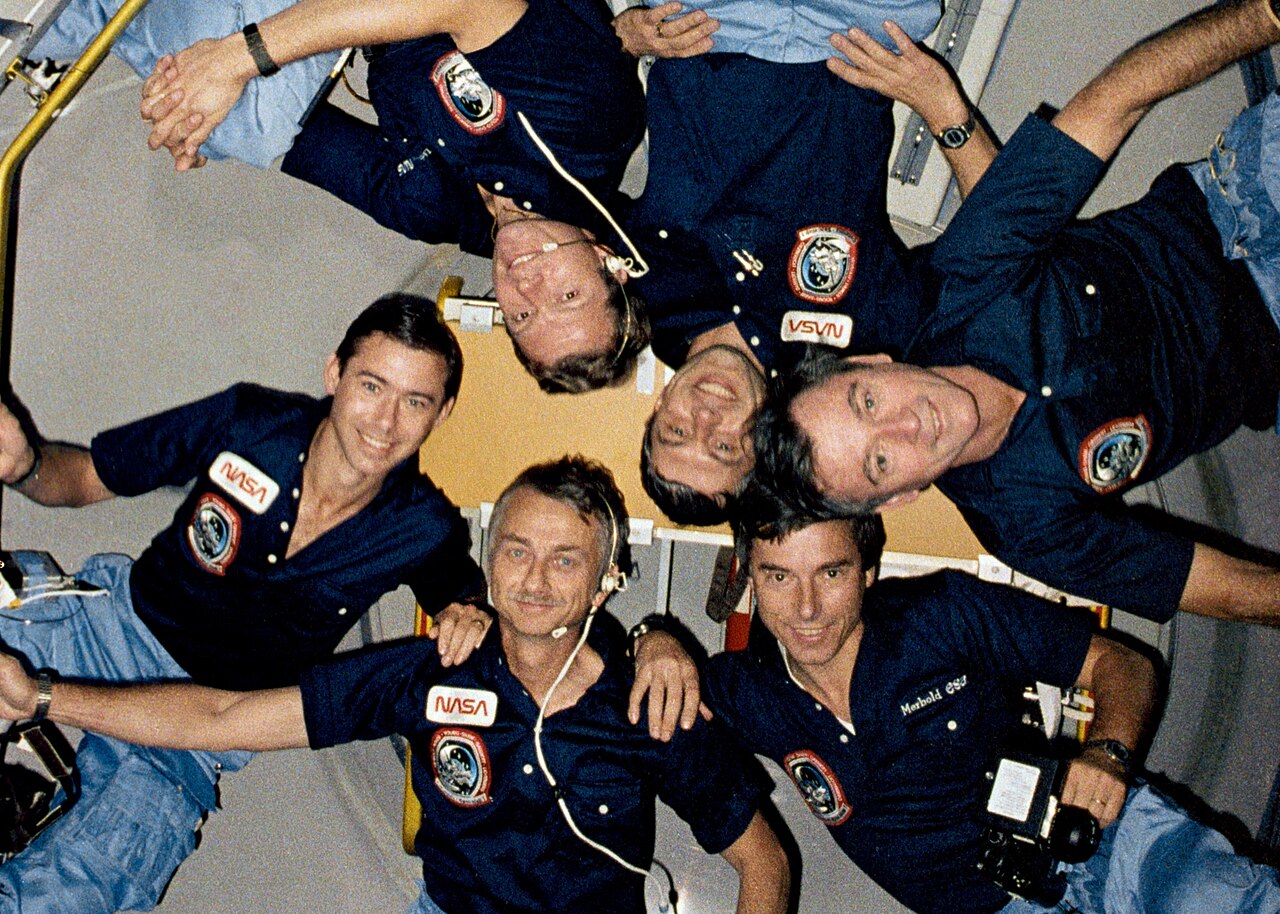
The crew of six was the largest ever on a human spaceflight at the time. Commander John W. Young, on his sixth and final mission, was the most experienced space traveler to date, having flown twice each in Gemini, Apollo, and the Shuttle, including two trips to the Moon. He had also commanded Columbia on its first flight, STS-1, making him the first person to fly the same spacecraft into orbit more than once. Pilot Brewster H. Shaw, mission specialists Owen K. Garriott and Robert A. Parker, and payload specialists Byron K. Lichtenberg and Merbold rounded out the team. Garriott had previously spent 56 days on Skylab in 1973. Lichtenberg was a researcher from MIT. This was the only Shuttle mission to include two pre-Shuttle era veterans (Young and Garriott), and the first Shuttle flight with more than one veteran astronaut.
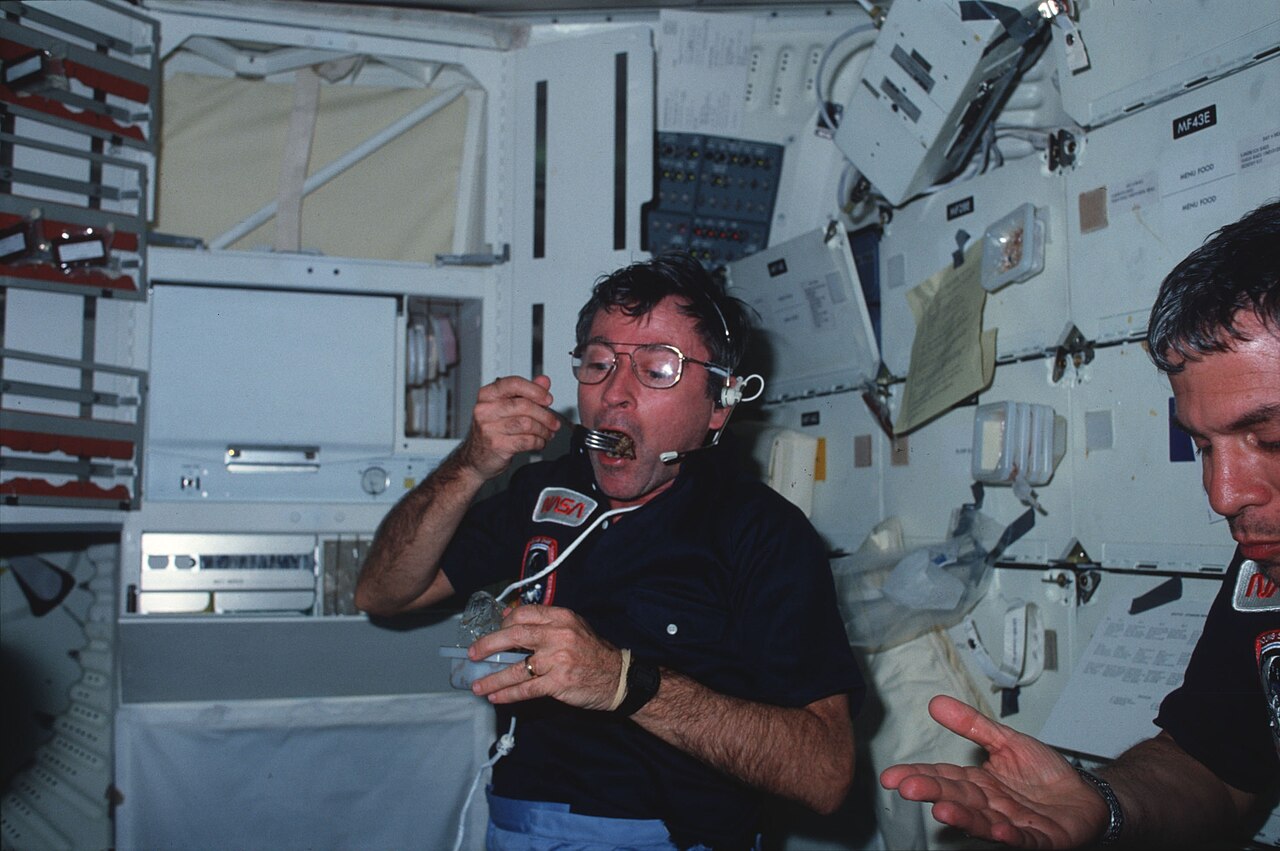
The entire mission focused on Spacelab 1, a joint NASA and European Space Agency program funded by the ESA. The crew worked in two 12-hour shifts: the Red Team (Young, Parker, Merbold) and the Blue Team (Shaw, Garriott, Lichtenberg). They coordinated with scientists at the Marshall Space Flight Center’s Payload Operations Control Center, then located at Johnson Space Center in Texas.
Before launch, Columbia underwent extensive modifications after STS-5, including a tunnel to the Spacelab, a galley, sleeping bunks, more powerful main engines rated for 104% thrust, higher-capacity fuel cells, and a Ku-band antenna for the Tracking and Data Relay Satellite.
Quick Facts
- Names List
- Space Transportation System-9 / Spacelab 1
- Mission Type
- Microgravity research
- Operator
- NASA
- Distance Travelled
- 6913504 km
- Orbits Completed
- 167
- Spacecraft
- 102
- Launch Mass
- 112918 kg
- Landing Mass
- 99800 kg
- Payload Mass
- 15068 kg
- Launch Site
- Kennedy, LC-39A
- Launch Contractor
- Rockwell International
Facts from the source article.
Lore & Background
During re-entry preparation, two flight control computers crashed due to a solder defect caused by thruster motion. Commander Young later stated that activating the Backup Flight Software would have resulted in loss of vehicle and crew, but the landing occurred on schedule as planned. Columbia landed safely at Edwards Air Force Base on December 8, 1983. After landing, two auxiliary power units caught fire due to a hydrazine leak, but the orbiter landed successfully. Columbia was then taken out of service for extensive renovations and did not fly again until STS-61-C in early 1986.
Reader's Guide
STS-9 was a landmark mission for international cooperation in space, demonstrating that complex scientific research could be conducted in orbit with non-NASA specialists. It was the first flight of the Spacelab module, a reusable laboratory that paved the way for later scientific missions. The mission also highlighted the risks of shuttle computer systems, as a solder defect nearly caused a catastrophic failure during re-entry. The crew's size of six set a record for human spaceflight at the time. After STS-9, Columbia underwent major upgrades, and the original STS numbering system was retired until after the Challenger disaster. The mission's success validated the concept of payload specialists and the use of the Tracking and Data Relay Satellite for data relay.
Did You Know?
- STS-9 carried the first non-U.S. citizen on the Space Shuttle, Ulf Merbold of West Germany.
- The mission's six-member crew was the largest of any human space mission at the time.
- Commander John W. Young was the first person to fly the same space vehicle into orbit more than once.
- Two of Columbia's auxiliary power units caught fire due to a hydrazine leak after landing.
A Record-Breaking Career
Discovery's operational history stands as one of the most remarkable in the Space Shuttle program. Over a span of twenty-seven years, the orbiter completed thirty-nine separate launches and landings, a total that, as of December 2024, surpasses the flight count of any other spacecraft in history. Its duties ranged widely: it placed the Hubble Space Telescope into orbit and later returned twice to service and repair that iconic observatory. It also deployed the Ulysses solar probe and three Tracking and Data Relay Satellites for the United States. In the realm of station work, Discovery conducted both scientific research flights and critical assembly tasks for the International Space Station, and on May 27, 1999, it became the first shuttle to dock with the ISS during mission STS-96. When the program wound down, Discovery was the first operational orbiter to be retired, with Endeavour and Atlantis following in subsequent years.
Twice the Return-to-Flight Orbiter
Few spacecraft carry the weight of responsibility that Discovery bore on three separate occasions when the entire shuttle program needed to prove itself safe again. After the tragic loss of Challenger in 1986, Discovery was selected as the vehicle to resume flights in 1988, carrying the program back from the brink of permanent cancellation. A second such burden fell upon it following the Columbia disaster of 2003; Discovery was chosen for both of the twin Return-to-Flight missions that flew in July 2005 and July 2006, restoring public and institutional confidence in the fleet. Between those somber chapters, Discovery also hosted a moment of pure inspiration: in 1998, Project Mercury veteran John Glenn, then seventy-seven years old, rode aboard STS-95 and became the oldest human ever to travel to space at that point in history. After the accidents that claimed Challenger and Columbia, Discovery stood as the oldest surviving member of the operational orbiter fleet, a living reminder of what had been lost and what still flew.
Engineering Distinctions and the Teardrop
From the moment Discovery rolled out of the factory, it carried subtle design differences that set it apart from its siblings. The orbiter was roughly 6,870 pounds lighter than Columbia when it entered service, a reduction achieved through lessons learned during the construction of Enterprise, Columbia, and Challenger. Part of that savings came from replacing some white LRSI thermal tiles with quilted AFRSI blankets on the fuselage, and from substituting graphite epoxy for aluminum in the payload bay doors and certain wing structural members. Compared to its later counterparts, Discovery is six pounds heavier than Atlantis and 363 pounds heavier than Endeavour, reflecting further weight trims made on those vehicles. Perhaps the most recognizable quirk is the cluster of black tiles near the middle starboard window where white tiles were expected. Whether a manufacturing slip or a deliberate flourish, the pattern—affectionately nicknamed the "teardrop"—gave Discovery a visual signature that allowed observers to identify it without reading its name, a small detail often missed by the uninitiated.
Final Wheels Stop and a New Chapter
Discovery's last flight, STS-133, began on February 24, 2011, and the orbiter touched down at Kennedy Space Center on March 9, bringing its cumulative time in orbit to nearly a full year across all missions. That same day marked its official decommissioning. After a month-long decontamination process, NASA offered the spacecraft to the Smithsonian's National Air and Space Museum for permanent public display, where it replaced Enterprise at the Steven F. Udvar-Hazy Center in Virginia. In April 2012, Discovery rode piggyback on a modified Boeing 747 to Washington Dulles International Airport, then was transferred to the Udvar-Hazy Center, where a welcome ceremony was held. At approximately 5:30 p.m., the orbiter was rolled to what was described as its "final wheels stop." Yet its story may not be entirely finished: in 2025, Texas senators John Cornyn and Ted Cruz inserted a provision into federal legislation allocating $85 million to relocate a crewed space vehicle, widely understood to be Discovery, back to Texas.
Gallery

Frequently Asked Questions
What is STS-9 and when did it fly?
STS-9, also called Spacelab 1, was the ninth flight in the Space Shuttle program and Columbia's sixth mission. It launched on November 28, 1983, and returned to Earth ten days later on December 8.
What made STS-9 a landmark mission?
It carried the very first Spacelab laboratory module into orbit, marking the debut of that joint U.S.-European research platform. It also put Ulf Merbold of West Germany aboard, making him the first non-U.S. citizen and the first ESA astronaut to ride the Shuttle.
How far did Columbia travel during STS-9?
Over its ten-day, 167-orbit flight, Columbia covered roughly 4.3 million miles (about 6.9 million km) around the Earth.
Why do fans note that STS-9's number is special?
After the Challenger loss on STS-51-L, NASA skipped ahead in its mission numbering, so STS-9 remained the last flight to use the original sequential STS numbering scheme until STS-26. It is also sometimes confused with STS-41-A, but the two are entirely separate missions.
What was the primary purpose of the Spacelab module on STS-9?
Spacelab 1 served as a pressurized laboratory where the crew could conduct extended scientific experiments in microgravity. The ten-day duration was deliberately set to give researchers enough time to run full experimental cycles inside the module.
More in Space Shuttle missions 1-24
Spotted an error? Know more?
Reader corrections go straight into our review queue. Suggest an edit · How this site is sourced