STS-1
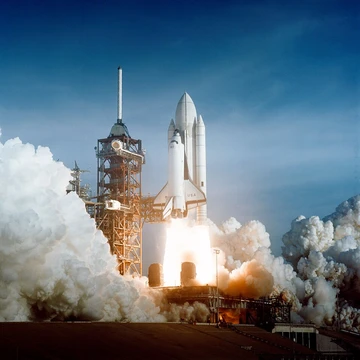
First orbital flight of NASA's Space Shuttle program.

NASA Photo by Carla Thomas. ke4roh rotated, cropped, and adjusted contrast. · Public domain
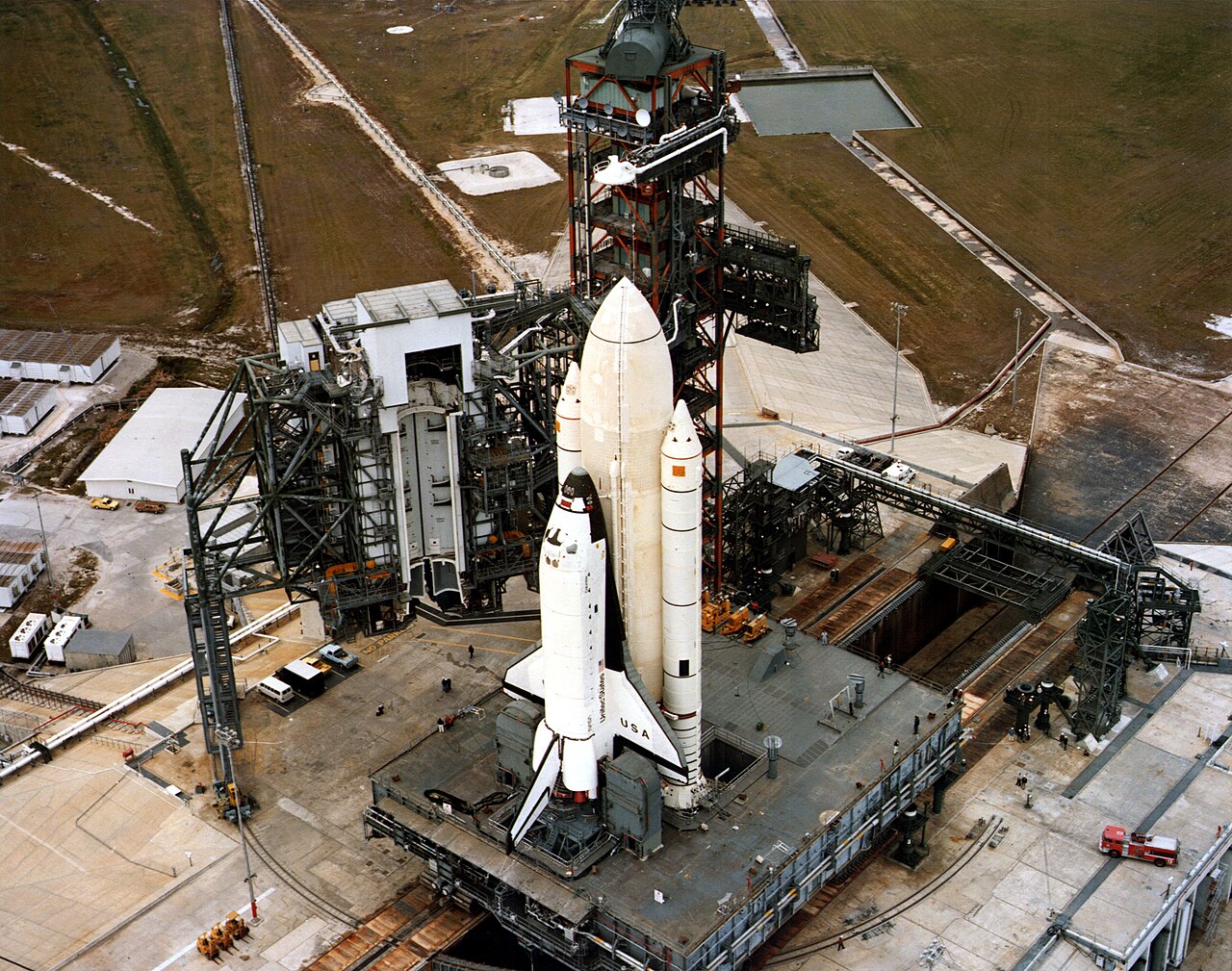
STS-1, short for Space Transportation System-1, kicked off NASA's Space Shuttle program as its first orbital mission. The orbiter *Columbia* lifted off on April 12, 1981, and touched down on April 14, 1981, after spending 54 hours, 20 minutes, and 52 seconds in space and circling Earth 36 times. On board were two astronauts: commander John W. Young and pilot Robert L. Crippen. This flight was the first time Americans had launched into space since the Apollo–Soyuz Test Project in 1975, and it served as the inaugural crewed test for a new U.S. spacecraft. While the Shuttle system had undergone atmospheric and ground tests, this was its first trip to orbit.
The launch date happened to fall on the 20th anniversary of Yuri Gagarin's Vostok 1 flight, the first human spaceflight, but that was a coincidence—a technical glitch had scrubbed the original attempt two days earlier.
Young and Crippen were picked for the crew in early 1978. Young, who was Chief of the Astronaut Office, admitted he recommended himself for the command. With four prior missions under his belt, he was NASA's most seasoned astronaut at the time. He had flown twice on Gemini, twice on Apollo (including walking on the Moon as Apollo 16's commander in 1972), and became Chief of the Astronaut Office in 1974. Crippen came from Astronaut Group 7, formed after the Manned Orbiting Laboratory was canceled, and was a spaceflight rookie—the first from his group to fly. Before STS-1, he had taken part in the Skylab Medical Experiment Altitude Test and served as a capsule communicator for all three Skylab missions and the Apollo-Soyuz Test Project.
*Columbia* carried Extravehicular Mobility Units for both crew members in case an emergency spacewalk was needed. If that happened, Crippen would go outside while Young stood ready to help. While Young and Crippen trained extensively for the mission, they did not hold the record for the longest training period in NASA history. If the flight had launched in March 1979 as originally planned, Young joked they'd have been "about half-trained." Since no one had flown the Shuttle before, they were heavily involved in testing and laying out its controls—2,214 switches and circuit breakers in the cockpit, roughly three times as many as the Apollo command module—along with many contingency procedures.
Quick Facts
- Names List
- Space Transportation System-1
- Mission Type
- Flight test
- Operator
- NASA
- Distance Travelled
- 1729348 km
- Orbits Completed
- 36
- Spacecraft
- 102
- Launch Site
- Kennedy, LC-39A
- Launch Contractor
- Rockwell International
- Crew Size
- 2
- Crew Members
- John Young · Robert Crippen
- Landing Site
- Edwards, Runway23
Facts from the source article.
Lore & Background
John Young, the commander, was the most experienced astronaut at NASA at the time, having flown on Project Gemini twice and the Apollo program twice, including walking on the Moon in 1972 as commander of Apollo 16. He became Chief of the Astronaut Office in 1974 and recommended himself for the STS-1 command. Robert Crippen, the pilot, was a rookie from NASA Astronaut Group 7, having previously served as a capsule communicator for all three Skylab missions and the Apollo-Soyuz Test Project. While Young and Crippen trained extensively, they did not hold the record for the longest training period for a space mission in NASA history. They were heavily involved in testing and laying out the shuttle's controls, including 2,214 switches and circuit breakers, and carried 22 manuals weighing 29 pounds (approximately 13 kg).
Reader's Guide
STS-1 was a pivotal mission that inaugurated the Space Shuttle era, the first reusable spacecraft system. It was the first U.S. crewed space vehicle launched without an uncrewed powered test flight and the first NASA crewed launch to use solid-fuel rockets. The launch occurred on the 20th anniversary of Vostok 1, a coincidence due to a technical delay. The mission successfully accomplished all 113 flight test objectives, verifying the orbiter's spaceworthiness. The crew's extensive training and involvement in design helped ensure the mission's success, despite the complexity of the new spacecraft. STS-1 demonstrated that the Space Shuttle could safely ascend, orbit, and return, laying the groundwork for decades of subsequent missions.
The Ambitious Early Projections
In 1972, NASA's planning teams envisioned a remarkably dense schedule for the Space Shuttle program, projecting as many as 570 missions to be flown between 1980 and 1991. This ambitious figure reflected the agency's confidence in the shuttle's reusability and operational tempo. However, as development challenges mounted, that number was revised downward to 487 launches spread across 1980 and 1992. The earliest 23 missions in this projected sequence were documented in two key sources: the third edition of Reginald Turnill's Manned Spaceflight, published in 1978, and the first edition of the STS Flight Assignment Baseline, an internal NASA document released in October 1977. These documents laid out the initial framework for what the shuttle program's early years would look like, before the realities of hardware development, budget pressures, and shifting priorities began to reshape the schedule. The gap between the original 570-mission vision and the eventual reality would become a recurring theme in the program's history.
The RTLS Test Proposal
At one point during development, NASA considered repurposing the very first crewed shuttle flight, STS-1, into a sub-orbital demonstration of the Return to Launch Site flight profile. This profile had been engineered as an emergency abort procedure, and the agency wanted to prove it worked before relying on it in a crisis. Under the proposed plan, Columbia would have lifted off from Kennedy Space Center, climbed to a limited altitude, and then executed a dramatic 180-degree turn while traveling at approximately 8,400 kilometres per hour, roughly 5,200 miles per hour. That speed represented about 6.7 times the speed of sound. After the turn, the orbiter would have descended and touched down on the Kennedy Space Center runway, completing a full round trip to its launch site. The concept was meant to validate the RTLS procedure under controlled conditions, giving the program a proven emergency option before venturing into orbital operations.
The Astronauts' Refusal
The proposed RTLS test flight met with firm resistance from the astronauts who would have been expected to fly it. The crew, including STS-1 commander John W. Young, assessed the maneuver as carrying unacceptable risk. Young later recalled the moment of decision with characteristic bluntness, stating that he flatly told NASA, "I said no. I said let's not practice Russian roulette, because you may have a loaded gun there. So we didn't." His analogy captured the core concern: a 180-degree turn at nearly seven times the speed of sound, performed on a brand-new vehicle during its very first crewed flight, left no margin for error. If the maneuver went wrong, there would be no second chance. The astronauts' collective refusal effectively killed the plan, and STS-1 was allowed to proceed to its intended orbital mission rather than serving as a high-speed abort rehearsal. The decision underscored a principle that would echo through the shuttle program: the crew's judgment about safety carried real weight.
A Pattern of Canceled Missions
The near-cancellation of STS-1's original purpose sits within a much larger pattern of missions that never flew. Throughout the Space Shuttle program's history, numerous planned flights were scrubbed for a variety of reasons. The catastrophic loss of Challenger in 1986 and Columbia in 2003 each triggered waves of cancellations as NASA reevaluated the program's scope and safety margins. Beyond those tragic events, the slow pace of shuttle development itself caused many projected flights to be dropped. Shifting payload requirements and evolving mission objectives also led to plans being abandoned. The original 1972 projection of 570 missions, later trimmed to 487, already hinted at the gap between aspiration and operational reality. STS-1's aborted RTLS test, rejected by its own crew, was an early and perhaps the most dramatic example of a planned mission being pulled before it ever reached the launch pad, setting a precedent for the many cancellations that would follow across the program's span.
Gallery
Frequently Asked Questions
What is STS-1?
STS-1 stands for Space Transportation System-1 and marks the very first crewed orbital flight of NASA's Space Shuttle program, carried out aboard the orbiter Columbia.
Who was on the STS-1 crew?
The mission carried two astronauts: John W. Young serving as commander and Robert L. Crippen as pilot.
How long did STS-1 last and how many orbits did it complete?
Columbia spent just over two days in space—54 hours, 20 minutes, and 42 seconds—looping around Earth 36 times before touching down.
Why is STS-1 considered a landmark mission?
It was the first time a U.S. crewed spacecraft had launched since the 1975 Apollo–Soyuz Test Project, and it proved the Shuttle could carry humans into orbit and return them safely.
When did STS-1 launch and land?
Columbia lifted off on April 12, 1981, and completed its mission by touching down two days later on April 14, 1981.
More in Space Shuttle missions 1-24
Spotted an error? Know more?
Reader corrections go straight into our review queue. Suggest an edit · How this site is sourced