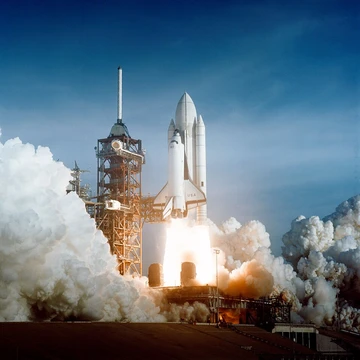
STS-7
Seventh Shuttle mission; first American woman in space.

NASA image · Public domain
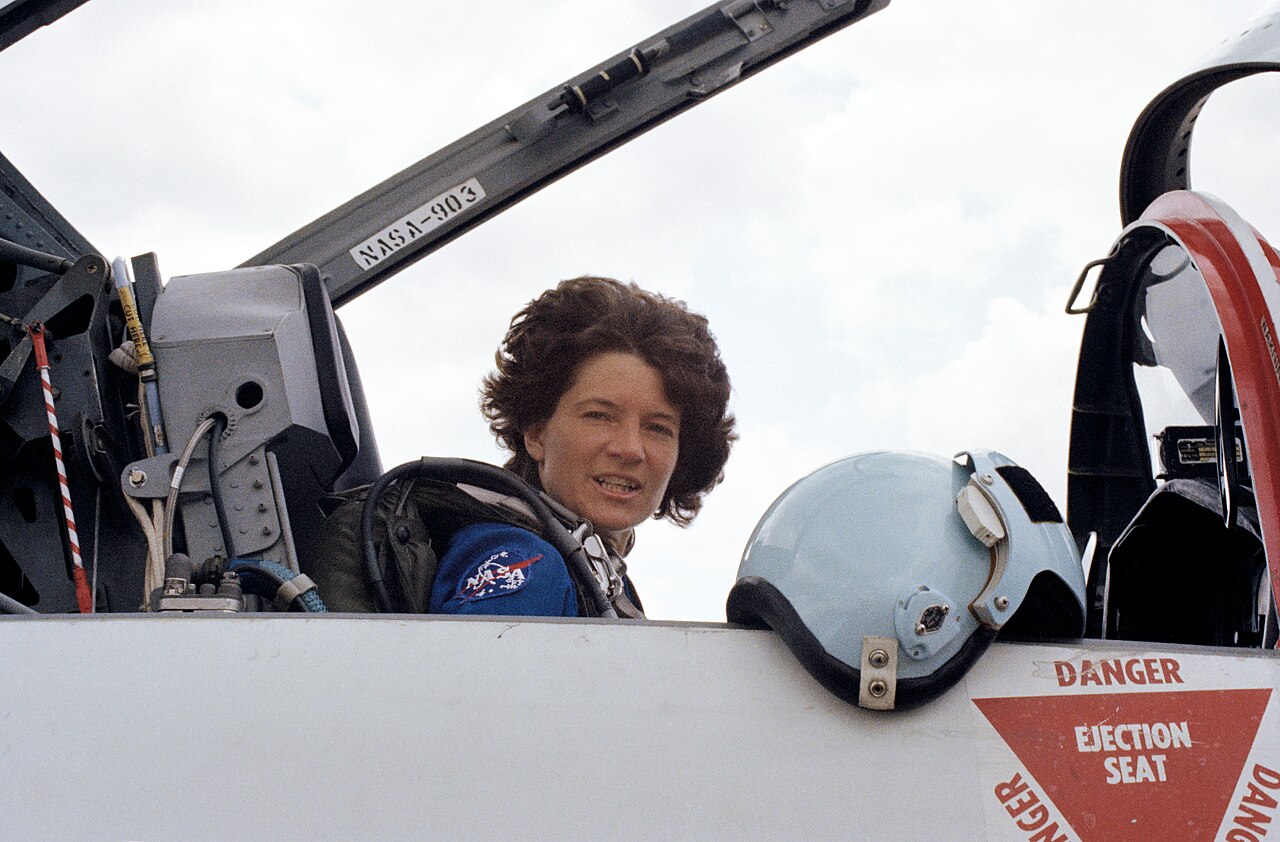
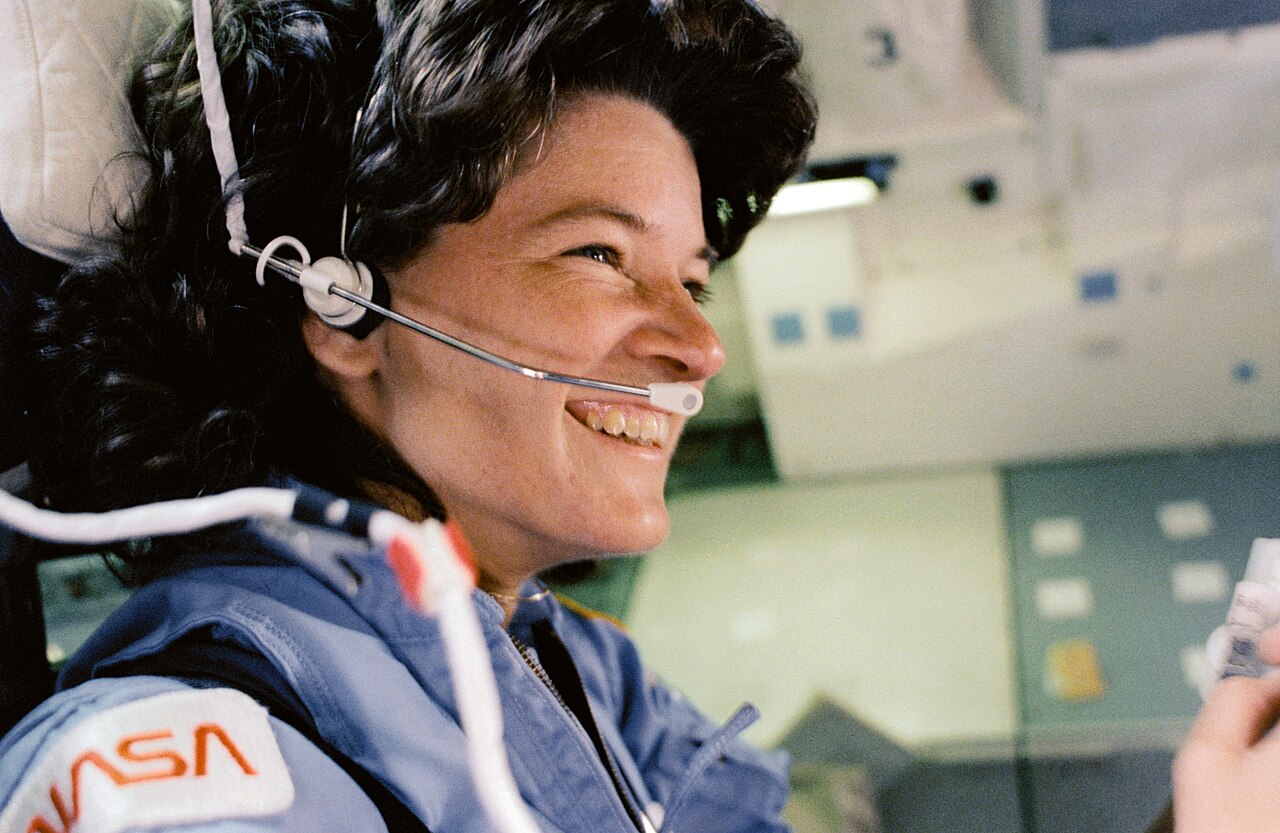
STS-7, the seventh Space Shuttle mission, marked the second time the orbiter Challenger flew. It lifted off from Kennedy Space Center on June 18, 1983, and touched down at Edwards Air Force Base on June 24, 1983. The flight is notable for carrying Sally Ride, who became the first American woman in space.
The crew consisted of Commander Robert Crippen, on his second Shuttle flight; Pilot Frederick Hauck; and Mission Specialists Sally Ride, John M. Fabian, and Norman Thagard. This was the largest crew to fly in a single spacecraft at the time, and it included the first members of NASA’s Group 8 astronaut class, selected in 1978. Thagard conducted medical tests on space adaptation syndrome, a common nausea condition. Before launch, the crew had lunch with President Ronald Reagan at the White House on June 1. Reagan also sent his favorite Jelly Belly jelly beans with the astronauts.
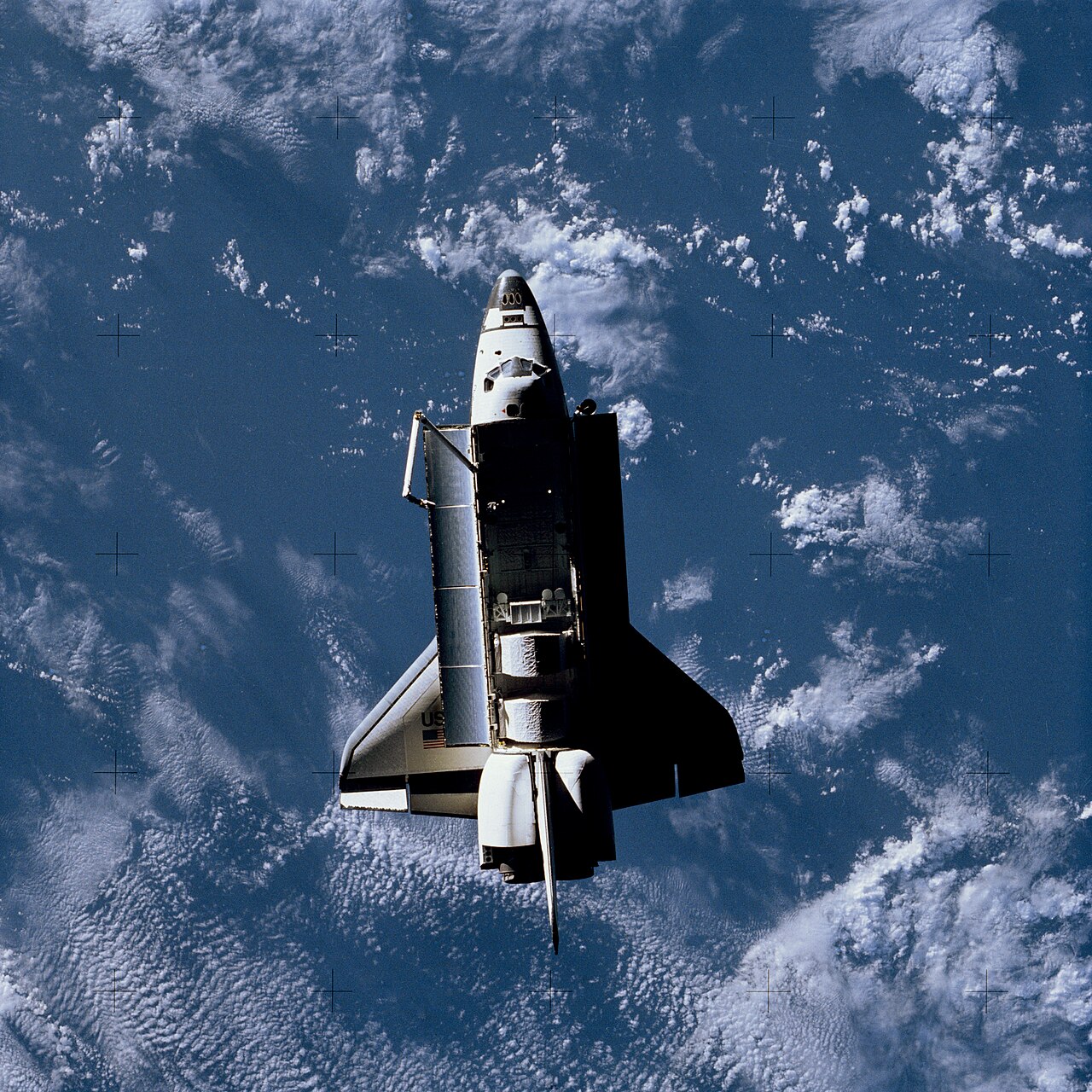
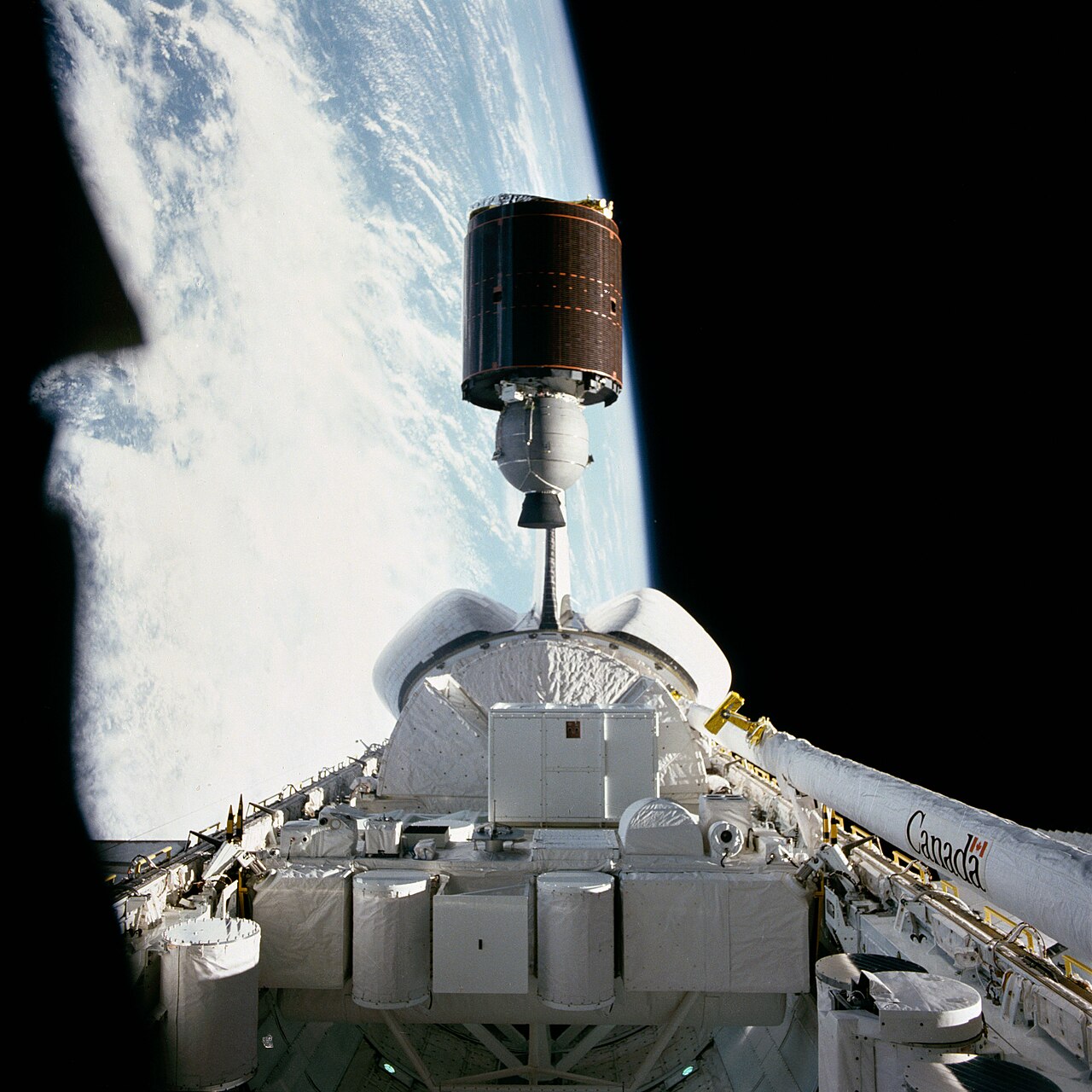
During the first two days, the mission deployed two communications satellites: Anik C2 for Canada’s Telesat and Palapa B1 for Indonesia, both Hughes-built HS-376 models. The flight also carried the first Shuttle pallet satellite, SPAS-1, built by West German firm Messerschmitt-Bölkow-Blohm. SPAS-1 could operate in the payload bay or be released as a free-flying satellite using the Canadarm. It carried ten experiments studying metal alloy formation in microgravity, heat pipe operation, remote sensing instruments, and a mass spectrometer to identify gases in the payload bay. The Canadarm deployed it, and it flew alongside Challenger for several hours, taking pictures with a U.S.-supplied camera. The arm later retrieved it. Seven Getaway Special canisters held various experiments, and the OSTA-2 payload—a joint U.S.-West German scientific pallet—was also aboard. For the first time, the orbiter’s Ku-band antenna relayed data through the Tracking and Data Relay Satellite to a ground terminal.
STS-7 was scheduled to land at Kennedy’s new Shuttle Landing Facility, but bad weather diverted it to Runway 15 at Edwards Air Force Base. The landing occurred on June 24, 1983, at 06:56:59 a.m. PDT. Aside from Enterprise’s 1977 Approach and Landing Tests, this was the only Shuttle landing on Runway 15.
Quick Facts
- Names List
- Space Transportation System-7
- Mission Type
- Communications satellites deployment · Microgravity research
- Operator
- NASA
- Distance Travelled
- 3570000 km
- Orbits Completed
- 97
- Spacecraft
- 099
- Launch Mass
- 113025 kg
- Landing Mass
- 92550 kg
- Payload Mass
- 16839 kg
- Crew Size
- 5
- Crew Members
- Robert Crippen · Frederick Hauck · John M. Fabian · Sally Ride · Norman Thagard
- Launch Site
- Kennedy, LC-39A
Facts from the source article.
Lore & Background
STS-7 was the second mission for the Space Shuttle Challenger and the first spaceflight of an American woman, Sally Ride. The crew also included Robert Crippen (commander), Frederick Hauck (pilot), and mission specialists John M. Fabian and Norman Thagard. It was the largest crew to fly in a single spacecraft up to that time, and the first flight to include members of NASA's Group 8 astronaut class, selected in 1978. President Ronald Reagan sent his favorite Jelly Belly jelly beans with the astronauts.
Reader's Guide
STS-7 deployed two communications satellites—Anik C2 for Canada and Palapa B1 for Indonesia—during the first two days. It also carried the first Shuttle pallet satellite (SPAS-1), built by West German firm MBB, which was deployed by the Canadarm and flew alongside Challenger for several hours. The mission carried seven Getaway Special canisters and the OSTA-2 payload, a joint U.S.-West German scientific pallet. The orbiter's Ku-band antenna relayed data through the TDRS satellite to a ground terminal for the first time. STS-7 experienced the first known Space Shuttle external tank bipod ramp foam shedding event during launch, a root cause of the later loss of Columbia. While on orbit, a window was non-critically damaged by space debris. Sally Ride was presented approximately 100 tampons by NASA workers before launch, should she experience menstruation during the 6-day orbit. The mission was scheduled to land at Kennedy Space Center but diverted to Edwards Air Force Base due to weather, landing on Runway 15—the only time a shuttle landed there aside from Enterprise's 1977 tests.
From Palmdale to the Pad
Rockwell International's Southern California facilities produced the orbiter that would become one of NASA's most storied workhorses. Designated OV-104, Atlantis was the fourth operational Space Shuttle and the second-to-last of the fleet to be built. The company completed the vehicle in roughly half the time required for Columbia, and when it rolled out of the Palmdale assembly plant it weighed 68,635 kilograms—nearly three and a half short tons less than its predecessor. Its physical footprint was substantial: 37.2 meters long, 17.2 meters tall, with a wingspan of 23.7 meters. Atlantis arrived at Kennedy Space Center in April 1985, just weeks before its October 3 maiden flight. It shared a unique capability with Challenger: both were the only orbiters fitted to carry the Shuttle-Centaur upper-stage booster. The vehicle's name honors the RV Atlantis, a two-masted sailing ship that served as the principal research vessel for the Woods Hole Oceanographic Institution between 1930 and 1966.
The STS-27 Tile Crisis
During the 1988 launch of STS-27, a fragment of insulation broke free from the right solid rocket booster and slammed into the belly of the orbiter. The impact shattered more than seven hundred thermal-protection tiles and knocked one completely away. The crew was directed to fly the remote manipulator arm beneath the vehicle to inspect the right wing's underside, and they confirmed extensive tile loss. Because the mission carried classified payloads, the only photographs relayed to mission control were encrypted and of very low resolution. Controllers interpreted what they saw as mere 'lights and shadows' and told the crew to continue the flight as planned—a decision that deeply angered the astronauts aboard. When Atlantis finally touched down, it held the distinction of being the most heavily damaged shuttle ever to make a safe landing. The crew's survival is credited to a steel L-band antenna plate that happened to sit directly beneath the missing tile. A comparable tile-strike scenario would later prove fatal to Columbia in 2003, though that incident involved the more vulnerable reinforced carbon-carbon panels.
Pioneering Science and Station Assembly
Atlantis became the first Space Shuttle to deploy an interplanetary probe when it released the Magellan Venus mapper on STS-30 in 1989; four months later it sent Galileo toward Jupiter on STS-34. In 1991 it carried the Compton Gamma Ray Observatory into orbit. The orbiter's role in international cooperation began with STS-71 in 1995, a flight that marked the hundredth American crewed spaceflight, the first Shuttle-to-Mir docking, and the first on-orbit crew swap; when linked, the combined vehicle was the largest spacecraft in orbit at the time. Atlantis then made seven consecutive Mir visits. Its contributions to the International Space Station were equally vital: the Destiny laboratory arrived on STS-98 in February 2001 (during which astronauts completed NASA's hundredth spacewalk), the Quest Joint Airlock was installed on STS-104 that July, the P3/P4 truss and solar arrays flew on STS-115 in 2006, and the Columbus module—ESA's largest single ISS contribution—was delivered on STS-122 in 2008. In May 2009, Atlantis carried a seven-person crew to Hubble for Servicing Mission 4, completing five spacewalks totaling thirty-seven hours to install new cameras, batteries, and a gyroscope.
Closing the Shuttle Era
On July 8, 2011, Atlantis lifted off for STS-135, its thirty-third and final mission, which also marked the last flight of the entire Space Shuttle program. The mission had been authorized in October 2010, after Endeavour's STS-134 was initially expected to be the program's swan song. STS-135 cleverly leveraged the processing work already underway for a contingency 'Launch on Need' rescue mission that would have been required if STS-134's crew had become stranded in orbit. Atlantis touched down at Kennedy Space Center on July 21, 2011, bringing its career to a close. Over the course of its thirty-three flights, the orbiter had circled the Earth 4,848 times and traveled nearly 126 million miles—over 203 million kilometers—a distance more than five hundred twenty-five times the span between the Earth and the Moon. Today, the retired vehicle stands on public display at the Kennedy Space Center Visitor Complex, a tangible reminder of three decades of American spaceflight.
Gallery
Frequently Asked Questions
Who flew on STS-7?
Commander Robert Crippen led a five-person crew that included Pilot Frederick Hauck and Mission Specialists Sally Ride, John M. Fabian, and Norman Thagard. It was the largest crew ever to occupy a single spacecraft up to that point and featured the first astronauts from NASA's Group 8.
Why is STS-7 historically significant?
The mission is best remembered for carrying Sally Ride into orbit, making her the first American woman to travel to space. It also served as Challenger's second flight, following her debut on STS-6 just months earlier.
Which orbiter carried the STS-7 crew?
Space Shuttle Challenger handled the flight, marking her second trip to orbit after her maiden voyage a few months prior.
How long was STS-7 in orbit?
The mission lasted approximately six days, two hours, and twenty-four minutes from liftoff to touchdown.
More in Space Shuttle missions 1-24
Spotted an error? Know more?
Reader corrections go straight into our review queue. Suggest an edit · How this site is sourced