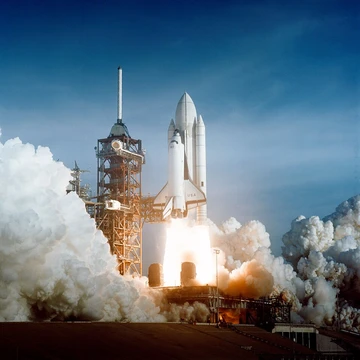
STS-28
Classified DoD shuttle mission carrying an SDS-2 relay satellite.

STS-28 was the 30th NASA Space Shuttle mission, the fourth shuttle mission dedicated to United States Department of Defense (DoD) purposes, and the eighth flight of Space Shuttle Columbia. The mission launched on August 8, 1989, and landed on August 13, 1989, after traveling 3,400,000 km during 81 orbits. Its payload is widely believed to have been an SDS-2 relay communications satellite, though mission details remain classified.
Quick Facts
- Names List
- Space Transportation System-28 / STS-28R
- Mission Type
- DoD satellites deployment
- Operator
- NASA
- Distance Travelled
- 3400000 km
- Orbits Completed
- 81
- Spacecraft
- 102
- Landing Mass
- 90816 kg
- Payload Mass
- 19600 kg
- Crew Size
- 5
- Crew Members
- Brewster H. Shaw · Richard N. Richards · James C. Adamson · David Leestma · Mark N. Brown
- Launch Site
- Kennedy, LC-39B
- Launch Contractor
- Rockwell International
Facts from the source article.
Lore & Background
Columbia landed at Edwards Air Force Base on August 13, 1989, at 9:37:08 a.m. EDT, after a mission lasting 5 days, 1 hour and 8 seconds. Due to a software glitch with weight-on-wheels sensors, the crew was instructed to touch down as softly as possible, resulting in a touchdown airspeed of 154 knots—among the slowest of the entire Shuttle program, though STS-3 landed at about 152 knots and the orbiter's stall speed was around 130-140 knots.
Reader's Guide
STS-28 holds significance as a classified Department of Defense mission that resumed Space Shuttle Columbia's flight career after a three-year hiatus following the Challenger disaster. Its payload, widely believed to be the first SDS-2 relay communications satellite, supported secure military communications. The mission also contributed to scientific understanding of space radiation effects on the human body through the IDRD experiment, which flew a human skull to measure radiation penetration at different orbital inclinations. Technical issues encountered during the flight, such as the RCS thruster leak and the post-flight discovery of protruding gap filler causing turbulent plasma flow during re-entry, informed later safety improvements. The unusually slow landing speed, the slowest in Shuttle history, highlighted software vulnerabilities in the landing gear sensors. STS-28 also marked the debut of Columbia's name moved from the payload bay doors to the fuselage, aiding in-orbit identification.
Did You Know?
- STS-28 was Columbia's first flight since January 1986, when it flew STS-61-C, the mission directly preceding the Challenger disaster.
- The mission carried a 5 kg human skull as part of the In-flight Radiation Dose Distribution (IDRD) experiment, which also flew on STS-36.
- The landing airspeed of 154 knots was among the slowest of the entire Space Shuttle program, but not the slowest.
- Post-flight analysis discovered unusual heating of the thermal protection system caused by protruding gap filler, the same material removed during a spacewalk on STS-114 in 2005.
Frequently Asked Questions
Who is STS-28?
STS-28 was the 30th flight in NASA's Space Shuttle program and the eighth time Space Shuttle Columbia went to orbit. It also marked the fourth shuttle mission specifically assigned to U.S. Department of Defense objectives.
What was STS-28's payload and role?
The mission's cargo has never been officially confirmed by NASA, but the aerospace community widely believes it carried an SDS-2 military relay communications satellite. Because the flight was classified, no detailed manifest or operational summary was ever released to the public.
When did STS-28 fly and how long did it last?
Columbia lifted off on August 8, 1989, and touched down five days later on August 13, 1989. Over the course of the mission the orbiter completed 81 orbits, covering roughly 3.4 million kilometres (about 2.1 million miles).
Why is STS-28 considered important to shuttle history?
It stands out as one of the most tightly guarded shuttle flights ever conducted, with its purpose and payload details still shrouded in secrecy decades later. For fans and researchers, that very opacity makes it a recurring subject of speculation and discussion in the shuttle community.
More in Space Shuttle missions 1-24
Spotted an error? Know more?
Reader corrections go straight into our review queue. Suggest an edit · How this site is sourced