STS-6
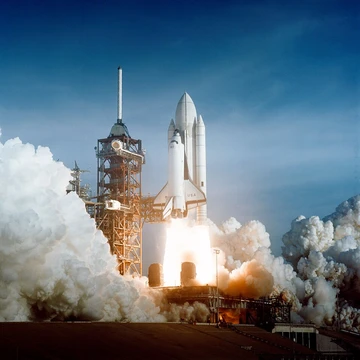
First flight of Challenger and first Shuttle spacewalk.

NASA on The Commons · No restrictions
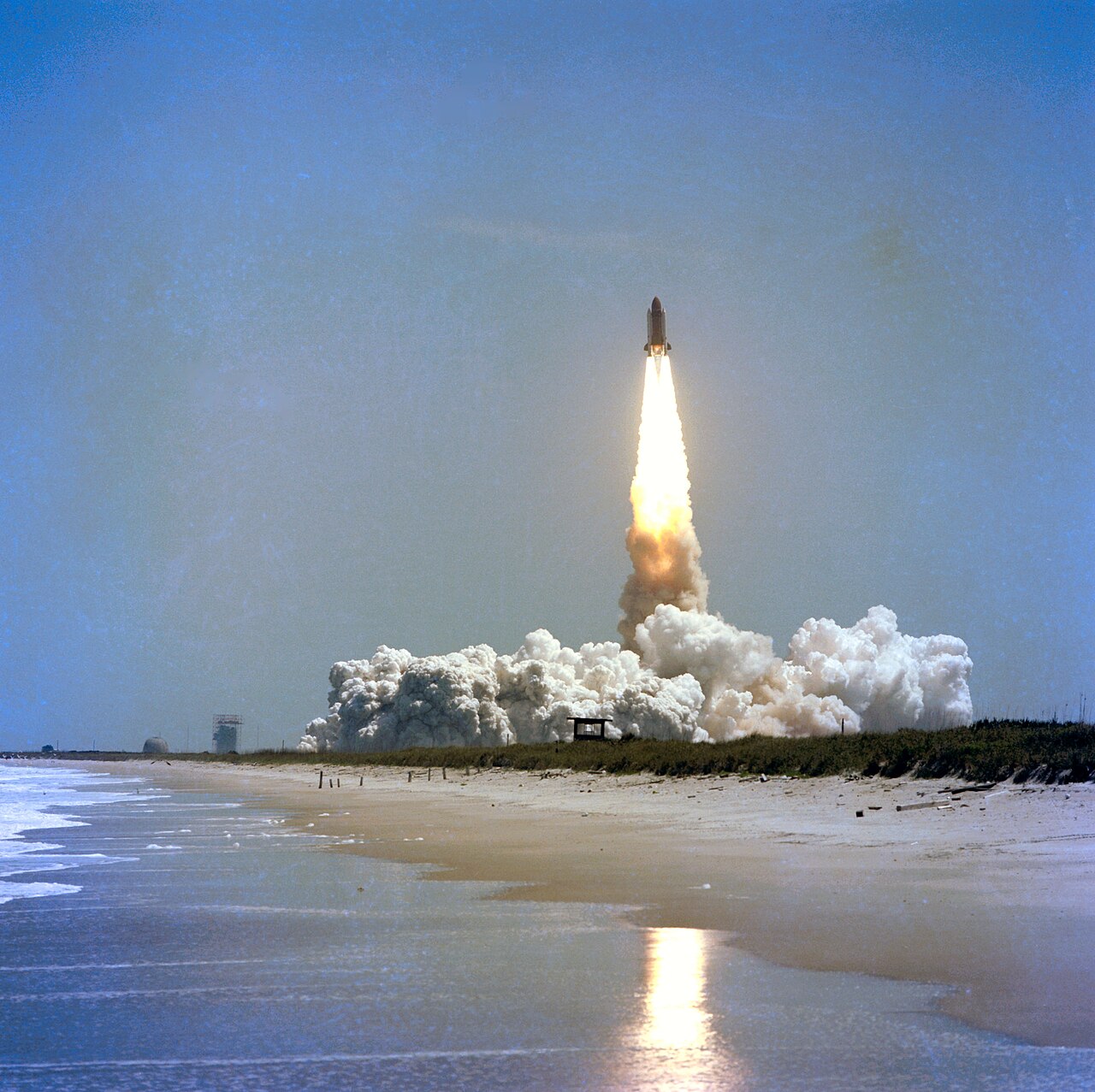
STS-6 marked the sixth flight of NASA’s Space Shuttle program and the first for the orbiter Challenger. It lifted off from Kennedy Space Center on April 4, 1983, carrying the initial Tracking and Data Relay Satellite, TDRS-1, which it released into orbit. The mission concluded with a landing at Edwards Air Force Base on April 9, 1983. This flight also saw the first spacewalk—or extravehicular activity (EVA)—in the Shuttle program, and the first use of the Extravehicular Mobility Unit (EMU) spacesuit.
The crew consisted of Commander Paul Weitz, who had previously served as pilot on the first crewed Skylab mission (Skylab-2) and later became Deputy Chief of the Astronaut Office; Pilot Karol J. Bobko, originally an Air Force Manned Orbiting Laboratory (MOL) astronaut who joined NASA after MOL’s cancellation and worked on the Skylab Medical Experiment Altitude Test and Apollo-Soyuz Test Project support crew; Mission Specialist F. Story Musgrave, a scientist-astronaut from the second group, who was backup Science Pilot for the first Skylab mission and helped design the EVA equipment; and Mission Specialist Donald H. Peterson, also a MOL transfer who served on the Apollo 16 support crew.
The support crew included Roy D. Bridges Jr. (entry CAPCOM), Mary L. Cleave, Richard O. Covey (ascent CAPCOM), Guy Gardner, Jon McBride, and Bryan D. O’Connor.
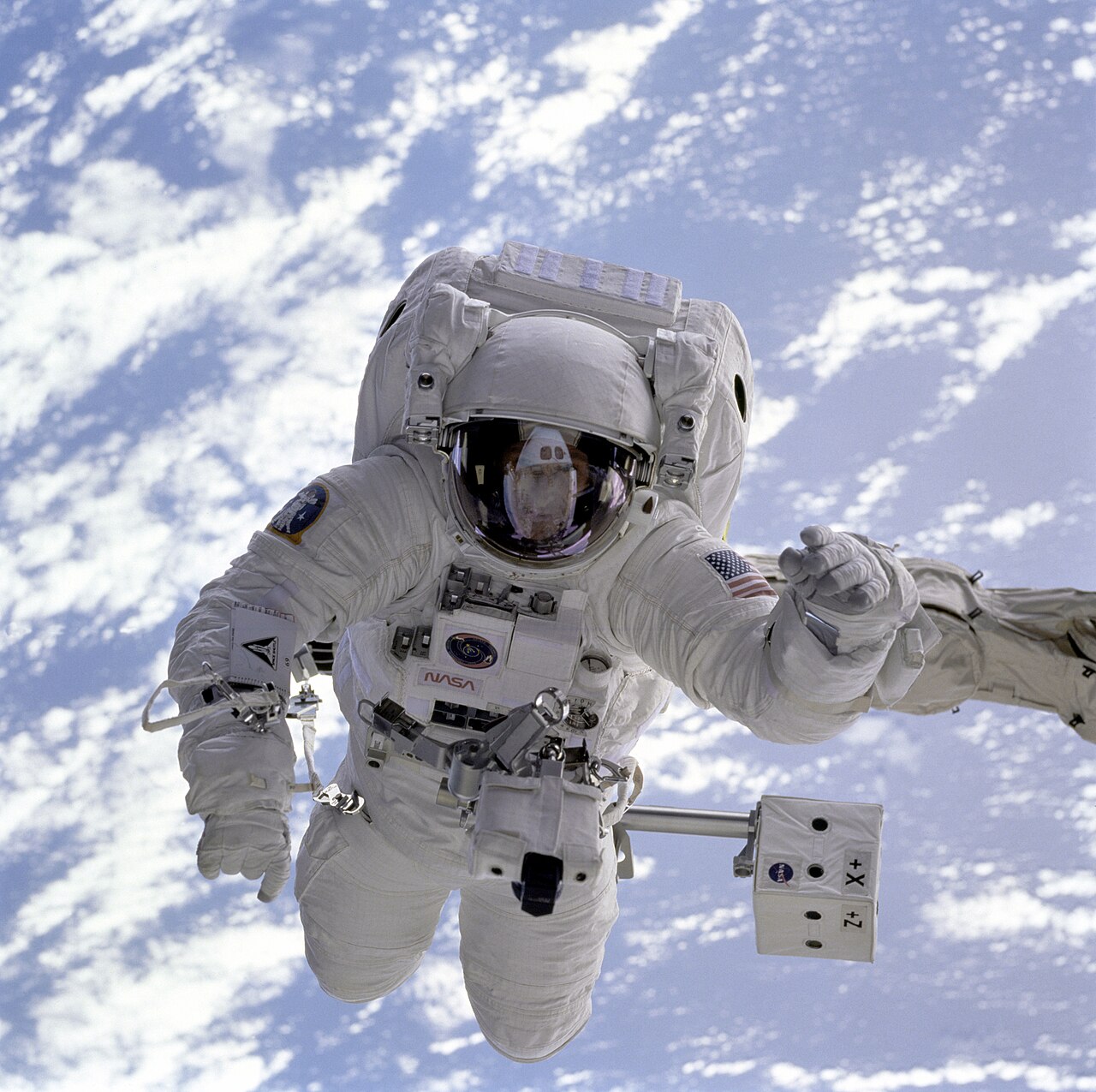
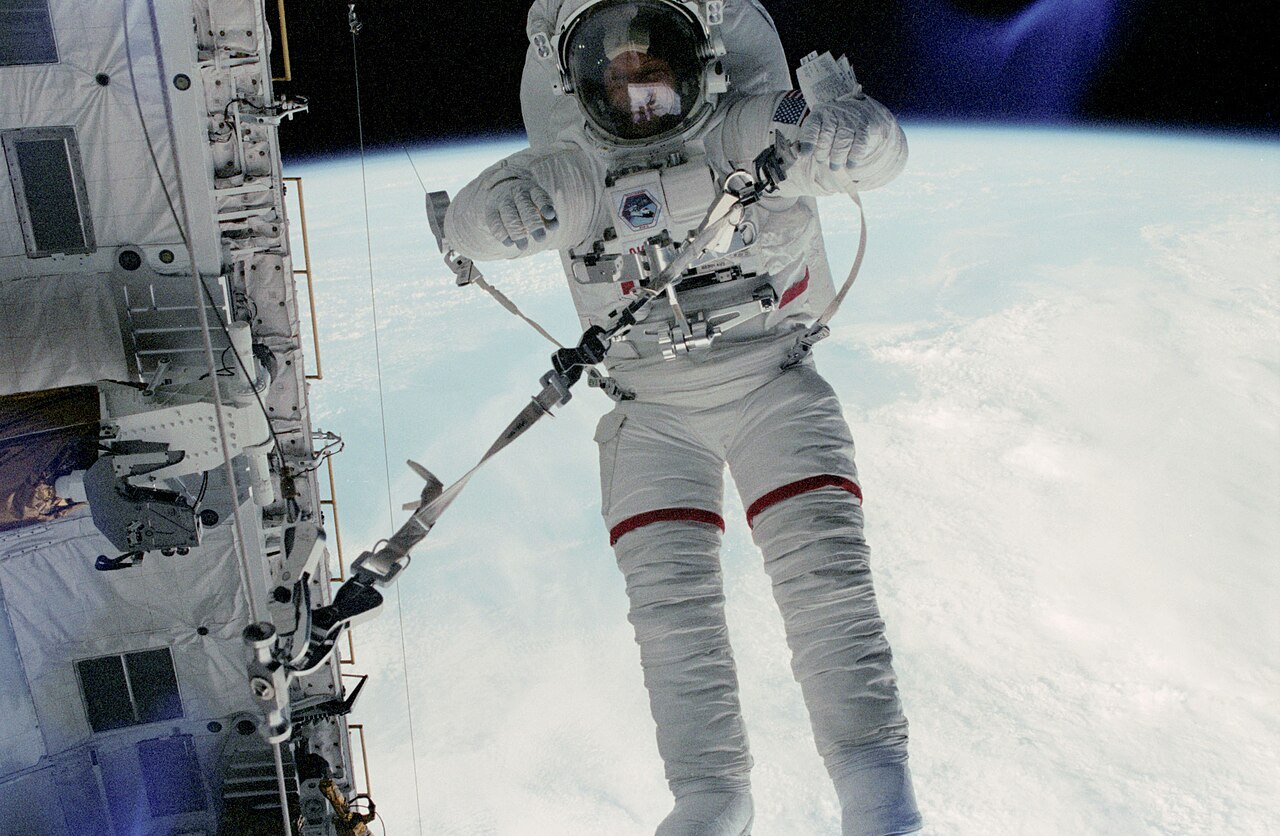
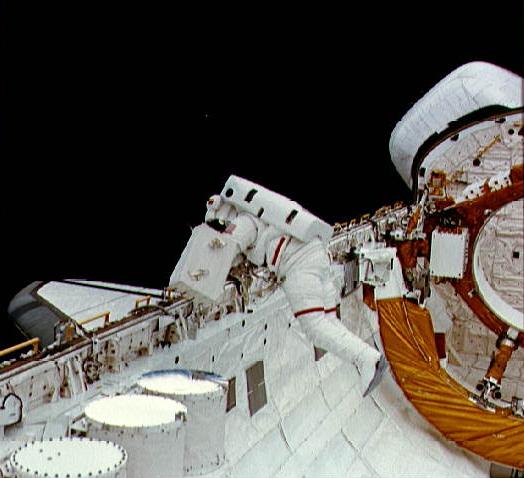
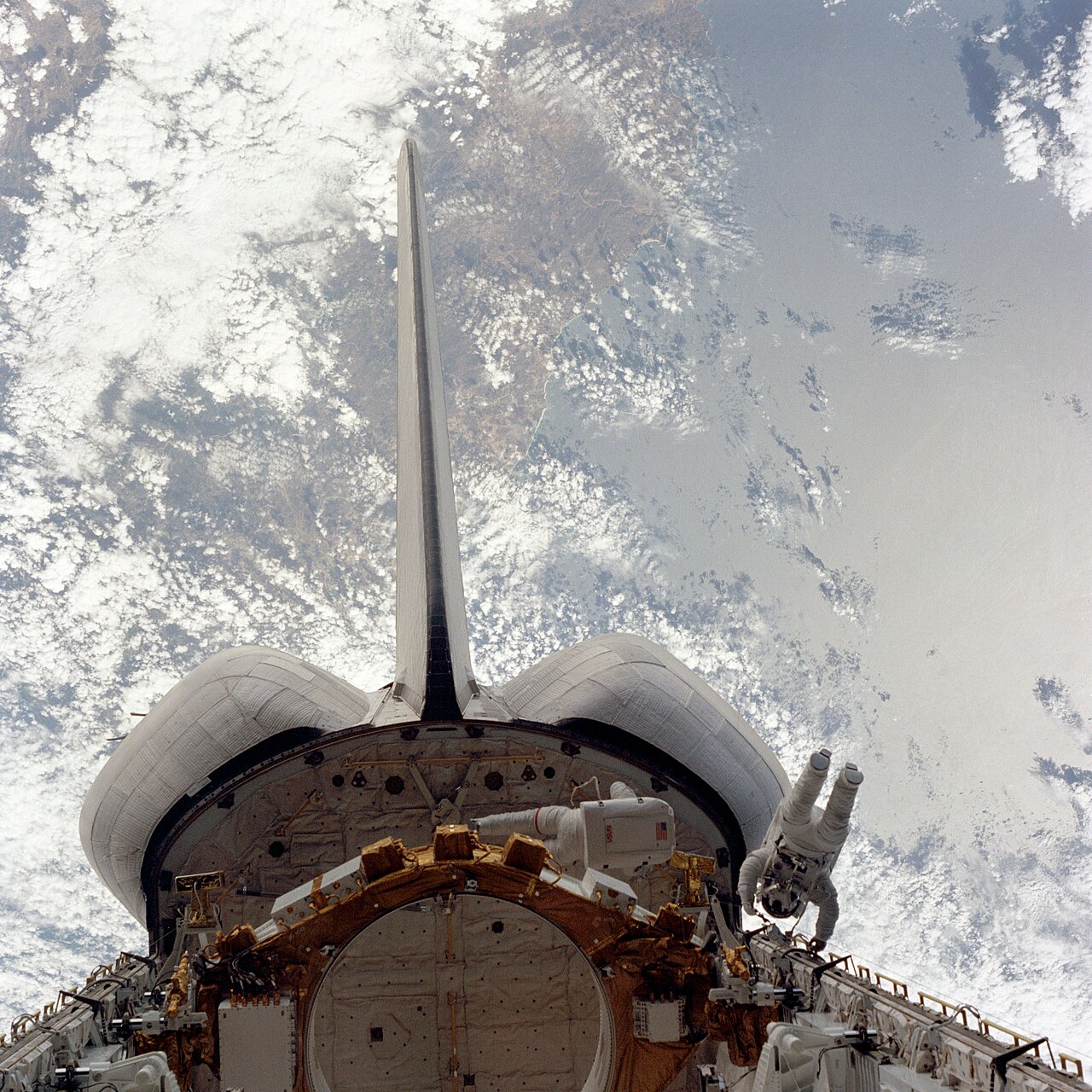
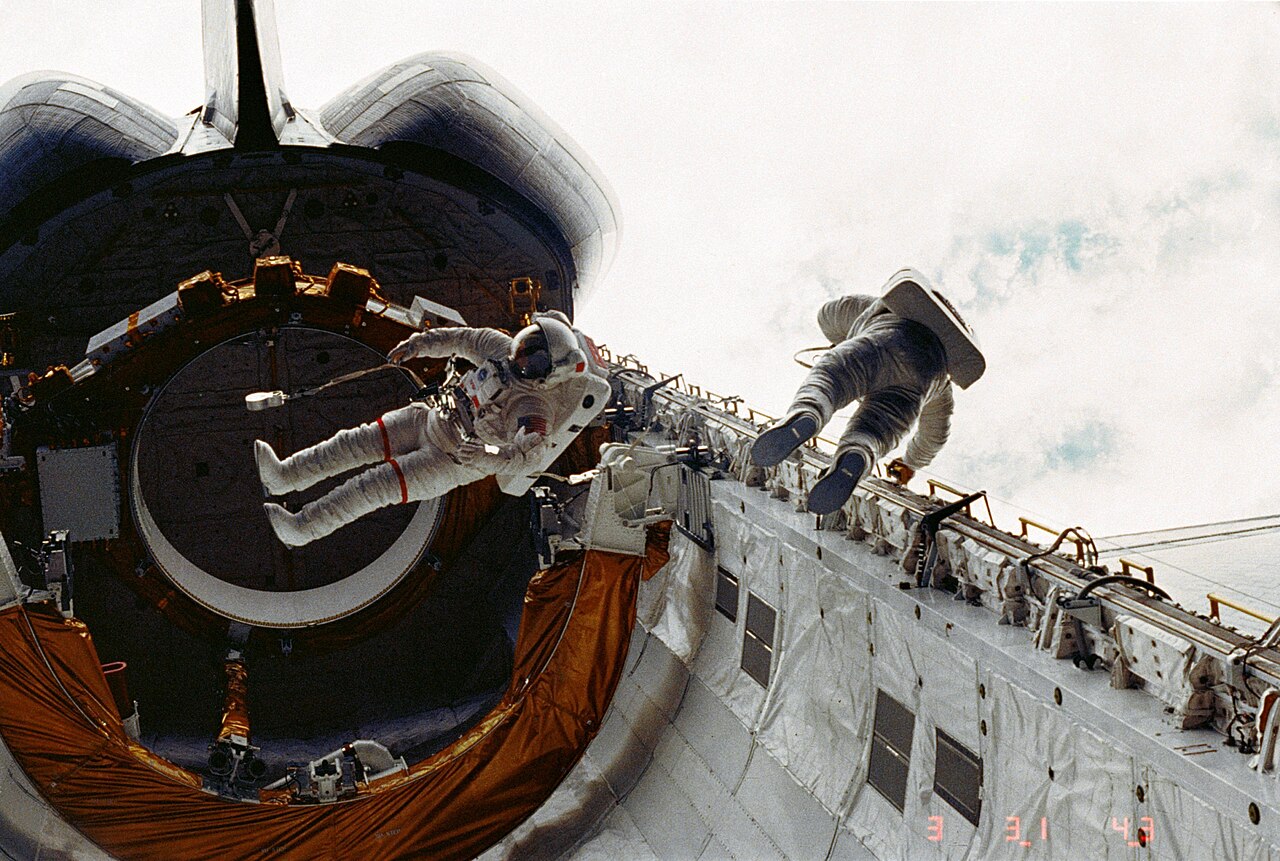
The spacewalk was performed by Musgrave and Peterson from April 7 to 8, 1983, lasting 4 hours and 17 minutes.
Challenger was rolled out to Launch Complex 39A on December 8, 1982. A Pre Flight Readiness Firing (PFRF) on December 18, 1982, lasted 16 seconds and revealed significant liquid hydrogen leakage in the thrust section, though the exact leak source was unclear. A second PFRF on January 25, 1983, lasting 23 seconds, showed more hydrogen leaks. Investigators found a cracked low-pressure duct in engine No. 1. After replacing it with a spare that also leaked, a third engine was ordered from Rocketdyne and tested successfully. Engines No. 2 and No. 3 also had leaks and were removed for repairs, which were completed by mid-March 1983.
On February 28, 1983, a severe storm contaminated the primary payload, TDRS-1, while it was in the Payload Changeout Room on the Rotating Service Structure.
Quick Facts
- Names List
- Space Transportation System-6
- Mission Type
- TDRS-1 satellite deployment
- Operator
- NASA
- Distance Travelled
- 3370437 km
- Orbits Completed
- 81
- Spacecraft
- 099
- Launch Mass
- 116457 kg
- Landing Mass
- 86330 kg
- Payload Mass
- 21305 kg
- Crew Size
- 4
- Crew Members
- Paul J. Weitz · Karol J. Bobko · Story Musgrave · Donald H. Peterson
- Launch Site
- Kennedy, LC-39A
Facts from the source article.
Lore & Background
The crew consisted of Commander Paul Weitz, Pilot Karol J. Bobko, and Mission Specialists F. Story Musgrave and Donald H. Peterson. Weitz had previously served as Pilot on the first Skylab crewed mission (Skylab-2), where he lived and worked in Skylab for nearly a month from May to June 1973. Bobko originally became an astronaut for the Air Force's Manned Orbiting Laboratory (MOL) program but later joined NASA in 1969 after the MOL program's cancellation. Peterson was also a transfer from the MOL program, and was a member of the support crew for Apollo 16. Musgrave joined NASA in 1967 as part of the second scientist-astronaut group, and was the backup Science Pilot for the first Skylab mission. He also participated in the design of the equipment that he and Peterson used during their EVA on the STS-6 mission.
Reader's Guide
STS-6 marked several firsts for the Space Shuttle program: the maiden flight of Challenger, the first use of a new lightweight external tank and lightweight Solid Rocket Booster casings, the first use of the head-up display, and the first extravehicular activity (EVA) in the program. Using new spacesuits designed specifically for the Space Shuttle program, Musgrave and Peterson successfully accomplished the program's first EVA on April 7–8, 1983, performing various tests in the orbiter's payload bay. Their spacewalk lasted 4 hours and 17 minutes and was the first American EVA since the last of Skylab 4's four EVAs nearly a decade prior. Although the TDRS-A satellite was successfully deployed, its two-stage booster rocket, the Inertial Upper Stage (IUS), tumbled out of control, placing the satellite into a low elliptical orbit. However, the satellite contained extra propellant, and during the next several months, its thrusters were fired at carefully planned intervals, gradually moving TDRS-1 into its geosynchronous operating orbit, thus saving the US$100-million satellite.
Did You Know?
- STS-6 was the first Space Shuttle mission during which an extravehicular activity was conducted, and hence was the first in which the Extravehicular Mobility Unit (EMU) was used.
- The mission's primary cargo, TDRS-1, was contaminated by a severe storm on February 28, 1983, while in the Payload Changeout Room, requiring cleaning and delaying the launch.
- Challenger was flown back to KSC on April 16, 1983, after landing at Edwards Air Force Base.
From Palmdale to the Florida Coast
Built by Rockwell International in Southern California, the orbiter that would become Atlantis was delivered to the Kennedy Space Center in Eastern Florida in April 1985. As the fourth operational shuttle and the second-to-last ever constructed, it represented a significant leap in production efficiency: its assembly took roughly half the time required for Columbia, and when it rolled out of the Palmdale plant it weighed nearly 3.5 short tons less than its predecessor. The vehicle measured 37.2 meters in length, 17.2 meters in height, and spanned 23.7 meters wing to wing, tipping the scales at 68,635 kilograms with its three main engines installed. Alongside Challenger, it was one of only two orbiters configured to carry the Shuttle-Centaur upper-stage booster. The name itself carries a maritime heritage, drawn from the RV Atlantis, a two-masted research vessel that served the Woods Hole Oceanographic Institution between 1930 and 1966. This nautical lineage would prove fitting for a machine whose career would span nearly three decades of American spaceflight.
The STS-27 Near-Miss
Atlantis's early career was marked by both rapid tempo and a harrowing scare. After its maiden voyage on STS-51-J in October 1985, a dedicated Department of Defense flight, it returned just 50 days later for STS-61-B, the program's second night launch, setting a record for the shortest turnaround between consecutive shuttle missions. The Challenger disaster in 1986 grounded the entire fleet, and Atlantis did not fly again until 1988. That year, during STS-27, a fragment of insulation broke free from the right solid rocket booster and slammed into the orbiter's belly, shattering more than 700 thermal-protection tiles and knocking one entirely away. The crew used the robotic arm to inspect the right wing's underside, but because the mission was classified, only encrypted, low-resolution imagery reached mission control. Controllers dismissed the damage as 'lights and shadows' and told the crew to continue, a decision that infuriated the astronauts aboard. Atlantis still made it home, becoming the most heavily damaged shuttle to land safely. A steel L-band antenna plate sitting directly beneath the missing tile is credited with saving the crew, a near-miss that eerily foreshadowed the Columbia tragedy of 2003.
Building the Station, Reaching the Stars
From 1989 onward, Atlantis became a workhorse for both planetary science and orbital construction. On STS-30 it became the first shuttle to deploy an interplanetary probe, releasing Magellan toward Venus, and followed with Galileo's journey to Jupiter on STS-34. In 1991, it carried the Compton Gamma Ray Observatory into orbit. Beginning in 1995, the orbiter flew seven consecutive missions to Mir, with STS-71 marking the 100th American crewed flight, the first Shuttle-to-Mir docking, and the first on-orbit crew swap; linked together, the two vehicles formed the largest spacecraft then in orbit. The International Space Station era brought even heavier responsibilities: the Destiny laboratory arrived on STS-98 in February 2001, a mission that also produced NASA's 100th spacewalk, the Quest airlock followed on STS-104, and the Columbus module, ESA's single largest contribution, was delivered on STS-122 in 2008. In May 2009, Atlantis carried a seven-person crew to Hubble for Servicing Mission 4, completing five spacewalks totaling 37 hours to install new cameras, batteries, and a gyroscope. Its longest flight, STS-117 in June 2007, lasted nearly 14 days.
The Final Descent and a Place in History
On July 8, 2011, Atlantis lifted off for STS-135, its 33rd and final mission, which also closed the book on the entire Space Shuttle program. The flight had not been certain to happen: STS-134 aboard Endeavour was originally slated as the last, but STS-135 was authorized in October 2010 and cleverly piggybacked on the processing already underway for a contingency 'Launch on Need' mission that would have been required if STS-134's crew had become stranded. Atlantis touched down at Kennedy Space Center on July 21, 2011, completing a career that included 4,848 orbits of the Earth and a cumulative distance of nearly 126 million miles, more than 525 times the gap between Earth and the Moon. Today the orbiter rests on display at the Kennedy Space Center Visitor Complex, where visitors can walk its corridors and reflect on three decades of firsts: interplanetary probes, Mir dockings, ISS assembly, Hubble repairs, and the quiet dignity of a machine that, despite a near-fatal tile strike in 1988, brought every crew it ever carried safely home.
Gallery
Frequently Asked Questions
What is STS-6 known for?
STS-6 was the maiden voyage of the orbiter Challenger and the mission that produced the first spacewalk in the entire Shuttle program. It also deployed the TDRS-1 communications satellite into orbit.
Who commanded STS-6?
Paul Weitz served as mission commander, completing a full circle since he had been the pilot on the very first Shuttle flight, STS-1.
How long did STS-6 last?
The mission ran for five days, zero hours, twenty-three minutes, and forty-two seconds, from its April 4, 1983 launch at Kennedy Space Center to its April 9 landing.
What satellite did STS-6 deploy?
Challenger carried and released TDRS-1, the first Tracking and Data Relay Satellite, into its operational orbit during the flight.
Where did STS-6 land?
Challenger touched down at Edwards Air Force Base in California on April 9, 1983, rather than returning to Kennedy Space Center.
More in Space Shuttle missions 1-24
Spotted an error? Know more?
Reader corrections go straight into our review queue. Suggest an edit · How this site is sourced