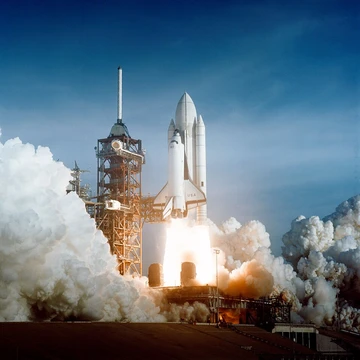
STS-44
U.S. Department of Defense shuttle mission deploying DSP-16 satellite.

STS-44 was a Space Shuttle flight flown by Atlantis, launched on November 24, 1991, at 23:44:00 UTC. The mission was operated for the U.S. Department of Defense. A planned launch on November 19 was postponed after a faulty redundant inertial measurement unit on the Inertial Upper Stage booster needed replacement and testing. The next attempt, on November 24, was delayed by 13 minutes to let an orbiting spacecraft pass and to allow the external tank to be refilled with liquid oxygen after minor repairs to a valve in the mobile launcher platform’s replenishment system. The shuttle’s launch weight was 117,766 kilograms.
The flight’s primary objective was deploying a Defense Support Program satellite, DSP-16, attached to an Inertial Upper Stage, which was released on the first day. Other unclassified payloads in the cargo bay and middeck included the Interim Operational Contamination Monitor, Terra-Scout, Military Man in Space experiment M88-1, Air Force Maui Optical Site instrument, Cosmic Radiation Effects and Activation Monitor, Shuttle Activation Monitor, Radiation Monitoring Equipment RME III, Visual Function Tester VFT-1, Bioreactor Flow, and several Extended Duration Orbiter Medical Project studies. The Ultraviolet Plume Instrument experiment, mounted on the previously launched LACE satellite, successfully observed thruster firings from Atlantis during this mission.
Landing took place on December 1, 1991, at 22:34:44 UTC on Runway 5 at Edwards Air Force Base, California. The rollout distance was 3,411 meters, lasting 107 seconds, with minimal braking used for testing. The landing weight was 87,918 kilograms. Originally scheduled to land at Kennedy Space Center on December 4, the ten-day mission was cut short after one of three orbiter inertial measurement units failed on November 30. Atlantis returned to Kennedy on December 8, 1991.
Quick Facts
- Names List
- Space Transportation System-44
- Mission Type
- DSP satellite deployment
- Operator
- NASA
- Distance Travelled
- 4651112 km
- Orbits Completed
- 110
- Spacecraft
- 104
- Launch Mass
- 117766 kg
- Landing Mass
- 87919 kg
- Payload Mass
- 20240 kg
- Crew Size
- 6
- Crew Members
- Frederick D. Gregory · Terence T. Henricks · James S. Voss · Story Musgrave · Mario Runco Jr. · Thomas J. Hennen
- Launch Site
- Kennedy, LC-39A
Facts from the source article.
Lore & Background
The launch was on November 24, 1991, at 23:44:00 UTC. A launch set for November 19, 1991, was delayed due to replacement and testing of a malfunctioning redundant inertial measurement unit on the Inertial Upper Stage (IUS) booster attached to the Defense Support Program (DSP) satellite. The launch was reset for November 24 and was delayed by 13 minutes to allow an orbiting spacecraft to pass and to allow external tank liquid oxygen replenishment after minor repairs to a valve in the liquid oxygen replenishment system in the mobile launcher platform. Launch weight was 117,766 kilograms (259,630 lb).
The mission was dedicated to the Department of Defense. The unclassified payload included a Defense Support Program (DSP) satellite, DSP-16 attached to Inertial Upper Stage (IUS-14), deployed on flight day one. Cargo bay and middeck payloads included the Interim Operational Contamination Monitor (IOCM), Terra-Scout, Military Man in Space (M88-1), Air Force Maui Optical Site (AMOS), Cosmic Radiation Effects and Activation Monitor (CREAM), Shuttle Activation Monitor (SAM), Radiation Monitoring Equipment (RME III), Visual Function Tester (VFT-1), Bioreactor Flow, and Extended Duration Orbiter Medical Project, a series of investigations in support of Extended Duration Orbiter. The Ultraviolet Plume Instrument (UVPI) experiment was located on board the previously launched LACE satellite, and could've been pointed at Atlantis on-orbit to observe the shuttle's thruster firings. However, no opportunities or intersections occurred during this mission.
The landing was on December 1, 1991, at 22:34:44 UTC, Runway 5, Edwards Air Force Base, California. The rollout distance was 3,411 m (11,191 ft), and the rollout time was 107 seconds. The landing weight was 87,918 kg (193,826 lb). The landing was originally scheduled for Kennedy Space Center on December 4, 1991, but the ten-day mission was shortened and the landing rescheduled following the November 30, 1991, on-orbit failure of one of three orbiter inertial measurement units. The lengthy rollout was due to minimal braking for test. Atlantis returned to Kennedy on December 8, 1991. This was also the final shuttle landing on a dry lake bed runway.
Reader's Guide
STS-44 was a dedicated Department of Defense mission that successfully deployed the DSP-16 satellite, contributing to the United States' missile warning and space surveillance capabilities. The mission also carried a range of unclassified payloads, including experiments for contamination monitoring, radiation effects, and medical investigations supporting extended orbiter duration. The mission's landing was notable for being the final Space Shuttle landing on a dry lake bed runway at Edwards Air Force Base. The mission was shortened by one day due to the failure of an orbiter inertial measurement unit, demonstrating the operational challenges of spaceflight. STS-44 represents a key example of the Space Shuttle's role in supporting national security objectives while also advancing scientific and medical research in low Earth orbit.
Did You Know?
- The launch was delayed from November 19, 1991, due to a malfunctioning redundant inertial measurement unit on the IUS booster.
- The landing rollout distance was 3,411 m (11,191 ft) due to minimal braking for test.
- The Ultraviolet Plume Instrument experiment on the LACE satellite could have observed Atlantis's thruster firings, but no opportunities occurred.
More in Space Shuttle missions 1-24
Spotted an error? Know more?
Reader corrections go straight into our review queue. Suggest an edit · How this site is sourced