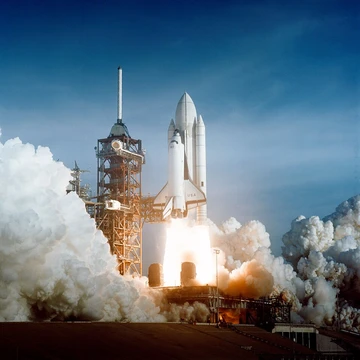
STS-43
Ninth Atlantis flight deployed TDRS-5 and tested space station cooling.

STS-43 was the ninth mission of the Space Shuttle Atlantis, a nine-day flight that launched on August 2, 1991. Its primary objective was deploying the TDRS-E satellite (TDRS-5), which became the fourth member of the Tracking and Data Relay Satellite cluster, enabling near-continuous communication between Earth and orbiting spacecraft.
Quick Facts
- Names List
- Space Transportation System-43
- Mission Type
- TDRS-E satellite deployment / Technology
- Operator
- NASA
- Distance Travelled
- 5955217 km
- Orbits Completed
- 142
- Spacecraft
- 104
- Launch Mass
- 117650 kg
- Landing Mass
- 89239 kg
- Payload Mass
- 21067 kg
- Crew Size
- 5
- Crew Members
- John E. Blaha · Michael A. Baker · Shannon Lucid · G. David Low · James C. Adamson
- Launch Site
- Kennedy, LC-39A
Facts from the source article.
Lore & Background
The crew conducted a variety of secondary experiments, including the Space Station Heat Pipe Advanced Radiator Element (SHARE II) test for potential use on Space Station Freedom, and the Solid Surface Combustion Experiment to study fire behavior in microgravity. The mission was also notable for being the first to send an email from space, when astronauts Lucid and Adamson used AppleLink from a Macintosh Portable on August 9, 1991. Atlantis landed on August 11, 1991 at Kennedy Space Center.
Reader's Guide
STS-43 advanced NASA's communication infrastructure by deploying TDRS-5, which filled a critical gap after the loss of TDRS-B in the Challenger accident. The TDRS network allowed spacecraft to communicate with Earth for 85% to 100% of each orbit, a major improvement over the previous 15% coverage. The mission also tested technologies for the future space station, including a heat pipe radiator and materials science experiments. The first email from space demonstrated early use of commercial technology in orbit. The mission's insignia highlighted thirty years of American crewed spaceflight from Project Mercury to the Space Shuttle.
Did You Know?
- STS-43 was the first mission to send an email from space, using AppleLink on a Macintosh Portable.
- The launch was delayed four times from its original July 23, 1991 date due to hardware and weather issues.
- TDRS-5 became the fourth TDRS satellite on orbit, but it did not replace the satellite lost in the Challenger accident; that satellite, TDRS-B, was never replaced by a single satellite.
- The crew adapted a camera part to replace one not packed for the mission.
More in Space Shuttle missions 1-24
Spotted an error? Know more?
Reader corrections go straight into our review queue. Suggest an edit · How this site is sourced