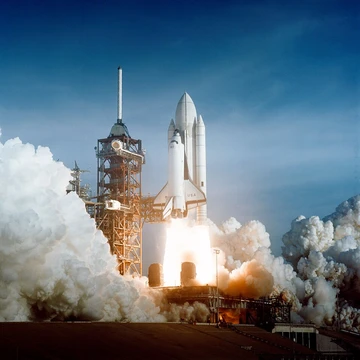
STS-41
Deployed Ulysses to study the Sun's poles.

STS-41, the 36th Space Shuttle mission and the 11th for Discovery, lifted off on October 6, 1990, at 7:47:16 a.m. EDT. This came 12 minutes after the day's launch window opened at 7:35 a.m. EDT. At 117,749 kilograms (259,592 pounds), Discovery carried its heaviest payload yet. The four-day mission's main goal was to deploy the Ulysses probe for the International Solar Polar Mission.
Ulysses, built by the European Space Agency, was a joint project with NASA. It was the first spacecraft meant to explore the Sun's poles. To send it on an out-of-ecliptic trajectory, two upper stages—the Inertial Upper Stage and a Payload Assist Module-S—were used together for the first time. Six hours after launch, Ulysses left Discovery's payload bay. Its journey began with a 16-month trip to Jupiter, whose gravity flung it southward out of the planets' orbital plane, leading to a solar south pole passage in 1994. After crossing back over the orbital plane, it made a north pole passage in 1995. By the time Discovery landed at Edwards Air Force Base, Ulysses had only begun its journey, having traveled a relatively short distance from Earth after its deployment just four days earlier.
With Ulysses on its way, the crew turned to a packed science schedule. The CHROMEX-2 experiment, from Kennedy Space Center and Stony Brook University, grew flowering plant samples. An earlier version on STS-29 had shown chromosome damage in root tip cells but not in Earth-based controls. Researchers hoped to learn how root-cell genetic material responds to microgravity, information useful for long space missions, the planned Space Station Freedom, and possibly improving farming on Earth.
Fire behavior in microgravity was studied for shuttle safety. In the Solid Surface Combustion Experiment, a paper strip was burned and filmed to see how flames develop and move without convection currents. This was sponsored by Lewis Research Center and Mississippi State University.
To help track ozone depletion, the Shuttle Solar Backscatter Ultraviolet instrument from Goddard Space Flight Center carried an ozone detector identical to those on NASA's Nimbus 7 and NOAA's TIROS satellites. By comparing Discovery's readings with satellite data, scientists could calibrate the satellite instruments for more accurate ozone measurements.
Quick Facts
- Names List
- Space Transportation System-41
- Mission Type
- Ulysses spacecraft deployment
- Operator
- NASA
- Distance Travelled
- 2747866 km
- Orbits Completed
- 66
- Spacecraft
- 103
- Launch Mass
- 117749 kg
- Landing Mass
- 89298 kg
- Payload Mass
- 15362 kg
- Crew Size
- 5
- Crew Members
- Richard N. Richards · Robert D. Cabana · Bruce E. Melnick · William Shepherd · Thomas Akers
- Launch Site
- Kennedy, LC-39B
Facts from the source article.
Lore & Background
The crew conducted an ambitious schedule of science experiments. The CHROMEX-2 module grew flowering plant samples to study genetic material response to microgravity. The Solid Surface Combustion Experiment burned a strip of paper to understand flame behavior without convection. The Shuttle Solar Backscatter Ultraviolet instrument calibrated satellite ozone detectors. The Physiological Systems Experiment administered proteins to rats to test treatments for bone loss and cardiac deconditioning. Other experiments included polymer membrane processing, voice command system tests, and radiation monitoring.
Reader's Guide
STS-41 is significant for launching the Ulysses probe, the first spacecraft to explore the Sun's polar regions, which required a novel combination of upper stages and a gravity assist at Jupiter. The mission also advanced understanding of microgravity effects on plants, combustion, and human physiology, contributing to safety and long-duration spaceflight planning. The Intelsat solar array test informed the successful STS-49 rescue mission. The crew's evaluation of a Macintosh Portable laptop with a trackball highlighted interface challenges in weightlessness. The mission's educational video and teacher resource distribution extended its impact beyond orbit.
Did You Know?
- STS-41 carried the heaviest payload of any Space Shuttle mission up to that time, at 117,749 kg.
- Ulysses was the first spacecraft to study the Sun's polar regions.
- The crew evaluated a Macintosh Portable laptop and found its trackball did not work well in weightlessness.
- By the time Discovery landed, Ulysses had already traveled 1,600,000 km on its five-year mission.
More in Space Shuttle missions 1-24
Spotted an error? Know more?
Reader corrections go straight into our review queue. Suggest an edit · How this site is sourced