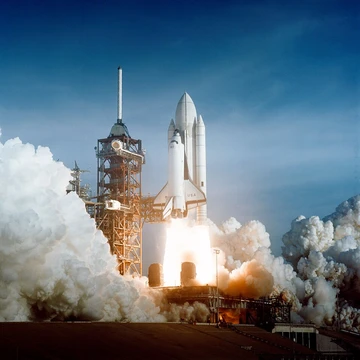
STS-41-G
First shuttle crew of seven, including two women.

STS-41-G, originally designated STS-12, marked the 13th mission of NASA's Space Shuttle program and the sixth flight for the orbiter Challenger. Challenger lifted off from Kennedy Space Center on October 5, 1984, and touched down there on October 13, 1984—the first shuttle landing at the KSC Shuttle Landing Facility. The crew of seven was the largest ever to fly on a single spacecraft at the time, and it set several firsts: two women flew together for the first time (Sally K. Ride and Kathryn D. Sullivan); Sullivan became the first American woman to perform a spacewalk; Paul D. Scully-Power was the first Australian-born person in space; and Marc Garneau became the first Canadian astronaut. The mission also carried an IMAX camera for the third time, with footage from the flight—including Sullivan and David Leestma’s spacewalk—appearing in the 1985 film *The Dream is Alive*.
The crew consisted of commander Robert L. Crippen (on his fourth shuttle flight and second in six months, making him the first American astronaut to complete two space missions in the same calendar year), pilot Jon A. McBride, mission specialists Leestma, Ride, and Sullivan, and payload specialists Scully-Power and Garneau. On October 11, 1984, Sullivan and Leestma performed a 3-hour, 29-minute spacewalk to test the Orbital Refueling System, demonstrating that satellites could be refueled in orbit. Nine hours after launch, the 2,307 kg Earth Radiation Budget Satellite (ERBS) was deployed from the payload bay using the Canadarm; its own thrusters boosted it to a 560 km orbit. ERBS was the first of three satellites designed to measure solar energy received and reradiated into space, as well as seasonal energy movement from the tropics to the poles.
Another major activity involved the Shuttle Imaging Radar-B (SIR-B), part of the OSTA-3 experiment package that also included a Large Format Camera for Earth photography, a MAPS camera for measuring air pollution, and a FILE experiment with two TV cameras and two 70 mm still cameras. SIR-B, an improved version of a device flown on STS-2, had an 11 × 2 meter antenna array. Problems with Challenger’s Ku-band antenna forced much of the radar data to be recorded onboard rather than transmitted in real time. Scully-Power, from the U.S.
Quick Facts
- Names List
- Space Transportation System-13
- Mission Type
- Satellite deployment / Radar imaging
- Operator
- NASA
- Distance Travelled
- 5293847 km
- Orbits Completed
- 133
- Spacecraft
- 099
- Launch Mass
- 110120 kg
- Landing Mass
- 91746 kg
- Payload Mass
- 8573 kg
- Crew Size
- 7
- Crew Members
- Robert L. Crippen · Jon A. McBride · Kathryn D. Sullivan · Sally K. Ride · David C. Leestma · Paul D. Scully-Power · Marc Garneau
- Crew Evas
- 1
Facts from the source article.
Lore & Background
The crew included commander Robert L. Crippen, making his fourth Shuttle flight and second in six months, becoming the first American astronaut to complete two space missions in the same calendar year. Pilot Jon A. McBride, mission specialists David C. Leestma, Sally K. Ride, and Kathryn D. Sullivan, and payload specialists Paul D. Scully-Power and Marc Garneau flew together. Sullivan became the first American woman to walk in space during a 3-hour EVA on October 11, 1984, demonstrating the Orbital Refueling System.
Reader's Guide
STS-41-G deployed the Earth Radiation Budget Satellite (ERBS) and operated the Shuttle Imaging Radar-B (SIR-B), though problems with Challenger's Ku-band antenna forced much data to be recorded onboard. Payload Specialist Scully-Power performed oceanography observations, and Garneau conducted Canadian government experiments. A claim that the Soviet Terra-3 laser tracking system caused equipment malfunction and crew blinding on October 10, 1984, was denied by crew members; in 2022, a former Soviet Minister stated a laser locator locked onto the shuttle. The mission's IMAX footage appeared in the 1985 film The Dream is Alive. Almost forty years later, one of Challenger's OMS engines was reused as the main engine for the Orion capsule on Artemis I.
Did You Know?
- STS-41-G was the first shuttle mission to carry a crew of seven.
- Kathryn D. Sullivan performed the first American EVA by a woman.
More in Space Shuttle missions 1-24
Spotted an error? Know more?
Reader corrections go straight into our review queue. Suggest an edit · How this site is sourced