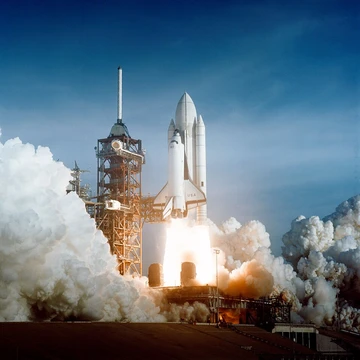
STS-41-D
Maiden flight of Discovery; first Shuttle launch abort.

STS-41-D (formerly STS-14) was the 12th flight of NASA's Space Shuttle program and the maiden flight of Space Shuttle Discovery. Launched from Kennedy Space Center, Florida, on August 30, 1984, and landing at Edwards Air Force Base, California, on September 5, 1984, the six-day mission deployed three commercial communications satellites and conducted scientific experiments, including a prototype solar array that later formed the basis for the International Space Station's main solar arrays. The mission experienced the Space Shuttle program's first launch abort at T−4 seconds on June 26, 1984, delaying the launch by over two months.
Quick Facts
- Names List
- Space Transportation System-12
- Mission Type
- Satellites deployment
- Operator
- NASA
- Distance Travelled
- 4010000 km
- Orbits Completed
- 97
- Spacecraft
- 103
- Launch Mass
- 119511 kg
- Landing Mass
- 91418 kg
- Payload Mass
- 18681 kg
- Crew Size
- 6
- Crew Members
- Henry W. Hartsfield Jr. · Michael L. Coats · Richard M. Mullane · Steven A. Hawley · Judith A. Resnik · Charles D. Walker
- Launch Site
- Kennedy, LC-39A
Facts from the source article.
Lore & Background
The launch was originally planned for June 25, 1984, but technical problems, including replacement of a faulty Space Shuttle Main Engine, caused a delay of over two months. During the June 26, 1984, launch attempt, a launch abort occurred at T−4 seconds, followed by a pad fire about ten minutes later. The abort marked the first time since Gemini 6A that a crewed spacecraft experienced an engine shutdown just prior to launch. Confusion ensued as flight controllers could not verify the state of the center engine, which had not started. About ten minutes after the abort, fire detectors indicated a hydrogen fire on the launch pad, and the crew evacuated without being doused by the pad deluge system, which activated after they had left. The fire was invisible to humans, and the normal escape route would have led the astronauts into it. Changes to procedures included more practice of 'safing' the orbiter, use of the fire suppression system in all pad aborts, and testing the slidewire escape system with a real person (Charles F. Bolden Jr.). Examination of telemetry data indicated the engine malfunction was caused by a stuck valve that prevented proper flow of LOX into the combustion chamber.
Reader's Guide
STS-41-D is significant as the maiden flight of Space Shuttle Discovery, which went on to become the longest-serving orbiter in the fleet. The mission deployed three commercial communications satellites—SBS-4, Telstar 302, and Syncom IV-2 (Leasat-2)—all successfully becoming operational. Leasat-2 was the first large communications satellite designed specifically for Shuttle deployment. The OAST-1 solar array, extended to 31 meters high, was the largest structure ever deployed from a crewed spacecraft at the time and demonstrated technology for the International Space Station. The mission also carried the first commercially sponsored payload specialist, Charles D. Walker of McDonnell Douglas, who operated the Continuous Flow Electrophoresis System for over 100 hours. Notably, STS-41-D was the first Shuttle mission where blow-by damage to the SRB O-rings was discovered, later identified as a 'big red flag' for safety after the Challenger disaster. The mission's launch abort and subsequent procedural changes improved crew safety for future flights.
Did You Know?
- STS-41-D was the maiden flight of Space Shuttle Discovery.
- The OAST-1 solar array deployed during the mission was the largest structure ever extended from a crewed spacecraft at the time.
- Blow-by damage to the SRB O-rings was first observed on STS-2, not on STS-41-D.
More in Space Shuttle missions 1-24
Spotted an error? Know more?
Reader corrections go straight into our review queue. Suggest an edit · How this site is sourced