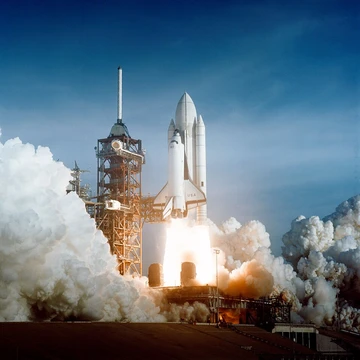
STS-41-C
First direct ascent; repaired Solar Max satellite.

STS-41-C, originally designated STS-13, was the eleventh Space Shuttle flight overall and the fifth for the orbiter Challenger. It lifted off on April 6, 1984, using a direct ascent trajectory for the first time in the program. The crew’s main tasks were to deploy the Long Duration Exposure Facility (LDEF) and to capture and fix the broken Solar Maximum Mission satellite, known as Solar Max.
The mission faced early trouble: during launch, both the primary and backup computers at the launch site (the Launch Processing System) failed, leaving controllers without data for a few minutes. Once in orbit, the crew released the LDEF—a 12-sided, 9,700-pound (about 4,400 kg) cylinder carrying 57 experiments from 200 researchers across eight countries—using the Canadarm. Though originally slated for retrieval in 1985, the LDEF was not brought back until January 1990, after delays and the Challenger disaster.
The Solar Max repair proved difficult. On the third day, astronauts Nelson and van Hoften suited up for a spacewalk. Nelson flew the Manned Maneuvering Unit to the satellite and tried three times to latch onto it with a Trunnion Pin Acquisition Device, but failed. When he grabbed a solar array by hand, the satellite began tumbling on multiple axes, and the attempt was called off. Commander Crippen had to maneuver Challenger aggressively, nearly depleting its RCS fuel. That night, engineers at Goddard Space Flight Center stabilized Solar Max by commanding its magnetorquers to slow its spin.
The next day, Crippen brought Challenger back alongside the now-slowly-spinning satellite, and astronaut Hart grappled it with the Canadarm. Nelson and van Hoften then performed two spacewalks—one lasting nearly three hours, the other over seven hours—to replace the satellite’s attitude control system and the main electronics of its coronagraph instrument. After repairs, Solar Max was redeployed and, following a 30-day checkout, resumed full operations.
Other activities included a student experiment showing that honeybees can build honeycomb in microgravity. An IMAX camera captured highlights of the LDEF deployment and Solar Max repair for the 1985 film *The Dream is Alive*. The mission lasted 6 days, 23 hours, 40 minutes, and 7 seconds, ending with a landing on Runway 17 at Edwards Air Force Base on April 13, 1984, after 108 orbits.
Quick Facts
- Names List
- Space Transportation System-41C / STS-13
- Mission Type
- Satellite deployment / Satellite repair
- Operator
- NASA
- Distance Travelled
- 4620000 km
- Orbits Completed
- 108
- Spacecraft
- 099
- Launch Mass
- 115328 kg
- Landing Mass
- 89346 kg
- Payload Mass
- 15345 kg
- Crew Size
- 5
- Crew Members
- Robert Crippen · Dick Scobee · Terry Hart · James van Hoften · George Nelson
- Crew Evas
- 2
Facts from the source article.
Lore & Background
STS-41-C launched at 8:58 a.m. EST on April 6, 1984, using a direct ascent trajectory that required only one burn of the Orbiter Maneuvering System to circularize its orbit. During ascent, both the main and backup computers at the launch site (the Launch Processing System) failed, leaving controllers without data for a few minutes. The crew deployed the Long Duration Exposure Facility (LDEF) on the second day, a 12-sided cylinder carrying 57 experiments from 200 researchers across eight countries. The LDEF was later retrieved in 1990 by STS-32 after delays including the Challenger disaster.
Reader's Guide
STS-41-C demonstrated the Space Shuttle's ability to perform complex on-orbit satellite servicing. The repair of the Solar Maximum Mission satellite, which involved two spacewalks and the use of the Manned Maneuvering Unit, marked the first time a satellite was captured, repaired, and redeployed in space. The mission also deployed the LDEF, a passive experiment platform that remained in orbit for nearly six years. The flight was extended by one day due to difficulties capturing Solar Max, and landed at Edwards Air Force Base instead of Kennedy Space Center. The mission's activities were featured in the IMAX film The Dream is Alive.
Did You Know?
- STS-41-C was originally numbered STS-13.
- The mission marked the first direct ascent trajectory for a Space Shuttle.
More in Space Shuttle missions 1-24
Spotted an error? Know more?
Reader corrections go straight into our review queue. Suggest an edit · How this site is sourced