STS-41-B
First untethered spacewalk and deployment of two communications satellites.

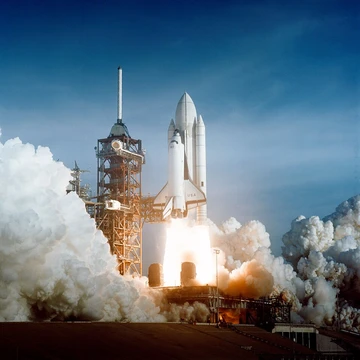
STS-41-B, the tenth Space Shuttle mission and the fourth for the orbiter Challenger, lifted off on February 3, 1984, and touched down on February 11, 1984. During the flight, two communications satellites were released. Its most famous achievement was the first spacewalk where astronauts were not tethered to the spacecraft.
The flight numbering system for the Shuttle program changed after STS-9. The flight that would have been STS-10 was canceled due to payload delays, so the next mission—originally called STS-11 internally—was redesignated STS-41-B.
Commander Vance D. Brand was on his second Shuttle flight. Pilot Robert L. Gibson and mission specialists Bruce McCandless II, Ronald E. McNair, and Robert L. Stewart rounded out the crew.
Challenger launched from Kennedy Space Center at 8:00 a.m. EST on February 3, 1984, with an estimated 100,000 people watching. About eight hours later, the crew deployed two Hughes-built HS-376-series communications satellites: Westar 6 for Western Union and Palapa B2 for Indonesia. Both satellites ended up in lower orbits than planned because their Payload Assist Modules failed. They were later retrieved successfully in November 1984 during STS-51-A aboard Discovery.
On February 7, the fourth day of the mission, McCandless and Stewart performed the first untethered spacewalk, using the Manned Maneuvering Unit (MMU) for the first time. At 8:25 a.m. EST, McCandless fired the MMU’s thrusters and moved 98 meters (322 feet) away from Challenger. Stewart tested a foot restraint at the end of the Canadarm. On the seventh day, both astronauts conducted another EVA to practice procedures for capturing and repairing the Solar Maximum Mission satellite, planned for STS-41-C.
The mission also carried the West German SPAS-1 pallet/satellite again (it first flew on STS-7), but an electrical issue with the Canadarm kept it in the payload bay. Five Get Away Special (GAS) canisters were aboard, along with six live rats in the middeck, a Cinema-360 camera, and ongoing experiments like the Continuous Flow Electrophoresis System and Monodisperse Latex Reactor. One GAS canister held the first space experiment designed and built by a high school team—a seed germination and growth study in zero gravity created by four students from Brighton High School in Utah, in partnership with Utah State University.
Quick Facts
- Names List
- Space Transportation System-41B / STS-11
- Mission Type
- Communications satellites deployment / Equipment testing
- Operator
- NASA
- Distance Travelled
- 5329150 km
- Orbits Completed
- 128
- Spacecraft
- 099
- Launch Mass
- 113603 kg
- Landing Mass
- 91280 kg
- Payload Mass
- 12815 kg
- Crew Size
- 5
- Crew Members
- Vance D. Brand · Robert L. Gibson · Ronald E. McNair · Robert L. Stewart · Bruce McCandless II
- Crew Evas
- 2
Facts from the source article.
Lore & Background
STS-41-B launched from Kennedy Space Center at 08:00:00 a.m. EST on February 3, 1984, with an estimated 100,000 people attending. About eight hours after launch, the crew deployed two Hughes-built HS-376-series communications satellites: Westar 6 for Western Union and Palapa B2 for Indonesia. However, both satellites' Payload Assist Modules malfunctioned, placing them into lower-than-planned orbits; they were later retrieved during STS-51-A in November 1984.
Reader's Guide
On February 7, 1984, astronauts McCandless and Stewart performed the first untethered spacewalk. McCandless used the Manned Maneuvering Unit to venture 98 meters from the orbiter, while Stewart tested a foot restraint on the Canadarm. A second EVA on February 9 practiced capture procedures for the Solar Maximum Mission satellite retrieval. The mission also carried scientific experiments, including the reflight of the SPAS-1 pallet (which remained in the payload bay due to an electrical problem), five Get Away Special canisters, and the first high school-designed experiment in space, from Brighton High School in Utah. During re-entry, ice from frozen dump valves damaged three thermal protection system tiles, but the crew was unharmed. The mission ended with the first landing of a spacecraft at its launch site, Kennedy Space Center's Shuttle Landing Facility.
Did You Know?
- STS-41-B was the first Space Shuttle mission to land at its launch site, Kennedy Space Center's Shuttle Landing Facility.
- The mission's original internal designation was STS-11, changed to STS-41-B after the flight numbering system was revised.
- Astronaut Bruce McCandless II sued singer Dido in 2010 over use of a public domain photo of him on this mission on her album Safe Trip Home.
- Ronald E. McNair, a crew member on this mission, later died in the Challenger disaster on STS-51-L.
More in Space Shuttle missions 1-24
Spotted an error? Know more?
Reader corrections go straight into our review queue. Suggest an edit · How this site is sourced