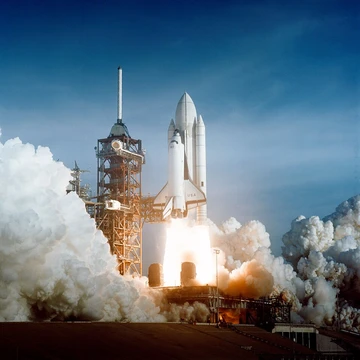
STS-39
First unclassified DoD-dedicated Space Shuttle mission.

STS-39 marked the twelfth flight of the Space Shuttle Discovery and the 39th orbital mission for the shuttle program. Its main goal was to run a series of payload experiments for the U.S. Department of Defense, and it became the first DoD-dedicated shuttle mission that was not classified.
The launch was originally set for March 9, 1991, but during pad processing at LC-39A, cracks were found on all four lug hinges of the two external tank umbilical door drive mechanisms. NASA decided to roll the vehicle back to the Vehicle Assembly Building on March 7, 1991, and then to the Orbiter Processing Facility for repairs. The faulty hinges were swapped with ones from the orbiter Columbia, which were also reinforced. Discovery returned to the pad on April 1, 1991, with a new launch date of April 23. That attempt was delayed again when a transducer on the high-pressure oxidizer turbopump for main engine number three gave readings outside acceptable limits during prelaunch tank loading. The transducer and its cable harness were replaced and tested, pushing the launch to April 28. Liftoff finally happened on April 28, 1991, at 7:33:14 a.m. EDT, with a launch weight of 112,207 kg.
The unclassified payloads included Air Force Program-675 (AFP-675); the Infrared Background Signature Survey (IBSS), which carried Critical Ionization Velocity (CIV), Chemical Release Observation (CRO), and Shuttle Pallet Satellite-II (SPAS-II) experiments; and Space Test Payload-1 (STP-1). The classified payload was the Multi-Purpose Release Canister (MPEC). Also aboard were Radiation Monitoring Equipment-III (RME-III) and the Cloud Logic to Optimize Use of Defense Systems-1A (CLOUDS-1A). While seven earlier DoD-dedicated shuttle missions had been fully classified, STS-39 kept only the MPEC payload secret. According to one crew member, astronaut Guion Bluford reportedly deployed the classified payload by himself while the rest of the crew “pretended not to notice.”
The crew split into two teams to work around the clock. They observed the atmosphere, gas releases, Discovery’s orbital environment, and firings of the orbiter’s engines across wavelengths from infrared to far ultraviolet. Five spacecraft or satellites were deployed from the payload bay, and one was later retrieved. The cargo bay carried AFP-675, IBSS, STP-01, and the MPEC, while the crew cabin held CLOUDS-1A and RME-III.
Quick Facts
- Names List
- Space Transportation System-39
- Mission Type
- DoD research
- Operator
- NASA
- Distance Travelled
- 5584423 km
- Orbits Completed
- 134
- Spacecraft
- 103
- Launch Mass
- 112207 kg
- Landing Mass
- 102755 kg
- Payload Mass
- 5663 kg
- Crew Size
- 7
- Crew Members
- Michael L. Coats · L. Blaine Hammond · Gregory J. Harbaugh · Donald R. McMonagle · Guion Bluford · Charles L. Veach · Richard Hieb
- Launch Site
- Kennedy, LC-39A
Facts from the source article.
Lore & Background
Launch was originally scheduled for March 9, 1991, but cracks found on all four lug hinges of the external tank umbilical door drive mechanisms forced a rollback to the Vehicle Assembly Building and then to the Orbiter Processing Facility for repair. Faulty hinges were replaced with units from orbiter Columbia and reinforced. Discovery returned to the pad on April 1, 1991, and launch was rescheduled for April 23, then postponed again due to a transducer issue on a main engine turbopump. Actual launch occurred on April 28, 1991, at 7:33:14 a.m. EDT.
The crew was divided into two teams for around-the-clock operations. Unclassified payloads included Air Force Program-675, Infrared Background Signature Survey (IBSS) with several experiments, and Space Test Payload-1. The classified payload was in the Multi-Purpose Release Canister (MPEC). The mission landed at Kennedy Space Center as planned, with no diversion to Edwards Air Force Base.
Reader's Guide
STS-39 marked a significant shift in the U.S. Department of Defense's use of the Space Shuttle, as it was the first DoD-dedicated mission where most payloads and experiments were unclassified. This allowed public insight into military space operations that had previously been secret. The mission carried a mix of scientific and defense-related experiments, including observations of the atmosphere, gas releases, and engine firings across multiple wavelengths. The crew overcame technical challenges, such as repairing tape recorders by routing wires to a Ku-band antenna to transmit data directly to the ground. The high orbital inclination of 57.01° enabled the crew to observe most of Earth's large land masses. STS-39 landed at Kennedy Space Center instead of Edwards Air Force Base due to high winds at the planned site, demonstrating the flexibility of Shuttle operations. Its legacy includes advancing the understanding of infrared signatures and space-based defense technologies.
Did You Know?
- Launch was delayed twice: first due to cracks on all four lug hinges of the external tank umbilical door drive mechanisms, then due to a transducer issue on a main engine turbopump.
- The crew reportedly allowed one member to launch the classified payload alone while the rest pretended not to notice.
- Two tape recorders failed after only four hours of work, requiring a two-hour bypass repair using a Ku-band antenna to send data directly to a ground station.
- Landing was diverted to Kennedy Space Center because of unacceptably high winds at Edwards Air Force Base.
More in Space Shuttle missions 1-24
Spotted an error? Know more?
Reader corrections go straight into our review queue. Suggest an edit · How this site is sourced