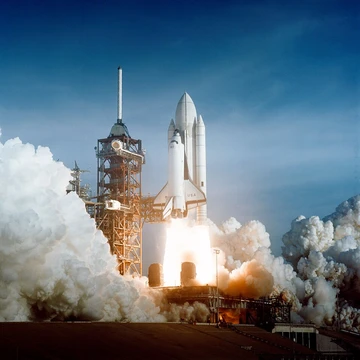
STS-38
Classified DoD shuttle mission with secret satellite deployment.

STS-38, the 37th Space Shuttle flight, saw Atlantis lift off on November 15, 1990, at 18:48:13 EST after a series of delays. Originally slated for July, the mission was pushed back when a hydrogen leak discovered on Atlantis itself during the STS-35 countdown led to three precautionary tanking tests. These tests confirmed a leak in the external tank’s quick disconnect umbilical, forcing a rollback to the Orbiter Processing Facility on August 9. During that rollback, Atlantis sat outside the Vehicle Assembly Building for about a day and suffered minor hail damage to its tiles. Repairs followed, but a falling platform beam during hoisting operations in the VAB caused additional minor damage. After rollout to Pad A on October 12, a fourth tanking test on October 24 showed no leaks. The launch was then set for November 9, but payload problems pushed it to November 15, with liftoff occurring within a classified window between 18:30 and 22:30 EST.
The mission carried a classified U.S. Department of Defense payload, code-named USA-67. According to Aviation Week, Atlantis initially entered a 204 km by 519 km orbit at a 28.45° inclination, then performed three OMS burns—the last on orbit four—to circularize at 519 km. USA-67 was deployed on the seventh orbit and ignited its rocket motor at the ascending node of the eighth to enter a geostationary transfer orbit. Originally thought to be a Magnum satellite launched via a two-stage Inertial Upper Stage, it is now believed to be a Satellite Data System (SDS-2) military communications satellite. A publicly released image of Atlantis’s vertical stabilizer and upper aft bulkhead, similar to one from STS-53, confirms the absence of the IUS airborne support equipment, suggesting two separate satellites were deployed using single-stage Payload Assist Modules. Amateur observers have identified an “unknown” geostationary satellite, but claims of a second, stealth payload called Prowler remain unsubstantiated rumors.
The 4-day, 21-hour, 54-minute mission covered 3,291,199 km over 79 revolutions. Landing was always planned for Kennedy Space Center’s Shuttle Landing Facility as the primary site, with Edwards Air Force Base as backup. This marked the first return to KSC in five years—since STS-51-D, when Discovery suffered a brake failure.
Quick Facts
- Names List
- Space Transportation System-38
- Mission Type
- DoD satellite deployment
- Operator
- NASA
- Distance Travelled
- 3291199 km
- Orbits Completed
- 79
- Spacecraft
- 104
- Launch Mass
- 2,055,639 kg
- Landing Mass
- 86677 kg
- Payload Mass
- (Classified)
- Crew Size
- 5
- Crew Members
- Richard O. Covey · Frank L. Culbertson Jr. · Carl J. Meade · Robert C. Springer · Charles D. Gemar
- Launch Site
- Kennedy, LC-39A
Facts from the source article.
Lore & Background
STS-38 was originally scheduled for July 1990 but was delayed due to a hydrogen leak found on Atlantis itself during the STS-35 countdown. During a rollback to the Orbiter Processing Facility, Atlantis was damaged by a hail storm. The eventual launch date of November 15, 1990, was set due to a payload problem. The launch occurred at 18:48:13 EST within a classified window between 18:30 and 22:30 EST.
The mission carried a classified payload code-named USA-67, which was deployed on the seventh orbit. According to Aviation Week, USA-67 was initially believed to be a Magnum satellite but is now thought to be a secret Satellite Data System (SDS-2) military communications satellite. Rumors of a second satellite—a stealth satellite known as Prowler—are unsubstantiated and not established canon.
Reader's Guide
STS-38 was a pivotal classified mission for the U.S. Department of Defense, demonstrating the Space Shuttle's ability to deploy secret payloads during a period of heightened geopolitical tension, including the first Gulf War. The mission's delays and technical issues—from a hydrogen leak to hail damage—highlight the complexities of shuttle operations. The uncertainty surrounding the payloads, with conflicting reports about whether USA-67 was a Magnum or SDS-2 satellite, and the possible deployment of a stealth satellite, underscores the secrecy that often shrouded DoD shuttle flights. The landing at Kennedy Space Center, after a five-year hiatus, marked a return to the original landing site and set a precedent for future KSC landings. STS-38 remains a subject of interest for space historians and amateur satellite observers due to its classified nature and the lingering questions about its cargo.
Did You Know?
- STS-38 was the seventh flight for Atlantis and the seventh shuttle mission dedicated to the Department of Defense.
- The launch was delayed from July 1990 due to a hydrogen leak found on Columbia during the STS-35 countdown.
- Atlantis suffered minor hail damage to its tiles while parked outside the Vehicle Assembly Building during a thunderstorm.
- The mission landed at Kennedy Space Center's Shuttle Landing Facility for the first time in five years, since STS-51-D.
More in Space Shuttle missions 1-24
Spotted an error? Know more?
Reader corrections go straight into our review queue. Suggest an edit · How this site is sourced