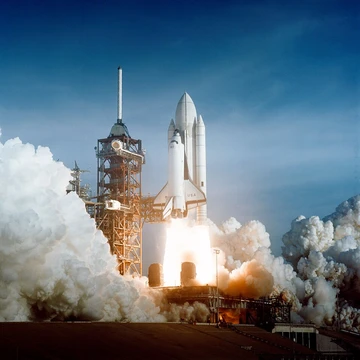
STS-37
Deployed the Compton Gamma Ray Observatory; first U.S. spacewalks since 1985.

STS-37 was the thirty-eighth NASA Space Shuttle mission and the eighth flight of the Space Shuttle Atlantis. Launched on April 5, 1991, the six-day mission's primary objective was deploying the Compton Gamma Ray Observatory (CGRO), the second of NASA's Great Observatories program. The mission is notable for featuring the first U.S. spacewalks since 1985, including an unscheduled contingency spacewalk to free a stuck antenna on the CGRO.
Quick Facts
- Names List
- Space Transportation System-37
- Mission Type
- Compton Gamma Ray Observatory deployment
- Operator
- NASA
- Distance Travelled
- 2487075 mi
- Orbits Completed
- 93
- Spacecraft
- 104
- Launch Mass
- 116040 kg
- Landing Mass
- 86227 kg
- Payload Mass
- 17204 kg
- Crew Size
- 5
- Crew Members
- Steven R. Nagel · Kenneth D. Cameron · Linda M. Godwin · Jerry L. Ross · Jerome Apt
- Crew Evas
- 2
Facts from the source article.
Lore & Background
The STS-37 crew consisted of five astronauts: Commander Steven R. Nagel, Pilot Kenneth D. Cameron, and Mission Specialists Jerry L. Ross, Jerome Apt, and Linda M. Godwin. The mission launched from Kennedy Space Center's pad 39A after a brief delay due to weather concerns. The primary payload, the CGRO, was deployed on flight day 3, but its high-gain antenna failed to deploy on command. After six failed attempts by ground controllers, Mission Specialists Ross and Apt performed an unscheduled contingency spacewalk on April 7, 1991, freeing the antenna boom within 17 minutes. This was the first U.S. spacewalk since April 1985.
Reader's Guide
STS-37 holds significance as the mission that deployed the Compton Gamma Ray Observatory, a 16,000 kg satellite that was the heaviest ever deployed from the Shuttle into low Earth orbit. The CGRO was the second of NASA's four Great Observatories, following the Hubble Space Telescope, and it conducted a two-year mission to study gamma-ray emissions from celestial sources. The mission also marked the resumption of U.S. spacewalks after a six-year hiatus, with two EVAs that demonstrated both contingency repair capabilities and techniques for future space station construction. The unscheduled spacewalk to free the CGRO's antenna highlighted the value of human presence in orbit for troubleshooting. Additionally, the mission's amateur radio experiment and photography of the Kuwaiti oil fires provided unique scientific and cultural contributions. The landing at Edwards Air Force Base, delayed by weather, was notable for an incorrect wind call that caused Atlantis to land 623 feet short of the runway threshold, though without incident.
Did You Know?
- The CGRO was the heaviest satellite deployed into low Earth orbit from the Shuttle, at about 15,620 kg.
- The first spacewalk of STS-37 was the first unscheduled contingency EVA since STS-51-D in April 1985.
- During the second spacewalk, a puncture in Apt's glove was noticed by Apt himself during the EVA.
- The crew photographed the Kuwaiti oil fires on April 7, 1991, during the Gulf War.
More in Space Shuttle missions 1-24
Spotted an error? Know more?
Reader corrections go straight into our review queue. Suggest an edit · How this site is sourced