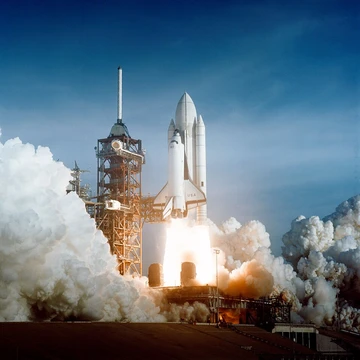
STS-36
Classified DoD shuttle mission deploying a reconnaissance satellite.

STS-36 was a NASA Space Shuttle mission flown by the orbiter Atlantis, carrying a classified payload for the U.S. Department of Defense. Launched on February 28, 1990, and landing on March 4, 1990, it was the 34th shuttle mission overall, the sixth flight for Atlantis, and the fourth night launch of the shuttle program. The mission is notable for its classified nature, a unique launch trajectory, and the deployment of what is believed to have been a Misty reconnaissance satellite.
Quick Facts
- Names List
- Space Transportation System-36 / STS-36
- Mission Type
- DoD satellite deployment
- Operator
- NASA
- Distance Travelled
- 2957913 km
- Orbits Completed
- 72
- Spacecraft
- 104
- Launch Mass
- 2,044,469 kg
- Landing Mass
- 84,912 kg
- Payload Mass
- 19600 kg
- Crew Size
- 5
- Crew Members
- John Oliver Creighton · John Casper · Pierre J. Thuot · David C. Hilmers · Mike Mullane
- Launch Date
- February 28, 1990, 07:50:22UTC (2:50:22amEST)
Facts from the source article.
Lore & Background
The mission also carried a 5 kg (11 lb) human skull as part of the 'In-flight Radiation Dose Distribution Experiment' (IDRD), a joint NASA/DoD experiment to examine radiation penetration into the human cranium during spaceflight. The female skull was seated in a plastic matrix, sliced into ten layers, and mounted with hundreds of thermo-luminescent dosimeters. This experiment, which also flew on STS-28 and STS-31, was located in the shuttle's mid-deck lockers. Atlantis landed on March 4, 1990, at 18:08:44 UTC (10:08:44 am PST) at Edwards Air Force Base on dry lakebed runway 23. About 62 impacts in the Thermal Protection System tiles were counted, with only one tile requiring replacement.
Reader's Guide
STS-36 holds significance as a secretive Department of Defense mission that demonstrated the Space Shuttle's ability to deploy classified national security payloads. Its unique 'dog-leg' trajectory allowed the shuttle to reach a higher orbital inclination than standard, showcasing mission flexibility for military requirements. The mission's payload, believed to be the Misty reconnaissance satellite, contributed to U.S. intelligence-gathering capabilities during the Cold War. The inclusion of the radiation dose experiment using a human skull provided valuable data on space radiation effects, relevant to long-duration human spaceflight. The mission also highlighted operational challenges, including delays due to crew illness and weather, and the waiver of safety rules for national defense. STS-36 remains a notable example of the intersection between civilian spaceflight and military objectives, with its payload still officially classified.
Did You Know?
- STS-36 was the first crewed space mission affected by crew illness since Apollo 13 in 1970.
- The mission used a 'dog-leg' trajectory to reach a 62° orbital inclination, exceeding the normal shuttle maximum of 57°.
- A 5 kg human skull was flown as part of a radiation dose experiment, also flown on STS-28 and STS-31.
- The payload is believed to have been a Misty reconnaissance satellite, a stealthy spacecraft distinct from the Advanced KH-11 series.
More in Space Shuttle missions 1-24
Spotted an error? Know more?
Reader corrections go straight into our review queue. Suggest an edit · How this site is sourced