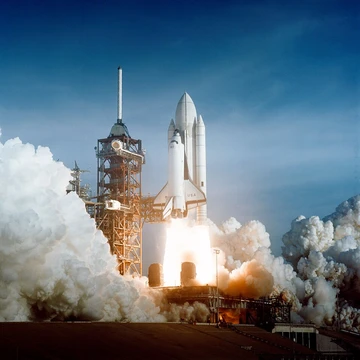
STS-35
Tenth flight of Columbia, devoted to astronomical observations with ASTRO-1.

STS-35, the tenth flight of the Space Shuttle *Columbia* and the 38th overall shuttle mission, carried a crew of seven—the second time that many astronauts had flown together since the Challenger accident (after STS-31 in April 1990). Its sole purpose was astronomical observation using the ASTRO-1 Spacelab observatory, a package of four telescopes. Liftoff occurred from Kennedy Space Center at 1:49:00 a.m. EST on December 2, 1990.
The mission had originally been scheduled as STS-61-E for March 1986, before the Challenger disaster. That earlier plan had Jon A. McBride as commander, but he left NASA in May 1989, and Vance D. Brand took over. At 59, Brand became the oldest astronaut in space at the time, a record later surpassed by Story Musgrave (61 on STS-80) and John Glenn (77 on STS-95). Other crew changes included Guy S. Gardner replacing pilot Richard N. Richards, and John M. Lounge replacing mission specialist David C. Leestma.
The launch was one of the most delayed in shuttle history. After the Challenger stand-down, the ASTRO-1 payload was taken out of storage and recertified, with the addition of the Broad Band X-ray Telescope (BBXRT-01). *Columbia* first rolled out to Pad 39A in late April 1990 for a planned May 16 launch, but a faulty freon coolant valve caused a delay. A May 30 attempt was scrubbed during tanking due to hydrogen leaks—one in the tail service mast, another in the external tank/orbiter quick disconnect, and a third detected in the orbiter’s aft compartment. A mini-tanking test on June 6 confirmed a leak in the 43 cm (17 in) umbilical assembly. Unable to fix it at the pad, the vehicle was rolled back to the Vehicle Assembly Building on June 12, demated, and moved to the Orbiter Processing Facility. The orbiter’s umbilical assembly was replaced with one borrowed from *Endeavour* (still under construction), and the external tank got new hardware. ASTRO-1 remained in the cargo bay during repairs.
*Columbia* rolled out again on August 9 for a September 1 launch, but two days before liftoff, the BBXRT-01 avionics box failed and had to be replaced. The new target was September 6, but during tanking, high hydrogen concentrations reappeared in the aft compartment. Managers concluded separate leaks existed: the umbilical (already fixed) and one or more in the aft compartment.
Quick Facts
- Names List
- Space Transportation System-35
- Mission Type
- Astronomical observations
- Operator
- NASA
- Distance Travelled
- 6000658 km
- Orbits Completed
- 144
- Spacecraft
- 102
- Launch Mass
- 121344 kg
- Landing Mass
- 102208 kg
- Payload Mass
- 12095 kg
- Crew Size
- 7
- Crew Members
- Vance D. Brand · Guy S. Gardner · Jeffrey A. Hoffman · John M. Lounge · Robert A. Parker · Samuel T. Durrance · Ronald Parise
- Launch Site
- Kennedy, LC-39B
Facts from the source article.
Lore & Background
Prior to the Challenger disaster, this mission was slated to launch in March 1986 as STS-61-E. Jon A. McBride was originally assigned to command, but he retired from NASA in May 1989 and was replaced by Vance D. Brand. Richard N. Richards and David C. Leestma were replaced by Guy S. Gardner and John M. Lounge respectively. Fifty-nine-year-old Brand was the oldest astronaut to fly into space until F. Story Musgrave (61 on STS-80 in 1996) and U.S. Senator John H. Glenn Jr. (77 on STS-95 in 1998).
The much-delayed ASTRO-1 had originally been manifested for STS-61-E. After the Challenger accident, the mission was remanifested as STS-35 with the addition of the Broad Band X-ray Telescope (BBXRT-01). Columbia rolled out to Pad 39A in late April 1990 for a scheduled launch of May 16, but multiple hydrogen leaks caused repeated delays, including a rollback to the Vehicle Assembly Building and a transfer to Pad B. Liftoff finally occurred on December 2, 1990, at 1:49:01 a.m. EST, the ninth night launch in shuttle history.
Reader's Guide
STS-35 was one of the most delayed launches of the Space Shuttle program, facing numerous hydrogen leaks and technical issues that postponed the flight for months. Its primary payload, ASTRO-1, conducted round-the-clock observations of the celestial sphere in ultraviolet and X-ray spectral wavelengths. The crew split into two shifts—Red Team (Gardner, Parker, Parise) and Blue Team (Hoffman, Durrance, Lounge)—with Commander Brand coordinating. Despite pointing precision issues with the Instrument Pointing System and failures of both data display units, the telescopes obtained 231 observations of 130 celestial objects over 143 hours. The mission demonstrated the complexity of operating multiple astronomical instruments from the Shuttle and highlighted the challenges of post-Challenger safety and reliability improvements.
Did You Know?
- STS-35 was the first shuttle mission since the Challenger disaster with a crew of seven astronauts.
- Commander Vance D. Brand, at age 59, was the oldest astronaut to fly into space until F. Story Musgrave on STS-80 in 1996.
- The mission was originally scheduled as STS-61-E in March 1986 before the Challenger accident.
- Liftoff was delayed by 21 minutes to allow the U.S. Air Force time to observe low-level clouds that might impede tracking of the Shuttle's ascent.
More in Space Shuttle missions 1-24
Spotted an error? Know more?
Reader corrections go straight into our review queue. Suggest an edit · How this site is sourced