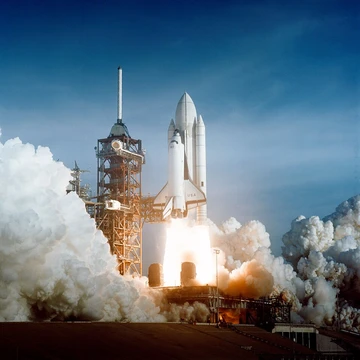
STS-34
Deployed Galileo probe; first shuttle with two women since Challenger.

STS-34 marked the 31st flight of NASA's Space Shuttle program and the fifth mission for the orbiter Atlantis. Launching from Kennedy Space Center in Florida on October 18, 1989, the mission touched down at Edwards Air Force Base in California five days later, on October 23. The primary objective was the deployment of the Galileo spacecraft, which was sent on a trajectory toward Jupiter.
The crew included a native of Costa Rica, Franklin Chang-Díaz, who described his second spaceflight as far more subdued than his first. Demonstrators protested the launch due to Galileo's radioisotope thermoelectric generator. Chang-Díaz later noted that the mission nearly had to abort in orbit three times due to malfunctions, but the crew pressed on because landing Atlantis in Senegal—carrying Galileo and its nuclear power source—could have sparked an international incident. He also recalled that deploying Galileo gave him only a tight six-second window to succeed.
Atlantis lifted off from Launch Complex 39B at 12:53:40 p.m. EDT. The countdown was held for nearly four minutes to update onboard computers after the Transoceanic Abort Landing site was switched from Ben Guerir, Morocco, to Zaragoza, Spain, due to heavy rain. Originally scheduled for October 12, the launch was pushed to October 17 to replace a faulty main engine controller, then delayed again to October 18 because rain showers near the Shuttle Landing Facility violated weather rules for a possible return-to-launch-site abort.
The Galileo spacecraft, attached to an Inertial Upper Stage booster, was deployed about six hours after launch. It was only the second shuttle mission to deploy a planetary probe—the first being STS-30, which launched Magellan. Galileo went on to become the first spacecraft to orbit an outer planet, penetrate its atmosphere, and conduct extended observations of the Jovian system, as well as the first to fly by asteroids. Its journey required three gravity assists—from Venus, Earth, and Earth again—and it later observed asteroids 951 Gaspra and 243 Ida.
Several minor anomalies occurred during the flight. On October 22, an alarm woke the crew when a heater on Auxiliary Power Unit 2 failed to recycle properly.
Quick Facts
- Names List
- Space Transportation System-34 / STS-34
- Mission Type
- Galileo spacecraft deployment
- Operator
- NASA
- Distance Travelled
- 2900000 km
- Orbits Completed
- 79
- Spacecraft
- 104
- Launch Mass
- 116831 kg
- Landing Mass
- 88881 kg
- Payload Mass
- 22064 kg
- Launch Site
- Kennedy, LC-39B
- Launch Contractor
- Rockwell International
Facts from the source article.
Lore & Background
STS-34 lifted off from Launch Complex 39B at Kennedy Space Center at 12:53:40 EDT on October 18, 1989, carrying the Galileo spacecraft in its cargo bay. The countdown was delayed at T-minus 5 minutes for 3 minutes and 40 seconds to update the onboard computer for a change in the Transoceanic Abort Landing site from Ben Guerir Air Base, Morocco, to Zaragoza Air Base, Spain, because of heavy rain. The launch was originally targeted for October 12, 1989, the first day of a 41-day launch period for a direct flight to Jupiter, but was rescheduled to October 17 to replace a faulty main engine controller, then postponed again to October 18 due to rain showers near the Shuttle Landing Facility.
The primary payload, the Galileo spacecraft with its attached Inertial Upper Stage, was successfully deployed on its journey to Jupiter. STS-34 was only the second shuttle flight to deploy a planetary spacecraft, the first being STS-30, which deployed Magellan. Galileo later became the first spacecraft to orbit an outer Solar System planet and to penetrate the atmosphere of an outer planet. Several anomalies occurred during the flight, including a failed heater recycle on an auxiliary power unit, minor problems with the Flash Evaporator System, and a jammed Hasselblad camera. On October 21, 1989, Costa Rican President Dr. Óscar Arias talked in Spanish with astronaut Chang-Díaz, a native of Costa Rica, via a special telephone linkup.
Reader's Guide
STS-34 is significant as the mission that deployed the Galileo spacecraft, which revolutionized understanding of the Jovian system. It was only the second shuttle mission to deploy a planetary spacecraft, following STS-30. The mission also marked the first time since the Challenger disaster that two female astronauts flew together on a shuttle. The flight faced multiple delays due to technical and weather issues, and experienced several in-flight anomalies, but none prevented the successful deployment of Galileo. The mission's crew also conducted a range of experiments, including the Shuttle Solar Backscatter Ultraviolet experiment, polymer morphology studies, and a student experiment on ice crystal growth. The flight's legacy includes its role in advancing planetary science and demonstrating the shuttle's capability for complex interplanetary missions.
Did You Know?
- STS-34 was the first shuttle mission since the Challenger disaster to have two female astronauts on board.
- The Galileo spacecraft deployed during STS-34 became the first spacecraft to orbit an outer Solar System planet.
- The launch was delayed twice: once to replace a faulty main engine controller, and once due to rain showers near the landing facility.
- Costa Rican President Dr. Óscar Arias spoke in Spanish with astronaut Chang-Díaz during the mission.
More in Space Shuttle missions 1-24
Spotted an error? Know more?
Reader corrections go straight into our review queue. Suggest an edit · How this site is sourced