STS-33
Classified DoD shuttle mission deploying a secret ELINT satellite.

STS-33 was the 31st Space Shuttle mission and the tenth flight of the orbiter Discovery. It carried a classified payload for the U.S. Department of Defense, making it the sixth shuttle mission dedicated to the DoD. This flight was also the seventh since the Challenger disaster and the final shuttle mission of the 1980s. Because of the secret nature of the operation, most details about the payload remain undisclosed.
The mission was originally designated STS-33R to avoid data-tracking conflicts with earlier missions that used the same number sequence. Flights STS-26 through STS-33 after the disaster carried an "R" in official documentation for this reason.
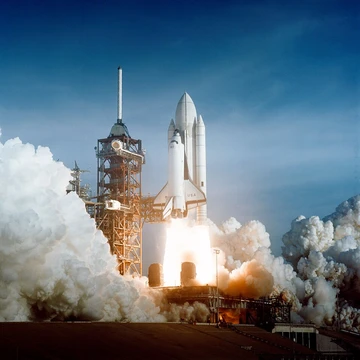
Discovery launched from Kennedy Space Center's Launch Complex 39B on November 22, 1989, at 7:23:30 p.m. EST, marking the third night launch in shuttle history and the second since flights resumed in 1988. The launch was originally set for November 20 but was delayed by issues with the electronics controlling the solid rocket boosters' ignition and separation.
The crew included pilot John Blaha, who replaced S. David Griggs after Griggs was killed in a vintage aircraft crash in June 1989. Griggs is honored on the mission patch with a gold star. Mission specialist Sonny Carter, who flew on this mission, later died in a commercial plane crash in April 1991 while training for STS-42.
During the flight, Discovery deployed a single satellite, designated USA-48. Experts believe it was a secret Magnum ELINT satellite destined for geosynchronous orbit, similar to the one launched on STS-51-C in 1985. According to ABC News, the satellite was meant to intercept communications from the Soviet Union, China, and other communist states, and it replaced an earlier satellite running low on station-keeping fuel. However, astronaut Gary E. Payton stated in 2009 that the STS-51-C payload was still operational.
Aviation Week reported that Discovery first entered a 204 km by 519 km orbit at a 28.45° inclination. Three OMS burns followed, the last on the fourth orbit, circularizing the orbit at 519 km. The satellite was deployed on the seventh orbit, and its Inertial Upper Stage fired at the ascending node of the eighth orbit, placing it into geostationary transfer orbit. This was the eighth IUS launched from a shuttle and the seventh successful deployment.
Quick Facts
- Names List
- Space Transportation System-33 / STS-33R
- Mission Type
- DoD satellite deployment
- Operator
- NASA
- Distance Travelled
- 3400000 km
- Orbits Completed
- 79
- Spacecraft
- 103
- Landing Mass
- 88125 kg
- Payload Mass
- 21000 kg
- Crew Size
- 5
- Crew Members
- Frederick D. Gregory · John E. Blaha · Sonny Carter · Story Musgrave · Kathryn C. Thornton
- Launch Site
- Kennedy, LC-39B
- Launch Contractor
- Rockwell International
Facts from the source article.
Lore & Background
STS-33 was originally scheduled to launch on November 20, 1989, but was delayed because of problems with the integrated electronics assemblies controlling the ignition and separation of the shuttle's solid rocket boosters. It was the third night launch of the Space Shuttle program, and the second since shuttle flights resumed in 1988 following the Challenger disaster. Discovery lifted off from Launch Complex 39B at Kennedy Space Center, Florida, on November 22, 1989, at 7:23:30 p.m. EST.
Reader's Guide
STS-33 deployed a single satellite, USA-48, which experts believe was a secret Magnum ELINT satellite headed for geosynchronous orbit, similar to that launched by STS-51-C in 1985. According to ABC News, USA-48 was intended to eavesdrop on military and diplomatic communications from the Soviet Union, China, and other communist states. The satellite was a replacement for the one launched by STS-51-C, which was running out of maneuvering fuel. However, astronaut Gary E. Payton stated in 2009 that STS-51-C's payload is 'still up there, and still operating.' The mission suffered a cabin leak in the Waste Collection System and was observed by the U.S. Air Force Maui Optical and Supercomputing observatory during five passes over Hawaii. Landing was postponed a day due to strong winds, touching down at Edwards Air Force Base, California, on November 27, 1989.
More in Space Shuttle missions 1-24
Spotted an error? Know more?
Reader corrections go straight into our review queue. Suggest an edit · How this site is sourced