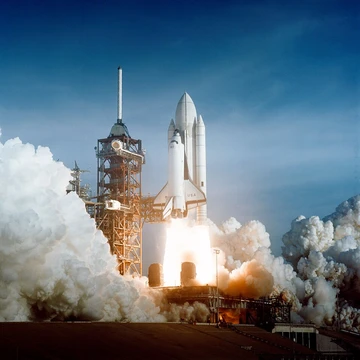
STS-32
First shuttle mission of the 1990s, retrieved LDEF after 4½-year delay.

STS-32 was the 33rd mission of NASA's Space Shuttle program and the eighth launch of Space Shuttle Columbia. Launched on January 9, 1990, it was the first Shuttle mission of the 1990s and, at the time, the longest shuttle mission yet conducted, with a duration of 10 days, 21 hours, 0 minutes, 36 seconds. The mission deployed the Leasat 5 (Syncom IV-5) military communications satellite and retrieved NASA's Long Duration Exposure Facility (LDEF), whose retrieval had been delayed for 4½ years.
Quick Facts
- Names List
- Space Transportation System-32 / STS-32R
- Mission Type
- Syncom IV-F5 satellite deployment / LDEF satellite retrieval
- Operator
- NASA
- Distance Travelled
- 7258096 km
- Orbits Completed
- 172
- Spacecraft
- 102
- Launch Mass
- 116117 kg
- Landing Mass
- 103571 kg
- Payload Mass
- 12014 kg
- Crew Size
- 5
- Crew Members
- Daniel Brandenstein · Jim Wetherbee · Bonnie J. Dunbar · Marsha Ivins · G. David Low
- Launch Site
- Kennedy, LC-39A
Facts from the source article.
Lore & Background
STS-32 marked the inaugural launch from Kennedy Space Center Launch Complex 39A following an extensive refurbishment, the first use of that pad since 1986. It also marked the first use of Mobile Launcher Platform-3 (MLP-3) in the Space Shuttle program, a legacy structure from the Apollo program that was substantially retrofitted for shuttle operations. The launch was initially scheduled for December 18, 1989, but was postponed to allow modifications to Pad A to be completed and verified; a second scheduled launch on January 8, 1990, was aborted due to weather conditions.
The primary objectives were to deploy the Leasat 5 (Syncom IV-5) military communications satellite and to retrieve NASA's Long Duration Exposure Facility (LDEF). The LDEF retrieval was of critical importance because a high rate of solar flux had increased the density of its orbital environment and accelerated its rate of orbital decay; specialists had anticipated that if not retrieved in time, it would pass too low for the shuttle to safely reach and could be destroyed during re-entry in February 1990. The mission's exact liftoff time was determined about 12 hours before launch using the latest tracking data on LDEF. The crew performed a 4½-hour photographic survey of the free-flying structure, which held 57 science, technology and applications experiments, before berthing it in the orbiter's payload bay.
Reader's Guide
STS-32 was significant as the first Shuttle mission of the 1990s and for setting a new shuttle duration record of nearly eleven days, surpassing the previous record set by STS-9 in 1983. The mission demonstrated the ability to perform complex rendezvous and retrieval operations under time-critical conditions, successfully recovering the Long Duration Exposure Facility after a 4½-year delay caused by scheduling changes and the Challenger disaster. The retrieval was filmed with an IMAX camera and later appeared in the 1994 film Destiny in Space. STS-32 also marked the return to service of Launch Complex 39A after extensive modifications, and the first use of Mobile Launcher Platform-3 in the Shuttle program. The mission's technical designation was STS-32R, as the original STS-32 designator had been used internally for STS-61-C, and flights with STS-26 through STS-33 designators used the R in their documentation to avoid conflicts in tracking data.
Did You Know?
- STS-32 was the first use of Kennedy Space Center Launch Complex 39A since 1986.
- STS-32 executed the third night landing of the shuttle program on January 20, 1990.
More in Space Shuttle missions 1-24
Spotted an error? Know more?
Reader corrections go straight into our review queue. Suggest an edit · How this site is sourced