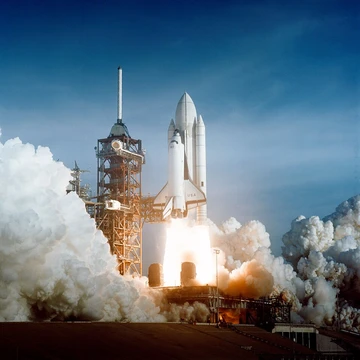
STS-31
Deployed the Hubble Space Telescope into low Earth orbit.

STS-31 was the 35th mission of NASA's Space Shuttle program and the tenth flight of the Space Shuttle Discovery. Its primary purpose was the deployment of the Hubble Space Telescope (HST) into low Earth orbit, a joint NASA-ESA effort dating to the late 1970s. The mission launched from Kennedy Space Center's Launch Complex 39B on April 24, 1990, and landed at Edwards Air Force Base on April 29, 1990.
Quick Facts
- Names List
- Space Transportation System-31 / STS-31R
- Mission Type
- Hubble Space Telescope deployment
- Operator
- NASA
- Distance Travelled
- 3328466 km
- Orbits Completed
- 80
- Spacecraft
- 103
- Launch Mass
- 117586 kg
- Landing Mass
- 85947 kg
- Payload Mass
- 11878 kg
- Crew Size
- 5
- Crew Members
- Loren Shriver · Charles Bolden · Bruce McCandless II · Steven Hawley · Kathryn D. Sullivan
- Launch Site
- Kennedy, LC-39B
Facts from the source article.
Lore & Background
Discovery landed on Runway 22 at Edwards Air Force Base on April 29, 1990, with a rollout of 2,705 m and a landing time of 61 seconds. The mission was originally scheduled for August 1986 as STS-61-J using Atlantis but was postponed due to the Challenger disaster. John W. Young was originally assigned to command but was reassigned and replaced by Loren J. Shriver in 1988.
Reader's Guide
STS-31 is significant as the mission that delivered the Hubble Space Telescope to orbit, an observatory that has fundamentally transformed astronomy by observing ultraviolet, visible, and near-infrared wavelengths above Earth's atmosphere. The deployment required careful coordination after a solar array malfunction, and the mission set altitude records for the Shuttle program. The flight also carried a unique radiation experiment using a human skull, reflecting Cold War-era concerns about space radiation. The mission's launch marked the first time since January 1986 that two Shuttles were on the pad simultaneously—Discovery on 39B and Columbia on 39A. The mission numbering system was clarified after the Challenger accident to avoid conflicts in tracking data. STS-31's legacy is tied to Hubble's decades of service, which began with this deployment.
Did You Know?
- STS-31 reached an apogee of 621 km, the highest altitude ever achieved by a Space Shuttle orbiter.
- The mission carried a human skull as part of a radiation penetration experiment, also flown on STS-28 and STS-36.
- Discovery's deorbit burn lasted 4 minutes and 58 seconds.
- The launch marked the first time since January 1986 that two Space Shuttles were on the launch pad at the same time.
More in Space Shuttle missions 1-24
Spotted an error? Know more?
Reader corrections go straight into our review queue. Suggest an edit · How this site is sourced