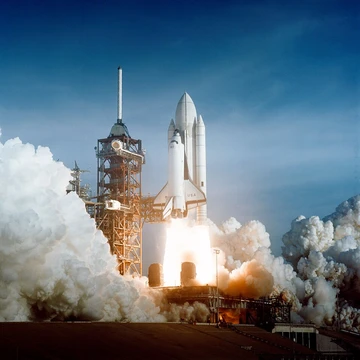
STS-29
Third shuttle mission after Challenger, deployed final TDRS sat

STS-29, officially designated STS-29R, was the 28th mission of NASA's Space Shuttle program (counting the ill-fated STS-51-L). The orbiter Discovery carried a Tracking and Data Relay Satellite (TDRS) into orbit, marking the third shuttle mission since the 1986 Challenger disaster. Liftoff occurred from Kennedy Space Center's Launch Complex 39B in Florida on March 13, 1989.
The "R" in the mission's technical designation was necessary to avoid data-tracking conflicts with earlier missions. The original STS-29 label had been assigned to a canceled mission, and no such reassignments to other orbiters occurred. Since the ill-fated STS-51-L had been designated STS-33, all missions numbered STS-26 through STS-33 required the "R" suffix in their documentation.
Before Challenger, this flight had been planned as STS-61-H aboard Columbia for June 1986. Astronaut Anna L. Fisher was originally assigned as a mission specialist—which would have been her second spaceflight—but she took a leave of absence to be with her family, and rookie James P. Bagian replaced her. Fisher later returned to flight status. The mission also would have included payload specialists from Indonesia and the United Kingdom, but they never flew on any shuttle mission.
Discovery launched at 9:57 a.m. EST on March 13, 1989, after several delays. The original February 18 date was postponed to replace faulty liquid oxygen turbopumps on the main engines. A March 11 target was pushed back by one day due to a failed master event controller during prelaunch checkout, plus another day to swap a faulty fuel preburner oxidizer valve. On launch day itself, ground fog and high upper winds caused a nearly two-hour hold, and a waiver was approved for the orbiter's wing loads.
The primary payload was TDRS-D, the third and final satellite for the Tracking and Data Relay Satellite System constellation in geosynchronous orbit. The three satellites were stationed about 35,900 kilometers above the equator, with two positioned 130° apart and the third serving as an on-orbit spare.
On the first day of flight, one of three cryogenic hydrogen tanks feeding the shuttle's fuel cells showed erratic pressure fluctuations. Engineers deactivated it while studying the problem, and the crew was told to conserve power. The tank was reactivated on Flight Day 3 (March 15) and worked normally afterward.
Quick Facts
- Names List
- Space Transportation System-29 / STS-29R
- Mission Type
- TDRS-D deployment
- Operator
- NASA
- Distance Travelled
- 3200000 km
- Orbits Completed
- 80
- Spacecraft
- 103
- Launch Mass
- 116281 kg
- Landing Mass
- 88353 kg
- Payload Mass
- 17280 kg
- Crew Size
- 5
- Crew Members
- Michael Coats · John E. Blaha · Robert C. Springer · James Buchli · James P. Bagian
- Launch Site
- Kennedy, LC-39B
Facts from the source article.
Lore & Background
The primary payload was TDRS-D, the third and final component of the Tracking and Data Relay Satellite System constellation, deployed less than six hours after launch. One of three cryogenic hydrogen tanks exhibited erratic pressure fluctuations on Flight Day 1 and was deactivated; it was reactivated on Flight Day 3 and operated successfully. Discovery landed one orbit early on March 18, 1989, at Edwards Air Force Base, California, to avoid excessive wind buildup. The mission also carried eight secondary payloads, including student experiments with rats and chicken eggs, and the SHARE experiment for Space Station Freedom, which was only partially successful.
Reader's Guide
STS-29 marked a significant step in rebuilding NASA's Space Shuttle program after the Challenger disaster, being the third mission to fly since 1986. Its successful deployment of TDRS-D completed the three-satellite TDRSS constellation, which provided critical communications coverage for future missions. The mission also demonstrated the shuttle's ability to carry diverse payloads, including student experiments and IMAX filming for the film Blue Planet. The technical challenges during launch and flight—such as the faulty turbopumps and cryogenic tank issues—highlighted the ongoing complexity and risks of shuttle operations. STS-29's legacy lies in its role in restoring confidence in the shuttle fleet and advancing satellite communications infrastructure.
Did You Know?
- STS-29 was technically designated STS-29R to avoid conflicts with earlier missions that had used the STS-29 designator.
- The launch was delayed nearly two hours on March 13, 1989, due to ground fog and high upper winds.
- One student experiment flew 32 chicken eggs to study the effects of space flight on fertilized chicken embryos.
- The SHARE experiment, a potential cooling system for Space Station Freedom, operated for less than 30 minutes and was blamed on faulty manifold design.
Frequently Asked Questions
What is STS-29?
STS-29, formally designated STS-29R, was the 28th flight in NASA's Space Shuttle program, carried out by the orbiter Discovery. It launched from Kennedy Space Center's Launch Complex 39B on March 13, 1989, and touched down five days later.
Why does STS-29 carry an "R" in its designation?
The "R" suffix was added because the original STS-29 number had already been assigned to a mission that was subsequently canceled, so the extra character was needed to keep flight-tracking data from colliding with earlier records.
What payload did STS-29 deploy?
The mission's primary objective was to place a Tracking and Data Relay Satellite (TDRS) into orbit, completing the deployment of the last satellite in that communications constellation.
How long did STS-29 last in space?
The flight lasted 4 days, 23 hours, 38 minutes, and 52 seconds, from liftoff on March 13, 1989, to landing on March 18, 1989.
Why is STS-29 considered significant in shuttle history?
It was only the third shuttle mission to fly after the January 1986 Challenger disaster, making it a pivotal step in restoring operational confidence in the program. It also represented Discovery's return to an active flight role following that tragedy.
More in Space Shuttle missions 1-24
Spotted an error? Know more?
Reader corrections go straight into our review queue. Suggest an edit · How this site is sourced