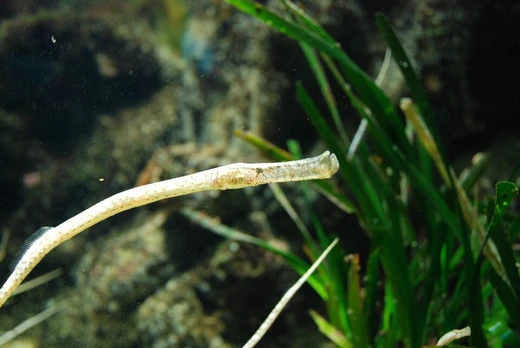
Urocampus nanus
A pipefish with male pregnancy and a blue-spotted female.

Urocampus nanus, commonly known as the barbed pipefish, is a species of marine fish belonging to the family Syngnathidae, which consists of 56 genera and 320 species. This species is notable for its elongated, wormlike body, tube-snout, and the fact that males become pregnant, a characteristic shared with other syngnathids. It is distributed in seagrass meadows of the Northwest Pacific Ocean, including waters around Japan, the southern Korean Peninsula, and the northeastern coast of China.
Quick Facts
- Genus
- Urocampus
- Species
- nanus
Facts from the source article.
Lore & Background
The barbed pipefish has an elongated, wormlike body with a small mouth and tube-snout, the length and width of which are determined by the prey it consumes. It possesses a single dorsal fin, a single caudal fin, pectoral fins, a small anal fin, and small gill openings, but lacks pelvic fins. Newborns hatch with their dorsal fins, caudal fin rays, and body and tail rings already formed, though pectoral fin rays develop later. Sexual dimorphism is present: females have a blue spot on the side of their heads and along their bodies, as well as deeper bodies with a ventral fold, while males lack these features.
Urocampus nanus is typically a poor swimmer, slow-moving and almost stationary, relying on quick movements of its dorsal and pectoral fins for locomotion and body control. Its diet likely consists of small crustaceans, copepods, amphipods, decapods, and mysids. It feeds using a rapid suction method similar to that of chameleons, frogs, and salamanders, with head rotation and muscle activation enabling it to strike faster than a copepod's reaction time. The species can act as a sit-and-wait predator when attached to a holdfast or actively hunt when free in the water.
Reproduction involves six mating stages: lateral display, rising up, holding, parallel swim, copulation, and wiggling. Males brood eggs for 11–16 days before giving live birth, making the species ovoviviparous. Females ovulate multiple times before reproducing, and the species is thought to be polyandrous, with multiple females competing for a single male. Threats include loss of seagrass habitats due to pollution, coastal development, and algae aquaculture, with population decline predicted if habitat loss continues.
Reader's Guide
The barbed pipefish is significant as a representative of the diverse family Syngnathidae, which includes 56 genera and 320 species. Its notable trait of male pregnancy and ovoviviparous reproduction highlights the unique reproductive strategies within this family. The species' reliance on seagrass meadows in the Northwest Pacific Ocean underscores the ecological importance of these habitats, which are threatened by natural and anthropogenic disturbances such as pollution, coastal development, and algae aquaculture. Although no studies have quantified habitat loss, the species' population is predicted to decline if seagrass habitats continue to be lost, potentially affecting species diversity and abundance in the region. Conservation efforts, including replanting, are underway but remain poorly described. The species' uses are not specifically known, but it is likely similar to other syngnathids used in aquariums, traditional medicine, and for ornamental purposes. Its feeding behavior, among the fastest of all fish, and its polyandrous mating system add to its biological interest, though no broader cultural or historical legacy is documented in the source article.
Did You Know?
- Male Urocampus nanus become pregnant and brood eggs for 11–16 days before giving live birth.
- The barbed pipefish is one of the fastest feeders among fish, using a suction method faster than a copepod's reaction time.
- This species is thought to be polyandrous, with multiple females competing to breed with a single male.
More in Seahorses and Pipefish 1-24
Spotted an error? Know more?
Reader corrections go straight into our review queue. Suggest an edit · How this site is sourced